Important Details
IJCRT - International Peer Reviewed, Open Access Journal, Multidisciplinary, Monthly, Nominal(Low) Fees for Professional Research Services International Journal of Creative Research Thoughts - IJCRT Peer Review Journal, Refereed Journal, Peer Reviewed Journal , Referred Journal and Indexed Journal, Open access, Online and Print Journal,international Journal Open Access, Accepted by Indian and foreign university ,IJCRT Followed Norms, guidelines, requirement, listing criteria and methodology of score/point also applied from: Scopus , Web of Science , UGC Approved , UGC CARE, UGC-CARE .
UGC Approved Journal No: 49023 (18)
UGC approval Link
https://ijcrt.org/ugc%20approval.jpg
All Policy and Approval
Please Like Our Facebook Page | CrossRef DOI and Hard copy of Certificate Provide if required. | www.IJCRT.org | editor@IJCRT.org | IJCRT WhatsApp +91 94294 58311
Publication Details:
- Paper Submission : 31-Oct-2026. Call For Paper (Volume 14 | Issue 9 | Month- September 2026)
- Acceptance/Rejection Notification: Within 02-04 Days.
- Paper Publish: Within 02-04 Days after submitting all documents.
-
Submit Your Paper Any time There No deadline.
-
Publication fees : 1570 INR for Indian author & 59$ for foreign International author.
Please Like Our Facebook Page | CrossRef DOI and Hard copy of Certificate Provide if required.
Licence and Indexing
Indexing In Google Scholar, SSRN, ResearcherID-Publons, Semantic Scholar | AI-Powered Research Tool, Microsoft Academic, Academia.edu, arXiv.org, Research Gate, CiteSeerX, ResearcherID Thomson Reuters, Mendeley : reference manager, DocStoc, ISSUU, Scribd, and many more | High Impact Factor: 7.97 | Digital object identifier (DOI) and Hard Copy of certificate Provided.



























Licence
DOI
ISSN Approved impact factor: 7.97 
Creative Common 
Valid as per new UGC Gazette regulations 

INTERNATIONAL JOURNAL OF CREATIVE RESEARCH THOUGHTS - IJCRT (IJCRT.ORG)
International Peer Reviewed & Refereed Journals, Open Access Journal
IJCRT Peer-Reviewed (Refereed) Journal as Per New UGC Rules.
ISSN Approved Journal No: 2320-2882 | Impact factor: 7.97 | ESTD Year: 2013
Call For Paper - Volume 14 | Issue 9 | Month- September 2026
Scholarly open access journals, Peer-reviewed, and Refereed Journals, Impact factor 7.97 (Calculate by google scholar and Semantic Scholar | AI-Powered Research Tool) , Multidisciplinary, Monthly, Indexing in all major database & Metadata, Citation Generator, Digital Object Identifier(CrossRef DOI)
IJCRT WhatsApp Contact
IJCRT Search Xplore - Search all paper by Paper Name , Author Name, and Title
Volume 13 | Issue 11 |
Volume 13 | Issue 11 | Month
Downlaod After Publication 1) Table of content index in PDF
2) Table of content index in HTML 2)Table of content index in HTML
3) Front Page 3) Front Page
4) Back Page 4) Back Page
5) Editor Board Member 5)Editor Board Member
6) OLD Style Issue 6)OLD Style Issue
 |
 |
|---|---|
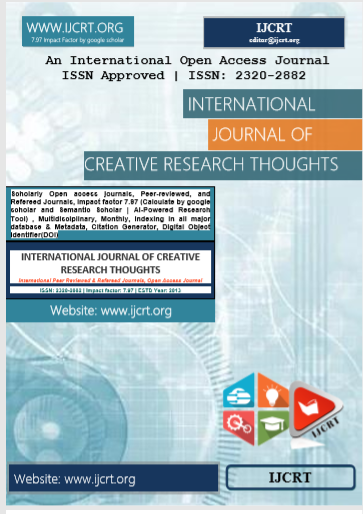
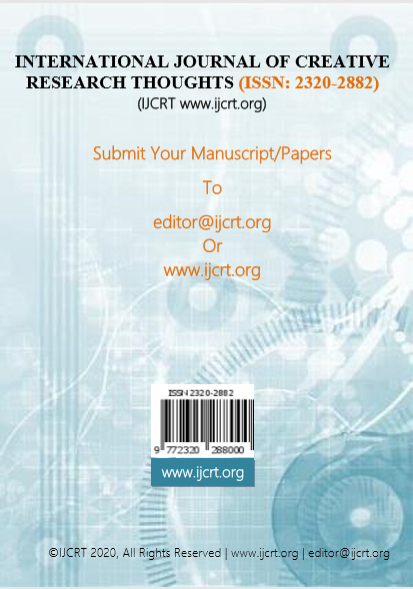
| IJCRT Journal front page | IJCRT Journal Back Page |
Paper Title: The Semiotics of Public Health Mascots: Influencing Adolescent Behaviour in Middle-to-High Income Urban Areas of Delhi
Author Name(s): Anshika Jain, Harsh Mehta
Published Paper ID: - IJCRT2511609
Register Paper ID - 297008
Publisher Journal Name: IJPUBLICATION, IJCRT
DOI Member ID: 10.6084/m9.doi.one.IJCRT2511609 and DOI :
Author Country : Indian Author, India, 110027 , New Delhi, 110027 , | Research Area: Others area Published Paper URL: http://ijcrt.org/viewfull.php?&p_id=IJCRT2511609 Published Paper PDF: download.php?file=IJCRT2511609 Published Paper PDF: http://www.ijcrt.org/papers/IJCRT2511609.pdf
Your Paper Publication Details:
Title: THE SEMIOTICS OF PUBLIC HEALTH MASCOTS: INFLUENCING ADOLESCENT BEHAVIOUR IN MIDDLE-TO-HIGH INCOME URBAN AREAS OF DELHI
DOI (Digital Object Identifier) :
Pubished in Volume: 13 | Issue: 11 | Year: November 2025
Publisher Name : IJCRT | www.ijcrt.org | ISSN : 2320-2882
Subject Area: Others area
Author type: Indian Author
Pubished in Volume: 13
Issue: 11
Pages: f218-f225
Year: November 2025
Downloads: 141
E-ISSN Number: 2320-2882
Abstract
Background: Mental health challenges among adolescents are a growing and significant public health burden in urban India. In a high-media-exposure environment such as Delhi and NCR, the prevalence rate of mental health problems among school-attending adolescents is estimated to be quite high, at about 23.33%. BCC often deploys anthropomorphic mascots as persuasive visual signs that are intended to simplify complex concepts and establish trust. However, the differential impact that variable semiotic structures-in particular, the design of the mascot, the cultural context, and the linguistic tone-have on youth perception and behavioral intent remains critically under-researched in the Indian context. This paper employs the framework of Visual Social Semiotics to deconstruct how localized cultural codes influence the persuasive efficacy of public health messaging aimed at the prevention of mental health and help-seeking behavior. Objectives and Methodology: The study attempts to investigate the differential effect of four types of public health mascot prototypes (Mascots A, B, C, D) on attitude and behavioral intent among urban Delhi adolescents, aged 13-19 years. The four conditions of the mascot vary essentially in their semiotic tonality and messages that accompany them: Emotional, Practical, Casual, and Authoritative. A quantitative, experimental-comparative, cross-sectional survey design was implemented in which a structured questionnaire containing several 5-point Likert scale items was administered to measure each key construct: Trust in Advice, Cultural Resonance, and Positive Attitude. Each participant was randomly exposed to one of the four mascot conditions. The analysis will compare the Mean Scores and Medians for each perception variable across the four mascot groups to descriptively assess which semiotic strategy produced the greatest efficacy. Outcomes and Conclusion: The central hypothesis is that mascots using culturally resonant visual signifiers and a relational, non-authoritative linguistic tone by the Casual or Practical approaches-will be significantly more effective in Trust and Behavioral Interest than will mascots using an institutional or directive tone-Mascot D. These findings are expected to provide empirical support for the view that Cultural Resonance serves as an important mediator because, without it, identification and trust cannot be established and because of the associated risk of negative identity outcomes mentioned earlier for mascots that are culturally dissonant. The findings will be used to develop evidence-based guidelines on how best to design effective, non-stigmatizing mental health mascots for the media-savvy, urban Indian youth demographic.
Licence: creative commons attribution 4.0
License
Creative Commons Attribution 4.0 and The Open Definition

Keywords
Semiotics; Public Health Mascots; Adolescent Mental Health; Delhi; Visual Communication; Behavior Change Communication; Cultural Resonance; Quantitative Analysis.
License
Creative Commons Attribution 4.0 and The Open Definition
Paper Title: Role of Mobile Health Applications in Addiction Prevention: A Narrative Review
Author Name(s): Dr.Narayanasamy K, Abinaya, Dr. S Kalpana, Dr .K Narayanasamy, Dr.Jasmine S Sunder,Dr.S Valarmathi,Dr.G Srinivas
Published Paper ID: - IJCRT2511608
Register Paper ID - 297036
Publisher Journal Name: IJPUBLICATION, IJCRT
DOI Member ID: 10.6084/m9.doi.one.IJCRT2511608 and DOI :
Author Country : Indian Author, India, - , -, - , | Research Area: Science and Technology Published Paper URL: http://ijcrt.org/viewfull.php?&p_id=IJCRT2511608 Published Paper PDF: download.php?file=IJCRT2511608 Published Paper PDF: http://www.ijcrt.org/papers/IJCRT2511608.pdf
Your Paper Publication Details:
Title: ROLE OF MOBILE HEALTH APPLICATIONS IN ADDICTION PREVENTION: A NARRATIVE REVIEW
DOI (Digital Object Identifier) :
Pubished in Volume: 13 | Issue: 11 | Year: November 2025
Publisher Name : IJCRT | www.ijcrt.org | ISSN : 2320-2882
Subject Area: Science and Technology
Author type: Indian Author
Pubished in Volume: 13
Issue: 11
Pages: f207-f217
Year: November 2025
Downloads: 178
E-ISSN Number: 2320-2882
Abstract
Background: Addiction remains one of the most pressing global public health challenges, encompassing both substance and behavioural dependencies. The emergence of mobile health (mHealth) applications offers innovative opportunities for prevention, early intervention, and recovery support. Objective: This narrative review explores the role, effectiveness, and challenges of mobile health applications in addiction prevention, with emphasis on global and Indian perspectives. Methods: A comprehensive search was performed across PubMed, Scopus, Google Scholar, and WHO databases from 2013-2024. Studies focusing on prevention and early intervention through mobile apps targeting substance or behavioural addiction were included. Results: mHealth apps integrate behavioural theories, cognitive-behavioural strategies, gamification, and self-monitoring tools to reduce addictive behaviours. Evidence indicates promising outcomes in smoking cessation, alcohol control, and digital addiction management. However, issues like data privacy, digital literacy, and limited long-term evaluation persist. Conclusion: Mobile applications have emerged as scalable, cost-effective adjuncts to traditional addiction prevention strategies. Integrating them into public health frameworks, especially in low- and middle-income countries, could enhance accessibility and community-level prevention efforts.
Licence: creative commons attribution 4.0
License
Creative Commons Attribution 4.0 and The Open Definition
Keywords
Addiction prevention, mobile health, mHealth, digital health, substance abuse, behavioural addiction.
License
Creative Commons Attribution 4.0 and The Open Definition
Paper Title: AUTOMATED ATTENDANCE SYSTEM USING WI-FI BASED DEVICE DETECTION AND FILE ENCRYPTION
Author Name(s): Kishore s, Mr. N. Nijanthan, Bharath M, Karthikeyan V
Published Paper ID: - IJCRT2511607
Register Paper ID - 296984
Publisher Journal Name: IJPUBLICATION, IJCRT
DOI Member ID: 10.6084/m9.doi.one.IJCRT2511607 and DOI :
Author Country : Indian Author, India, 612001 , Kumbakonam , 612001 , | Research Area: Science and Technology Published Paper URL: http://ijcrt.org/viewfull.php?&p_id=IJCRT2511607 Published Paper PDF: download.php?file=IJCRT2511607 Published Paper PDF: http://www.ijcrt.org/papers/IJCRT2511607.pdf
Your Paper Publication Details:
Title: AUTOMATED ATTENDANCE SYSTEM USING WI-FI BASED DEVICE DETECTION AND FILE ENCRYPTION
DOI (Digital Object Identifier) :
Pubished in Volume: 13 | Issue: 11 | Year: November 2025
Publisher Name : IJCRT | www.ijcrt.org | ISSN : 2320-2882
Subject Area: Science and Technology
Author type: Indian Author
Pubished in Volume: 13
Issue: 11
Pages: f199-f206
Year: November 2025
Downloads: 136
E-ISSN Number: 2320-2882
Abstract
Abstract Automated attendance systems have become crucial in schools and organizations. They replace manual roll call, reduce human errors, and improve productivity. This paper suggests a Wi-Fi-based automated attendance system that detects registered devices within a specific network range by scanning MAC addresses. The system verifies student presence by identifying authenticated devices connected or detectable through the Wi-Fi access point. To protect confidentiality and prevent unauthorized access, all attendance records are encrypted with AES-256 file-level encryption before local storage. The hardware uses a microcontroller/Wi-Fi development board to detect nearby devices. Meanwhile, a backend script automates data logging and secure file creation. The system was tested in a controlled setting and showed reliable detection within 8 to 12 meters, achieving an accuracy of 92% during peak device density. This proposed model is a cost-effective, secure, and scalable option compared to biometric or RFID systems, making it especially suitable for classrooms and small institutions.
Licence: creative commons attribution 4.0
License
Creative Commons Attribution 4.0 and The Open Definition
Keywords
Index Terms-- Wi-Fi scanning, automated attendance, device detection, AES encryption, IoT, MAC authentication, secure logging.
License
Creative Commons Attribution 4.0 and The Open Definition
Paper Title: Major Problems Involved in Multipurpose Dam Projects: Analyses of Upper Kolab Project of Odisha.
Author Name(s): Balamakunda Bhuyan
Published Paper ID: - IJCRT2511606
Register Paper ID - 296962
Publisher Journal Name: IJPUBLICATION, IJCRT
DOI Member ID: 10.6084/m9.doi.one.IJCRT2511606 and DOI :
Author Country : Indian Author, India, 751002 , Bhubaneswar, 751002 , | Research Area: Medical Science All Published Paper URL: http://ijcrt.org/viewfull.php?&p_id=IJCRT2511606 Published Paper PDF: download.php?file=IJCRT2511606 Published Paper PDF: http://www.ijcrt.org/papers/IJCRT2511606.pdf
Your Paper Publication Details:
Title: MAJOR PROBLEMS INVOLVED IN MULTIPURPOSE DAM PROJECTS: ANALYSES OF UPPER KOLAB PROJECT OF ODISHA.
DOI (Digital Object Identifier) :
Pubished in Volume: 13 | Issue: 11 | Year: November 2025
Publisher Name : IJCRT | www.ijcrt.org | ISSN : 2320-2882
Subject Area: Medical Science All
Author type: Indian Author
Pubished in Volume: 13
Issue: 11
Pages: f185-f198
Year: November 2025
Downloads: 155
E-ISSN Number: 2320-2882
Abstract
Construction of Large Dam Projects have many negative and positive impacts where, positive impacts are supply of water though canals, hydro electricity generation, flood control of rivers, pisciculture, navigation and recreation and some major negative impacts are the displacement, valuable land loss, forest loss, environment degradation and biodiversity depletion. Big River Valley Projects have effect towards climatic change, damage natural eco- system, high soil erosion and creates air and water pollution. Mega Projects facing big challenges in the ground of massive involuntarily displacement which causes movements and unrest by various Social Organizations, environmentalists, Non-Government Organizations (NGOs), affected Indigenous People and Human Right Activists. The role of environment is not appreciated properly by the public decision-making process. No more river valley projects are considered as symbolic dogma and temple of growth of the nation. This research paper is an enquiry to investigate the major problems involved in Upper Kolab Multipurpose Dam Project. Only from the stock-taking of the project and secondary data collected from various institutions is processed and analyzed to deduce the inferences.
Licence: creative commons attribution 4.0
License
Creative Commons Attribution 4.0 and The Open Definition
Keywords
Biodiversity Depletion, Dam Impoundment Area, Decision Making Process, Environmental Degradation, Environmental Economics, Massive involuntary Displacement, Mult-Purpose River Basin Projects, World Commission on Dams.
License
Creative Commons Attribution 4.0 and The Open Definition
Paper Title: Smart AI Solution for Teachers Work Management in Education
Author Name(s): Abhishek Jadhav, Anurag Kushare, Prasad Pund, Prathmesh Jadhav, Pallavi Baviskar
Published Paper ID: - IJCRT2511605
Register Paper ID - 296836
Publisher Journal Name: IJPUBLICATION, IJCRT
DOI Member ID: 10.6084/m9.doi.one.IJCRT2511605 and DOI :
Author Country : Indian Author, India, 422007 , Nashik, 422007 , | Research Area: Science and Technology Published Paper URL: http://ijcrt.org/viewfull.php?&p_id=IJCRT2511605 Published Paper PDF: download.php?file=IJCRT2511605 Published Paper PDF: http://www.ijcrt.org/papers/IJCRT2511605.pdf
Your Paper Publication Details:
Title: SMART AI SOLUTION FOR TEACHERS WORK MANAGEMENT IN EDUCATION
DOI (Digital Object Identifier) :
Pubished in Volume: 13 | Issue: 11 | Year: November 2025
Publisher Name : IJCRT | www.ijcrt.org | ISSN : 2320-2882
Subject Area: Science and Technology
Author type: Indian Author
Pubished in Volume: 13
Issue: 11
Pages: f177-f184
Year: November 2025
Downloads: 146
E-ISSN Number: 2320-2882
Abstract
The escalating administrative responsibilities in educational institutions, including manual timetable generation, lesson planning, and assignment tracking, present significant challenges to educators, often leading to increased workload and inefficiency. Traditional management methods are frequently error-prone and time- consuming, necessitating a shift towards automated, intelligent solutions. This paper introduces the "Smart AI Solution for Teachers Work Management," a comprehensive website designed to streamline academic and administrative tasks. The system features three distinct, role-based dashboards for administrators, teachers, and students, providing a centralized interface for managing critical educational workflows. A key innovation of this system is the integration of a generative Artificial Intelligence (AI) model, powered by the OpenAI API, which empowers teachers to automatically generate high-quality lecture notes and study materials, thereby significantly reducing content preparation time. In addition to AI-powered content creation, the platform offers robust modules for master timetable management, automated assignment submission and tracking, real-time syllabus progress monitoring, and integrated communication channels for announcements. By automating these routine processes, the proposed solution aims to reduce teacher workload, enhance operational efficiency, and mitigate the risks of digital burnout. This system represents a significant step towards creating a more organized, efficient, and technologically empowered educational environment for all stakeholders.
Licence: creative commons attribution 4.0
License
Creative Commons Attribution 4.0 and The Open Definition
Keywords
Artificial Intelligence (AI), Educational Technology, Teacher Workload Management, Generative AI, Timetable Generation, Assignment Management System, Digital Burnout.
License
Creative Commons Attribution 4.0 and The Open Definition
Paper Title: Self-Evaluation Of Ergonomics And Musculoskeletal Pain Among Computer Desk Job Workers
Author Name(s): Dr Shruti Wani (PT), Dr.Gira Thakrar
Published Paper ID: - IJCRT2511604
Register Paper ID - 296952
Publisher Journal Name: IJPUBLICATION, IJCRT
DOI Member ID: 10.6084/m9.doi.one.IJCRT2511604 and DOI :
Author Country : Indian Author, India, 380061 , Ahmedabad, 380061 , | Research Area: Health Science All Published Paper URL: http://ijcrt.org/viewfull.php?&p_id=IJCRT2511604 Published Paper PDF: download.php?file=IJCRT2511604 Published Paper PDF: http://www.ijcrt.org/papers/IJCRT2511604.pdf
Your Paper Publication Details:
Title: SELF-EVALUATION OF ERGONOMICS AND MUSCULOSKELETAL PAIN AMONG COMPUTER DESK JOB WORKERS
DOI (Digital Object Identifier) :
Pubished in Volume: 13 | Issue: 11 | Year: November 2025
Publisher Name : IJCRT | www.ijcrt.org | ISSN : 2320-2882
Subject Area: Health Science All
Author type: Indian Author
Pubished in Volume: 13
Issue: 11
Pages: f169-f176
Year: November 2025
Downloads: 176
E-ISSN Number: 2320-2882
Abstract
Abstract: Background: Nowadays, Computer users are increasingly facing Musculoskeletal Pain due to prolonged use of computer devices, which cause adverse health effects. Prolonged sitting in inappropriate, awkward, and static postures at the Computer workstation can lead to musculoskeletal pain. However, this can be Mitigated by setting up computer workstations according to ergonomic principles. Objective: To evaluate ergonomics and musculoskeletal pain through a self-filled questionnaire among computer desk job workers. Method: This cross-sectional observational study was conducted on 100 computer desk job workers of age group 22-55 years selected through random sampling. The Computer Workstation Ergonomics: Self-Assessment Checklist evaluated workstation ergonomics, while the Cornell Musculoskeletal Discomfort Questionnaire assessed pain. Both tools were administered via Google Forms, and data was analyzed to determine ergonomic practices and the prevalence of pain among the workers. Results: 64% of ergonomic deficiencies in Computer Desk Job Workers were identified. Adjustable chair height, proper keyboard positioning, adequate back support, postural and eye breaks had most documented deficits. Most affected body parts were the Neck (54%), Shoulder (49%), Upper back (47%), Lower back (45%), Elbow (20%) and Wrist (12%). Conclusion: Prevalence of deficits in computer workstation ergonomics and Pain are seen. Appropriate strategies, work practices, and preventive measures are needed to eliminate ergonomic deficits and pain associated with computer workstations.
Licence: creative commons attribution 4.0
License
Creative Commons Attribution 4.0 and The Open Definition
Keywords
Computer Workstation Ergonomics: Self-Assessment Checklist, Cornell Musculoskeletal Discomfort Question, Pain and Computer desk job.
License
Creative Commons Attribution 4.0 and The Open Definition
Paper Title: A Study On Sustainable Goat Farming Practices In Namakkal District, Tamil Nadu
Author Name(s): N.Sudha, Dr.K.Selvaraj
Published Paper ID: - IJCRT2511603
Register Paper ID - 296977
Publisher Journal Name: IJPUBLICATION, IJCRT
DOI Member ID: 10.6084/m9.doi.one.IJCRT2511603 and DOI :
Author Country : Indian Author, India, 637503 , Namakkal, 637503 , | Research Area: Commerce All Published Paper URL: http://ijcrt.org/viewfull.php?&p_id=IJCRT2511603 Published Paper PDF: download.php?file=IJCRT2511603 Published Paper PDF: http://www.ijcrt.org/papers/IJCRT2511603.pdf
Your Paper Publication Details:
Title: A STUDY ON SUSTAINABLE GOAT FARMING PRACTICES IN NAMAKKAL DISTRICT, TAMIL NADU
DOI (Digital Object Identifier) :
Pubished in Volume: 13 | Issue: 11 | Year: November 2025
Publisher Name : IJCRT | www.ijcrt.org | ISSN : 2320-2882
Subject Area: Commerce All
Author type: Indian Author
Pubished in Volume: 13
Issue: 11
Pages: f156-f168
Year: November 2025
Downloads: 285
E-ISSN Number: 2320-2882
Abstract
ABSTRACT Goat farming is a significant agricultural activity in Namakkal district, Tamil Nadu, contributing substantially to the livelihood of small and marginal farmers. Sustainable goat farming practices are essential to ensure the long-term viability of this activity. This article discusses the best practices for sustainable goat farming in Namakkal district, focusing on selecting suitable breeds, improving genetic quality, and implementing breeding programs to enhance productivity and providing high-quality fodder, ensuring adequate nutrition, and promoting grazing with supplementation and implementing regular vaccination, parasite control, and veterinary care to maintain goat health and developing market linkages, improving price fixation, and promoting value-added products.The study further assesses the profitability of goat farming through cost and returns analysis and identifies major constraints faced by farmers such as inadequate veterinary services, fluctuating market prices, feed scarcity, and limited credit availability. The findings indicate that goat farming significantly supplements household income, enhances food and nutritional security, and provides substantial self-employment opportunities, especially for women and marginal farmers. Sustainable goat farming practices can improve productivity, income, and livelihood security for farmers in Namakkal district. Government support, extension services, and farmers' organizations play a crucial role in promoting these practices.
Licence: creative commons attribution 4.0
License
Creative Commons Attribution 4.0 and The Open Definition
Keywords
Key words: Sustainable Goat farming, Long-term viability, Breeding, Feeding, Health management, Marketing, Livelihood security.
License
Creative Commons Attribution 4.0 and The Open Definition
Paper Title: Starbucks Digital Platform
Author Name(s): Shreya Pogul, Ishwari Dharane, Vishvanath Mokashi, Zadbuke.S.B.
Published Paper ID: - IJCRT2511602
Register Paper ID - 296954
Publisher Journal Name: IJPUBLICATION, IJCRT
DOI Member ID: 10.6084/m9.doi.one.IJCRT2511602 and DOI :
Author Country : Indian Author, India, 413005 , Solapur, 413005 , | Research Area: Science and Technology Published Paper URL: http://ijcrt.org/viewfull.php?&p_id=IJCRT2511602 Published Paper PDF: download.php?file=IJCRT2511602 Published Paper PDF: http://www.ijcrt.org/papers/IJCRT2511602.pdf
Your Paper Publication Details:
Title: STARBUCKS DIGITAL PLATFORM
DOI (Digital Object Identifier) :
Pubished in Volume: 13 | Issue: 11 | Year: November 2025
Publisher Name : IJCRT | www.ijcrt.org | ISSN : 2320-2882
Subject Area: Science and Technology
Author type: Indian Author
Pubished in Volume: 13
Issue: 11
Pages: f153-f155
Year: November 2025
Downloads: 153
E-ISSN Number: 2320-2882
Abstract
The Starbucks Digital Platform is a front-end web application designed to provide users with an interactive and seamless browsing experience for Starbucks products. Developed using HTML, CSS, and JavaScript, the platform offers a responsive interface that allows users to explore menu items, view product details, and manage their selections through a real-time cart system. JavaScript enhances the website's interactivity by enabling dynamic updates, search functionality, and smooth navigation across the platform. An integrated chatbot is incorporated to simulate automated customer assistance, improving user engagement and providing quick responses to common queries. This project demonstrates the practical application of modern front-end technologies to create a user-friendly and visually appealing digital shopping experience, making it suitable for academic learning, prototype development, and front-end skill enhancement.
Licence: creative commons attribution 4.0
License
Creative Commons Attribution 4.0 and The Open Definition
Keywords
Digital Ordering System , E-commerce Platform, Mobile Application, Web Application
License
Creative Commons Attribution 4.0 and The Open Definition
Paper Title: Welfare without dignity? A Critical Review of Conditional Cash Transfers in India
Author Name(s): Padmakshee Pani, Prajual Agarwal
Published Paper ID: - IJCRT2511601
Register Paper ID - 296969
Publisher Journal Name: IJPUBLICATION, IJCRT
DOI Member ID: 10.6084/m9.doi.one.IJCRT2511601 and DOI :
Author Country : Indian Author, India, 754005 , Cuttack, 754005 , | Research Area: Other area not in list Published Paper URL: http://ijcrt.org/viewfull.php?&p_id=IJCRT2511601 Published Paper PDF: download.php?file=IJCRT2511601 Published Paper PDF: http://www.ijcrt.org/papers/IJCRT2511601.pdf
Your Paper Publication Details:
Title: WELFARE WITHOUT DIGNITY? A CRITICAL REVIEW OF CONDITIONAL CASH TRANSFERS IN INDIA
DOI (Digital Object Identifier) :
Pubished in Volume: 13 | Issue: 11 | Year: November 2025
Publisher Name : IJCRT | www.ijcrt.org | ISSN : 2320-2882
Subject Area: Other area not in list
Author type: Indian Author
Pubished in Volume: 13
Issue: 11
Pages: f145-f152
Year: November 2025
Downloads: 159
E-ISSN Number: 2320-2882
Abstract
Conditional Cash Transfers (CCTs) have always been a foundational tool for promoting the welfare of citizens in diversified sectors such as health, education and women empowerment in India. Yet, the approachability of these schemes for people belonging to excluded or marginalized groups remains a persistent and unresolved concern. While CCTs aim to support the ones most in need, a significant vacuum in stakeholder accountability and administrative responsiveness raises a big question about their effectiveness. The government's aim of digitizing every scheme also ignores the fact that a large group of people do not have proper bank accounts or adequate access to digital payment interfaces, raising critical questions about equitable access. On one hand, the government seeks to uplift the sections of society that genuinely need help, but on the other hand, the due diligence and compliance requirements for these programmes often become major barriers for the very population they intend to uplift. The bureaucracy needs to ensure that the mechanism is redesigned in a manner that includes all targeted sections of society smoothly through truly inclusive implementation, while ensuring access to everyone who qualifies after fair verification. Without substantive measures, the government is failing to fulfill its constitutional obligations to its citizens under Article 14 and Article 21 of the Constitution, which guarantee equality and the right to live with dignity. This critical review highlights the dire need to recalibrate India's CCT framework towards a more holistic, accessible and dignified uplifting model.
Licence: creative commons attribution 4.0
License
Creative Commons Attribution 4.0 and The Open Definition
Keywords
Aadhaar, Welfare Rights, Article 21, Constitutional Justice, Digital Exclusion, Social Security, Governance Reform
License
Creative Commons Attribution 4.0 and The Open Definition
Paper Title: Smart Home Automation System
Author Name(s): Shrutika Dolas, Arpita Salve, Sayee Waskar, Atnurkar .A.B
Published Paper ID: - IJCRT2511600
Register Paper ID - 296955
Publisher Journal Name: IJPUBLICATION, IJCRT
DOI Member ID: 10.6084/m9.doi.one.IJCRT2511600 and DOI :
Author Country : Indian Author, India, 411039 , Pune, 411039 , | Research Area: Science and Technology Published Paper URL: http://ijcrt.org/viewfull.php?&p_id=IJCRT2511600 Published Paper PDF: download.php?file=IJCRT2511600 Published Paper PDF: http://www.ijcrt.org/papers/IJCRT2511600.pdf
Your Paper Publication Details:
Title: SMART HOME AUTOMATION SYSTEM
DOI (Digital Object Identifier) :
Pubished in Volume: 13 | Issue: 11 | Year: November 2025
Publisher Name : IJCRT | www.ijcrt.org | ISSN : 2320-2882
Subject Area: Science and Technology
Author type: Indian Author
Pubished in Volume: 13
Issue: 11
Pages: f140-f144
Year: November 2025
Downloads: 156
E-ISSN Number: 2320-2882
Abstract
This project presents a Smart Home Automation System that enables remote monitoring and control of household appliances using microcontroller-based hardware, integrated sensors, and mobile applications, providing convenience, energy efficiency, and accessibility for all users, including the elderly and physically challenged.
Licence: creative commons attribution 4.0
License
Creative Commons Attribution 4.0 and The Open Definition
Keywords
1 Smart Home 2 Internet of Things (IoT) 3 Home Appliances 4 Wireless Sensors 5 Lifestyle Automation 6 Microcontrollers(e.g., Arduino, Raspberry pi,ESP32)
License
Creative Commons Attribution 4.0 and The Open Definition
Call For Paper September 2026
Call For Papers
September 2026
Volume 14 | Issue 9
Last Date :
31-Oct-2026
Submit Manuscript Online Impact Factor: 7.97 Review Results : Within 02-03 Days Paper Publication : Within 02-03 Days
September 2026
Volume 14 | Issue 9
Last Date :
31-Oct-2026
Submit Manuscript Online Impact Factor: 7.97 Review Results : Within 02-03 Days Paper Publication : Within 02-03 Days
Published Issue Details
For Authors
Forms / Downloads
Other IMP Links
Indexing Partner
Research Area
LICENSE





ISSN and 7.97 Impact Factor Details
ISSN: 2320-2882 Impact Factor: 7.97 and ISSN APPROVED Journal Starting Year (ESTD) : 2013


ISSN and 7.97 Impact Factor Details
ISSN: 2320-2882 Impact Factor: 7.97 and ISSN APPROVED Journal Starting Year (ESTD) : 2013
DOI Details
CONFERENCE
CONFERENCE MANAGMENT & PUBLICATION CONFERENCE PROPOSAL
RECENT CONFERENCE

CONFERENCE PROPOSAL CONFERENCE PROCEEDINGS
CONFERENCE PROPOSAL CONFERENCE PROCEEDINGS
For Reviewer /Referral (RMS) Earn 500 per paper
Important Links
NEWS & Conference
Digital Library
IJCRT RMS | Earn 500 Per Paper.

Open Access


LICENSE
Indexing Partner
Scholarly open access journals, Peer-reviewed, and Refereed Journals, Impact factor 7.97 (Calculate by google scholar and Semantic Scholar | AI-Powered Research Tool) , Multidisciplinary, Monthly, Indexing in all major database & Metadata, Citation Generator, Digital Object Identifier(DOI)