Important Details
IJCRT - International Peer Reviewed, Open Access Journal, Multidisciplinary, Monthly, Nominal(Low) Fees for Professional Research Services International Journal of Creative Research Thoughts - IJCRT Peer Review Journal, Refereed Journal, Peer Reviewed Journal , Referred Journal and Indexed Journal, Open access, Online and Print Journal,international Journal Open Access, Accepted by Indian and foreign university ,IJCRT Followed Norms, guidelines, requirement, listing criteria and methodology of score/point also applied from: Scopus , Web of Science , UGC Approved , UGC CARE, UGC-CARE .
UGC Approved Journal No: 49023 (18)
UGC approval Link
https://ijcrt.org/ugc%20approval.jpg
All Policy and Approval
Please Like Our Facebook Page | CrossRef DOI and Hard copy of Certificate Provide if required. | www.IJCRT.org | editor@IJCRT.org | IJCRT WhatsApp +91 94294 58311
Publication Details:
- Paper Submission : 31-Oct-2026. Call For Paper (Volume 14 | Issue 9 | Month- September 2026)
- Acceptance/Rejection Notification: Within 02-04 Days.
- Paper Publish: Within 02-04 Days after submitting all documents.
-
Submit Your Paper Any time There No deadline.
-
Publication fees : 1570 INR for Indian author & 59$ for foreign International author.
Please Like Our Facebook Page | CrossRef DOI and Hard copy of Certificate Provide if required.
Licence and Indexing
Indexing In Google Scholar, SSRN, ResearcherID-Publons, Semantic Scholar | AI-Powered Research Tool, Microsoft Academic, Academia.edu, arXiv.org, Research Gate, CiteSeerX, ResearcherID Thomson Reuters, Mendeley : reference manager, DocStoc, ISSUU, Scribd, and many more | High Impact Factor: 7.97 | Digital object identifier (DOI) and Hard Copy of certificate Provided.




























Licence
DOI
ISSN Approved impact factor: 7.97 
Creative Common 
Valid as per new UGC Gazette regulations 

INTERNATIONAL JOURNAL OF CREATIVE RESEARCH THOUGHTS - IJCRT (IJCRT.ORG)
International Peer Reviewed & Refereed Journals, Open Access Journal
IJCRT Peer-Reviewed (Refereed) Journal as Per New UGC Rules.
ISSN Approved Journal No: 2320-2882 | Impact factor: 7.97 | ESTD Year: 2013
Call For Paper - Volume 14 | Issue 9 | Month- September 2026
Scholarly open access journals, Peer-reviewed, and Refereed Journals, Impact factor 7.97 (Calculate by google scholar and Semantic Scholar | AI-Powered Research Tool) , Multidisciplinary, Monthly, Indexing in all major database & Metadata, Citation Generator, Digital Object Identifier(CrossRef DOI)
IJCRT WhatsApp Contact
IJCRT Search Xplore - Search all paper by Paper Name , Author Name, and Title
Volume 14 | Issue 3 |
Volume 14 | Issue 3 | Month
Downlaod After Publication 1) Table of content index in PDF
2) Table of content index in HTML 2)Table of content index in HTML
3) Front Page 3) Front Page
4) Back Page 4) Back Page
5) Editor Board Member 5)Editor Board Member
6) OLD Style Issue 6)OLD Style Issue
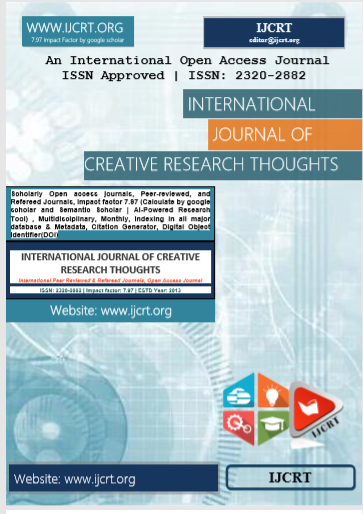 |
 |
|---|---|
| IJCRT Journal front page | IJCRT Journal Back Page |
Paper Title: Preliminary Toxicological Assessment of Hesperidin-Loaded Iron Oxide Nanoparticles in Brine Shrimp and Zebrafish Embryo Models
Author Name(s): Abiramy Neveda T R, *S Deeparani, B Janani, R.K.Premeela
Published Paper ID: - IJCRT2603210
Register Paper ID - 302405
Publisher Journal Name: IJPUBLICATION, IJCRT
DOI Member ID: 10.6084/m9.doi.one.IJCRT2603210 and DOI :
Author Country : Indian Author, India, 600008 , Chennai, 600008 , | Research Area: Life Sciences All Published Paper URL: http://ijcrt.org/viewfull.php?&p_id=IJCRT2603210 Published Paper PDF: download.php?file=IJCRT2603210 Published Paper PDF: http://www.ijcrt.org/papers/IJCRT2603210.pdf
Your Paper Publication Details:
Title: PRELIMINARY TOXICOLOGICAL ASSESSMENT OF HESPERIDIN-LOADED IRON OXIDE NANOPARTICLES IN BRINE SHRIMP AND ZEBRAFISH EMBRYO MODELS
DOI (Digital Object Identifier) :
Pubished in Volume: 14 | Issue: 3 | Year: March 2026
Publisher Name : IJCRT | www.ijcrt.org | ISSN : 2320-2882
Subject Area: Life Sciences All
Author type: Indian Author
Pubished in Volume: 14
Issue: 3
Pages: b731-b739
Year: March 2026
Downloads: 177
E-ISSN Number: 2320-2882
Abstract
Licence: creative commons attribution 4.0
License
Creative Commons Attribution 4.0 and The Open Definition

Keywords
Hesperidin; Iron oxide nanoparticles; Nanotoxicology; Brine shrimp lethality assay; Zebrafish embryo toxicity
License
Creative Commons Attribution 4.0 and The Open Definition
Paper Title: Beach Profiling At Vettucad Beach Trivandrum
Author Name(s): Gowri Vinod, Beema Sulthana Najim Shamla, Nisma Jasmine, Nikhil Arun, Dr Rani Vishalakshi Amma
Published Paper ID: - IJCRT2603209
Register Paper ID - 302721
Publisher Journal Name: IJPUBLICATION, IJCRT
DOI Member ID: 10.6084/m9.doi.one.IJCRT2603209 and DOI :
Author Country : Indian Author, India, 695605 , Trivandrum, 695605 , | Research Area: Science and Technology Published Paper URL: http://ijcrt.org/viewfull.php?&p_id=IJCRT2603209 Published Paper PDF: download.php?file=IJCRT2603209 Published Paper PDF: http://www.ijcrt.org/papers/IJCRT2603209.pdf
Your Paper Publication Details:
Title: BEACH PROFILING AT VETTUCAD BEACH TRIVANDRUM
DOI (Digital Object Identifier) :
Pubished in Volume: 14 | Issue: 3 | Year: March 2026
Publisher Name : IJCRT | www.ijcrt.org | ISSN : 2320-2882
Subject Area: Science and Technology
Author type: Indian Author
Pubished in Volume: 14
Issue: 3
Pages: b726-b730
Year: March 2026
Downloads: 179
E-ISSN Number: 2320-2882
Abstract
Beach profiling is an important coastal study used to understand shoreline shape, sediment movement, and seasonal changes along a coast. This paper focuses on Vettukadu Beach, a dynamic coastal stretch influenced by wave action, tides, and monsoon patterns of the Arabian Sea. Monitoring such beaches helps identify erosion and accretion trends and supports sustainable coastal management. The study is based on field data collected from September to December, a period that includes post-monsoon and winter coastal conditions. During this time, variations in , sediment deposition, and beach slope are observed, allowing analysis of short-term seasonal changes in beach morphology. The collected data helps assess shoreline stability, sediment transport patterns, and the overall morphology of the beach, which are essential for coastal planning, hazard prevention, and environmental conservation.
Licence: creative commons attribution 4.0
License
Creative Commons Attribution 4.0 and The Open Definition
Keywords
beach profile, sediment transport ,beach erosion ,mitigation method,beach properties ,vettcaud beach
License
Creative Commons Attribution 4.0 and The Open Definition
Paper Title: AN AYURVEDIC APPROACH OF DEVELOPMENTAL DELAY IN CHILDREN: A REVIEW ARTICLE
Author Name(s): Dr Muskan Choudhary, Prof. Ram Kumar Bhamu, Dr. Piyushika Sharma
Published Paper ID: - IJCRT2603208
Register Paper ID - 301887
Publisher Journal Name: IJPUBLICATION, IJCRT
DOI Member ID: 10.6084/m9.doi.one.IJCRT2603208 and DOI :
Author Country : Indian Author, India, 342026 , Jodhpur, 342026 , | Research Area: Humanities All Published Paper URL: http://ijcrt.org/viewfull.php?&p_id=IJCRT2603208 Published Paper PDF: download.php?file=IJCRT2603208 Published Paper PDF: http://www.ijcrt.org/papers/IJCRT2603208.pdf
Your Paper Publication Details:
Title: AN AYURVEDIC APPROACH OF DEVELOPMENTAL DELAY IN CHILDREN: A REVIEW ARTICLE
DOI (Digital Object Identifier) :
Pubished in Volume: 14 | Issue: 3 | Year: March 2026
Publisher Name : IJCRT | www.ijcrt.org | ISSN : 2320-2882
Subject Area: Humanities All
Author type: Indian Author
Pubished in Volume: 14
Issue: 3
Pages: b717-b725
Year: March 2026
Downloads: 222
E-ISSN Number: 2320-2882
Abstract
Developmental delay (DD) is characterised by significant lag in achieving age- appropriate milestones in motor, cognitive, speech- language and social domains. Ayurveda describes childhood growth and development under the concept of Samvardhana (physiological growth and maturation) and disturbances therein may be conceptualised as Samvardhana Janya Vikara. To review developmental delay from modern and Ayurvedic perspectives, correlate it with Samvardhana Janya Vikara and summarise diagnostic and therapeutic approaches including Panchakarma and Rasayana therapy. Ayurvedic management includes Medhya Rasayana, Ghrita preparations, Nasya, Abhyanga, Shirodhara, nutritional modulation. Ayurveda provides a holistic and individualised framework for understanding developmental delay. Integrative approaches combining early stimulation and Ayurvedic therapeutics may improve outcomes.
Licence: creative commons attribution 4.0
License
Creative Commons Attribution 4.0 and The Open Definition
Keywords
Developmental Delay, Samvardhana Janya Vikara, Balrog, Medhya Rasayana, Panchakarma
License
Creative Commons Attribution 4.0 and The Open Definition
Paper Title: GREEN BUILDING CONCEPTS, PRINCIPLES AND ELEMENTS: A REVIEW OF NATIONAL AND INTERNATIONAL LIBRARY SCIENCE THESES
Author Name(s): AYUSHI SONI, Dr. Ritu Singh
Published Paper ID: - IJCRT2603207
Register Paper ID - 302712
Publisher Journal Name: IJPUBLICATION, IJCRT
DOI Member ID: 10.6084/m9.doi.one.IJCRT2603207 and DOI : https://doi.org/10.56975/ijcrt.v14i3.302712
Author Country : Indian Author, India, 284002 , Jhansi Khas, 284002 , | Research Area: Arts1 All Published Paper URL: http://ijcrt.org/viewfull.php?&p_id=IJCRT2603207 Published Paper PDF: download.php?file=IJCRT2603207 Published Paper PDF: http://www.ijcrt.org/papers/IJCRT2603207.pdf
Your Paper Publication Details:
Title: GREEN BUILDING CONCEPTS, PRINCIPLES AND ELEMENTS: A REVIEW OF NATIONAL AND INTERNATIONAL LIBRARY SCIENCE THESES
DOI (Digital Object Identifier) : https://doi.org/10.56975/ijcrt.v14i3.302712
Pubished in Volume: 14 | Issue: 3 | Year: March 2026
Publisher Name : IJCRT | www.ijcrt.org | ISSN : 2320-2882
Subject Area: Arts1 All
Author type: Indian Author
Pubished in Volume: 14
Issue: 3
Pages: b696-b716
Year: March 2026
Downloads: 256
E-ISSN Number: 2320-2882
Abstract
Increased interest in environmental degradation and the condition of climate have introduced a new issue that people are now focusing on sustainability in other fields such as libraries. The green building ideas focus on the environmentally aware and resource saving practices applied during the life cycle of a building. Social and educational institutions such as libraries are important in implementing and encouraging sustainable infrastructure and service. This paper has a descriptive and analytical review of the concepts, principles and elements of green building as expressed in the theses presented by Library and Information Science (LIS) across the globe nationally. The paper will analyze the fundamental elements of the green building including sustainable site selection, water conservation, energy efficiency, waste management and indoor environmental quality based on their main use in library buildings. The paper based on the analysis of the selected Indian and international LIS thesis determines the research trends, methodological approaches, and gaps in the literature. The results indicate that although the green and sustainable libraries are getting more and more familiarized with the idea, it is not practiced extensively and on a framework basis. The paper mentions that empirical research and policy based models are required to help toward making traditional libraries sustainable and green.
Licence: creative commons attribution 4.0
License
Creative Commons Attribution 4.0 and The Open Definition
Keywords
Green Building, Sustainable Libraries, the Green Library Concepts, Library Science Theses, Sustainability
License
Creative Commons Attribution 4.0 and The Open Definition
Paper Title: ARABIDOPSIS THALIANA (L.) HEYNH - A PHYTOLOGICAL MODEL ORGANISM IN PLANT SCIENCE RESEARCH
Author Name(s): DR DANDE SWAPNA SREE
Published Paper ID: - IJCRT2603206
Register Paper ID - 302682
Publisher Journal Name: IJPUBLICATION, IJCRT
DOI Member ID: 10.6084/m9.doi.one.IJCRT2603206 and DOI :
Author Country : Indian Author, India, 518004 , KURNOOL, 518004 , | Research Area: Biological Science Published Paper URL: http://ijcrt.org/viewfull.php?&p_id=IJCRT2603206 Published Paper PDF: download.php?file=IJCRT2603206 Published Paper PDF: http://www.ijcrt.org/papers/IJCRT2603206.pdf
Your Paper Publication Details:
Title: ARABIDOPSIS THALIANA (L.) HEYNH - A PHYTOLOGICAL MODEL ORGANISM IN PLANT SCIENCE RESEARCH
DOI (Digital Object Identifier) :
Pubished in Volume: 14 | Issue: 3 | Year: March 2026
Publisher Name : IJCRT | www.ijcrt.org | ISSN : 2320-2882
Subject Area: Biological Science
Author type: Indian Author
Pubished in Volume: 14
Issue: 3
Pages: b690-b695
Year: March 2026
Downloads: 188
E-ISSN Number: 2320-2882
Abstract
Abstract: Model organisms are the indispensable tools in biological research, providing simplified, tractable systems for uncovering fundamental principles of life. Biological research depends on model organisms, species that are well-studied and experimentally accessible to uncover fundamental life processes. These models enable controlled experiments and genetic manipulation, allowing insights that often apply broadly due to evolutionary conservation. The choice of a model depends on the research question, genetic tractability, and relevance. Arabidopsis thaliana, a small, fast-growing flowering plant belonging to the Brassicaceae family, is the foremost model organism in plant biology. Being native to Europe and parts of Asia, this non-crop plant has become the model organism in many allied fields of Plant Sciences due to its short life cycle and small genome size. These characters have rendered it as one of the principal model systems. Additionally, numerous large T-DNA insertion mutant collections are available. The advent of molecular biology and the completion of the Arabidopsis genome sequence have contributed to helping researchers discover a large variety of mutants identified for their phenotypes. Arabidopsis is closely related to crops like cabbage and broccoli, and its rapid life cycle (5-6 weeks) and small genome make it ideal for genetic studies. Plants like Arabidopsis thaliana are used as "stand-in" objects for molecular, genetic, and physiological studies due to their simplicity and rapid growth. The present article emphasizes the key features of Arabidopsis thaliana to be used as a phytological model in conducting research in various fields of Plant Sciences like Genomic research.
Licence: creative commons attribution 4.0
License
Creative Commons Attribution 4.0 and The Open Definition
Keywords
Arabidopsis thaliana, phytological models, Genetic Simplicity, Experimental Accessibility
License
Creative Commons Attribution 4.0 and The Open Definition
Paper Title: "Voices from the Darkness: Social Criticism and Class Inequality in Aravind Adiga's The White Tiger"
Author Name(s): DR SAROJA MANDAL
Published Paper ID: - IJCRT2603205
Register Paper ID - 302638
Publisher Journal Name: IJPUBLICATION, IJCRT
DOI Member ID: 10.6084/m9.doi.one.IJCRT2603205 and DOI :
Author Country : Indian Author, India, 752084 , NAYAGARH, 752084 , | Research Area: Arts All Published Paper URL: http://ijcrt.org/viewfull.php?&p_id=IJCRT2603205 Published Paper PDF: download.php?file=IJCRT2603205 Published Paper PDF: http://www.ijcrt.org/papers/IJCRT2603205.pdf
Your Paper Publication Details:
Title: "VOICES FROM THE DARKNESS: SOCIAL CRITICISM AND CLASS INEQUALITY IN ARAVIND ADIGA'S THE WHITE TIGER"
DOI (Digital Object Identifier) :
Pubished in Volume: 14 | Issue: 3 | Year: March 2026
Publisher Name : IJCRT | www.ijcrt.org | ISSN : 2320-2882
Subject Area: Arts All
Author type: Indian Author
Pubished in Volume: 14
Issue: 3
Pages: b685-b689
Year: March 2026
Downloads: 227
E-ISSN Number: 2320-2882
Abstract
Abstract Aravind Adiga's The White Tiger (2008) presents a powerful narrative that exposes the socio-economic inequalities embedded in contemporary Indian society. Through the voice of Balram Halwai, a poor village boy who eventually becomes an entrepreneur in Bangalore, the novel reveals the harsh realities of poverty, class hierarchy, corruption, and moral degradation in a rapidly globalizing India. The narrative functions as a critique of the structural injustices that shape the lives of marginalized individuals while highlighting the contradictions of India's economic growth. This paper examines the various dimensions of social criticism in The White Tiger, focusing on class disparity, systemic corruption, caste hierarchy, and the socio-psychological mechanisms that sustain oppression. The study employs textual analysis and socio-cultural interpretation to analyze how Adiga uses satire, symbolism, and narrative structure to expose the darker realities of Indian society. The research also explores the symbolic significance of the "Rooster Coop" metaphor and the transformation of Balram Halwai as a representation of rebellion against oppressive structures. By examining the novel within the broader context of post-liberalization India, the paper argues that The White Tiger functions as a literary critique of economic globalization and its uneven social consequences. Ultimately, the study demonstrates that Adiga's work serves not only as a fictional narrative but also as a social document reflecting the complexities and contradictions of modern India.
Licence: creative commons attribution 4.0
License
Creative Commons Attribution 4.0 and The Open Definition
Keywords
Keywords: Social criticism, class inequality, corruption, globalization, caste hierarchy, post-liberalization India, Indian English fiction
License
Creative Commons Attribution 4.0 and The Open Definition
Paper Title: "Emotional Management in Human Resource Practices and Its Impact on Employee Engagement, Retention, and Performance"
Author Name(s): Rahamathulla P
Published Paper ID: - IJCRT2603204
Register Paper ID - 302695
Publisher Journal Name: IJPUBLICATION, IJCRT
DOI Member ID: 10.6084/m9.doi.one.IJCRT2603204 and DOI :
Author Country : Indian Author, Oman, 130 , Muscat, 130 , | Research Area: Management All Published Paper URL: http://ijcrt.org/viewfull.php?&p_id=IJCRT2603204 Published Paper PDF: download.php?file=IJCRT2603204 Published Paper PDF: http://www.ijcrt.org/papers/IJCRT2603204.pdf
Your Paper Publication Details:
Title: "EMOTIONAL MANAGEMENT IN HUMAN RESOURCE PRACTICES AND ITS IMPACT ON EMPLOYEE ENGAGEMENT, RETENTION, AND PERFORMANCE"
DOI (Digital Object Identifier) :
Pubished in Volume: 14 | Issue: 3 | Year: March 2026
Publisher Name : IJCRT | www.ijcrt.org | ISSN : 2320-2882
Subject Area: Management All
Author type: Indian Author
Pubished in Volume: 14
Issue: 3
Pages: b661-b684
Year: March 2026
Downloads: 158
E-ISSN Number: 2320-2882
Abstract
Purpose: This research examines the transition of Human Resource Management (HRM) from traditional rational-performance paradigms to emotionally intelligent systems. It investigates the impact of emotional management on employee engagement, retention, and overall organizational performance. Methodology: The study employs a mixed-methods approach, utilizing a five-point Likert scale survey and qualitative analysis. Ten hypotheses were formulated to test the correlations between emotional intelligence (EI) training, managerial support, and workforce stability. Findings: Empirical results indicate that while emotional well-being is a primary driver of retention, over 65% of surveyed organizations lack formal emotional management policies. The study confirms that high managerial emotional intelligence significantly reduces attrition and enhances discretionary effort. Originality: The paper proposes a strategic framework that moves beyond financial incentives, advocating for the institutionalization of emotional intelligence within core HR functions.
Licence: creative commons attribution 4.0
License
Creative Commons Attribution 4.0 and The Open Definition
Keywords
Emotional Management, Human Resource Management, Employee Engagement, Retention, Organizational Behavior, Emotional Intelligence.
License
Creative Commons Attribution 4.0 and The Open Definition
Paper Title: CHALLENGES FACED BY THE HANDLOOM WEAVERS: A STUDY IN ERODE DISTRICT OF TAMILNADU
Author Name(s): Dr.R.S.Mohan Prakash, Ms.Kalaivani G
Published Paper ID: - IJCRT2603203
Register Paper ID - 302690
Publisher Journal Name: IJPUBLICATION, IJCRT
DOI Member ID: 10.6084/m9.doi.one.IJCRT2603203 and DOI :
Author Country : Indian Author, India, 638116 , Erode, 638116 , | Research Area: Commerce All Published Paper URL: http://ijcrt.org/viewfull.php?&p_id=IJCRT2603203 Published Paper PDF: download.php?file=IJCRT2603203 Published Paper PDF: http://www.ijcrt.org/papers/IJCRT2603203.pdf
Your Paper Publication Details:
Title: CHALLENGES FACED BY THE HANDLOOM WEAVERS: A STUDY IN ERODE DISTRICT OF TAMILNADU
DOI (Digital Object Identifier) :
Pubished in Volume: 14 | Issue: 3 | Year: March 2026
Publisher Name : IJCRT | www.ijcrt.org | ISSN : 2320-2882
Subject Area: Commerce All
Author type: Indian Author
Pubished in Volume: 14
Issue: 3
Pages: b656-b660
Year: March 2026
Downloads: 198
E-ISSN Number: 2320-2882
Abstract
Handloom weaving is one of India's most important craft-based industries and represents the largest cottage industry in the country. It plays a crucial role in providing employment and income generator especially in rural and semi-urban areas, and is deeply rooted in the cultural heritage of regions like Tamil Nadu. Despite its significance, the sector faces numerous challenges threaten its survival. One of the major problems is the intense competition from power loom and machine-made fabrics, which are cheaper and produced more rapidly, making it difficult for traditional weavers to compete. In addition, weavers suffer from health issues due to long working hours and poor infrastructure conditions, along with low and unstable incomes that make it difficult to sustain their livelihoods. On the marketing side, issues such as poor-quality control, dependence on middlemen, and high competition further affect profitability and growth. These combined production and marketing challenges have placed immense pressure on the traditional handloom industry. This study explores the key problems faced by handloom weavers and stresses the urgent need for policy measures aimed at improving market access, providing financial and health assistance, promoting fair trade practices, and preserving the cultural and economic value of this age-old craft through targeted interventions.
Licence: creative commons attribution 4.0
License
Creative Commons Attribution 4.0 and The Open Definition
Keywords
Handloom Sector, Production Problem, Marketing Problem, Training Programme, Financial Assistance.
License
Creative Commons Attribution 4.0 and The Open Definition
Paper Title: Haunting the Colonized Mind: Postcolonial Echoes in The God of Small Things and Beloved
Author Name(s): Monika Gupta
Published Paper ID: - IJCRT2603202
Register Paper ID - 302679
Publisher Journal Name: IJPUBLICATION, IJCRT
DOI Member ID: 10.6084/m9.doi.one.IJCRT2603202 and DOI :
Author Country : Indian Author, India, 110062 , Delhi , 110062 , | Research Area: Arts1 All Published Paper URL: http://ijcrt.org/viewfull.php?&p_id=IJCRT2603202 Published Paper PDF: download.php?file=IJCRT2603202 Published Paper PDF: http://www.ijcrt.org/papers/IJCRT2603202.pdf
Your Paper Publication Details:
Title: HAUNTING THE COLONIZED MIND: POSTCOLONIAL ECHOES IN THE GOD OF SMALL THINGS AND BELOVED
DOI (Digital Object Identifier) :
Pubished in Volume: 14 | Issue: 3 | Year: March 2026
Publisher Name : IJCRT | www.ijcrt.org | ISSN : 2320-2882
Subject Area: Arts1 All
Author type: Indian Author
Pubished in Volume: 14
Issue: 3
Pages: b652-b655
Year: March 2026
Downloads: 174
E-ISSN Number: 2320-2882
Abstract
The researchers examined how people keep their memories about slavery and colonialism once all actual proof of these events has vanished from their physical surroundings. The characters in Beloved by Toni Morrison and The God of Small Things by Arundhati Roy show how historical events from earlier times still impact contemporary society. In Beloved, the ghost symbolizes the lasting burden of slavery, while Roy's novel shows how colonialism and caste silently shape relationships and social boundaries. Both texts highlight generational trauma and suggest that healing begins when individuals confront painful histories and reclaim their personal narratives as resistance against oppression.
Licence: creative commons attribution 4.0
License
Creative Commons Attribution 4.0 and The Open Definition
Keywords
Keywords:-Postcolonialism, Haunting, Trauma, Memory, Identity, Colonial Legacy, Slavery ,Caste System, Historical Impact
License
Creative Commons Attribution 4.0 and The Open Definition
Paper Title: GREEN LIBRARIES -TOWARDS SUSTAINABLE LIBRARIES
Author Name(s): DEVARAJU M
Published Paper ID: - IJCRT2603201
Register Paper ID - 302698
Publisher Journal Name: IJPUBLICATION, IJCRT
DOI Member ID: 10.6084/m9.doi.one.IJCRT2603201 and DOI :
Author Country : Indian Author, India, 560061 , Bangalore, 560061 , | Research Area: Science All Published Paper URL: http://ijcrt.org/viewfull.php?&p_id=IJCRT2603201 Published Paper PDF: download.php?file=IJCRT2603201 Published Paper PDF: http://www.ijcrt.org/papers/IJCRT2603201.pdf
Your Paper Publication Details:
Title: GREEN LIBRARIES -TOWARDS SUSTAINABLE LIBRARIES
DOI (Digital Object Identifier) :
Pubished in Volume: 14 | Issue: 3 | Year: March 2026
Publisher Name : IJCRT | www.ijcrt.org | ISSN : 2320-2882
Subject Area: Science All
Author type: Indian Author
Pubished in Volume: 14
Issue: 3
Pages: b637-b651
Year: March 2026
Downloads: 191
E-ISSN Number: 2320-2882
Abstract
In the context of rapid technological advancement, urbanization, and escalating environmental challenges, sustainability has become a central concern for institutions worldwide. Libraries, as enduring knowledge centres and socially responsible public institutions are uniquely positioned to support sustainable development. This paper examines the concept of green libraries as an integrated and holistic approach to environmental responsibility, combining sustainable infrastructure, eco-friendly management practices, digital innovation and community engagement. It traces the historical evolution of green libraries alongside the global environmental movement and highlights how sustainability principles have expanded from green building design to encompass library operations, services and policies. The study elaborates on the core concepts, objectives, principles and practices of green libraries, emphasizing energy efficiency, conservation of natural resources, waste management, digitalization and environmental education. The pivotal role of librarians in promoting sustainability literacy, implementing green practices and fostering a culture of environmental responsibility is also discussed. Furthermore, the paper critically analyses the challenges associated with implementing green libraries, including financial constraints, technical limitations, resistance to change and policy gaps, while outlining the wide ranging environmental, economic, social and educational benefits of adopting green practices. Finally, it explores future prospects of green libraries, highlighting the integration of smart technologies, digital services, global collaboration and policy support. The paper concludes that green libraries are vital contributors to sustainable development, reinforcing the library's evolving role as a progressive, environmentally responsible and community-oriented institution in the knowledge society.
Licence: creative commons attribution 4.0
License
Creative Commons Attribution 4.0 and The Open Definition
Keywords
Green Libraries; Sustainability; Environmental Sustainability; Sustainable Development; Eco friendly Library Practices; Energy Efficiency Resource Conservation, Digital Libraries; Environmental Awareness; Role of Librarians
License
Creative Commons Attribution 4.0 and The Open Definition
Call For Paper September 2026
Call For Papers
September 2026
Volume 14 | Issue 9
Last Date :
31-Oct-2026
Submit Manuscript Online Impact Factor: 7.97 Review Results : Within 02-03 Days Paper Publication : Within 02-03 Days
September 2026
Volume 14 | Issue 9
Last Date :
31-Oct-2026
Submit Manuscript Online Impact Factor: 7.97 Review Results : Within 02-03 Days Paper Publication : Within 02-03 Days
Published Issue Details
For Authors
Forms / Downloads
Other IMP Links
Indexing Partner
Research Area
LICENSE





ISSN and 7.97 Impact Factor Details
ISSN: 2320-2882 Impact Factor: 7.97 and ISSN APPROVED Journal Starting Year (ESTD) : 2013


ISSN and 7.97 Impact Factor Details
ISSN: 2320-2882 Impact Factor: 7.97 and ISSN APPROVED Journal Starting Year (ESTD) : 2013
DOI Details
CONFERENCE
CONFERENCE MANAGMENT & PUBLICATION CONFERENCE PROPOSAL
RECENT CONFERENCE

CONFERENCE PROPOSAL CONFERENCE PROCEEDINGS
CONFERENCE PROPOSAL CONFERENCE PROCEEDINGS
For Reviewer /Referral (RMS) Earn 500 per paper
Important Links
NEWS & Conference
Digital Library
IJCRT RMS | Earn 500 Per Paper.

Open Access


LICENSE
Indexing Partner
Scholarly open access journals, Peer-reviewed, and Refereed Journals, Impact factor 7.97 (Calculate by google scholar and Semantic Scholar | AI-Powered Research Tool) , Multidisciplinary, Monthly, Indexing in all major database & Metadata, Citation Generator, Digital Object Identifier(DOI)