Important Details
IJCRT - International Peer Reviewed, Open Access Journal, Multidisciplinary, Monthly, Nominal(Low) Fees for Professional Research Services International Journal of Creative Research Thoughts - IJCRT Peer Review Journal, Refereed Journal, Peer Reviewed Journal , Referred Journal and Indexed Journal, Open access, Online and Print Journal,international Journal Open Access, Accepted by Indian and foreign university ,IJCRT Followed Norms, guidelines, requirement, listing criteria and methodology of score/point also applied from: Scopus , Web of Science , UGC Approved , UGC CARE, UGC-CARE .
UGC Approved Journal No: 49023 (18)
UGC approval Link
https://ijcrt.org/ugc%20approval.jpg
All Policy and Approval
Please Like Our Facebook Page | CrossRef DOI and Hard copy of Certificate Provide if required. | www.IJCRT.org | editor@IJCRT.org | IJCRT WhatsApp +91 94294 58311
Publication Details:
- Paper Submission : 31-Oct-2026. Call For Paper (Volume 14 | Issue 9 | Month- September 2026)
- Acceptance/Rejection Notification: Within 02-04 Days.
- Paper Publish: Within 02-04 Days after submitting all documents.
-
Submit Your Paper Any time There No deadline.
-
Publication fees : 1570 INR for Indian author & 59$ for foreign International author.
Please Like Our Facebook Page | CrossRef DOI and Hard copy of Certificate Provide if required.
Licence and Indexing
Indexing In Google Scholar, SSRN, ResearcherID-Publons, Semantic Scholar | AI-Powered Research Tool, Microsoft Academic, Academia.edu, arXiv.org, Research Gate, CiteSeerX, ResearcherID Thomson Reuters, Mendeley : reference manager, DocStoc, ISSUU, Scribd, and many more | High Impact Factor: 7.97 | Digital object identifier (DOI) and Hard Copy of certificate Provided.



























Licence
DOI
ISSN Approved impact factor: 7.97 
Creative Common 
Valid as per new UGC Gazette regulations 

INTERNATIONAL JOURNAL OF CREATIVE RESEARCH THOUGHTS - IJCRT (IJCRT.ORG)
International Peer Reviewed & Refereed Journals, Open Access Journal
IJCRT Peer-Reviewed (Refereed) Journal as Per New UGC Rules.
ISSN Approved Journal No: 2320-2882 | Impact factor: 7.97 | ESTD Year: 2013
Call For Paper - Volume 14 | Issue 9 | Month- September 2026
Scholarly open access journals, Peer-reviewed, and Refereed Journals, Impact factor 7.97 (Calculate by google scholar and Semantic Scholar | AI-Powered Research Tool) , Multidisciplinary, Monthly, Indexing in all major database & Metadata, Citation Generator, Digital Object Identifier(CrossRef DOI)
IJCRT WhatsApp Contact
IJCRT Search Xplore - Search all paper by Paper Name , Author Name, and Title
Volume 12 | Issue 3 |
Volume 12 | Issue 3 | Month
Downlaod After Publication 1) Table of content index in PDF
2) Table of content index in HTML 2)Table of content index in HTML
3) Front Page 3) Front Page
4) Back Page 4) Back Page
5) Editor Board Member 5)Editor Board Member
6) OLD Style Issue 6)OLD Style Issue
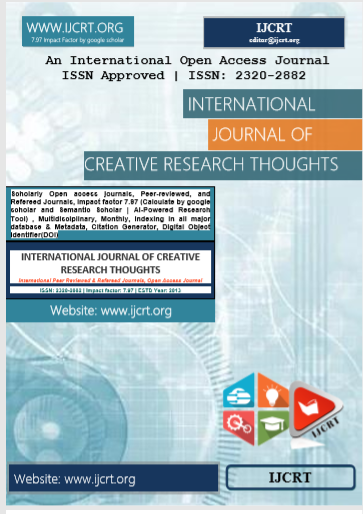 |
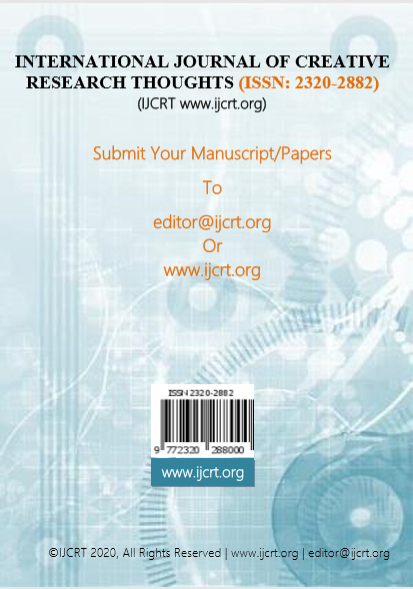 |
|---|---|
| IJCRT Journal front page | IJCRT Journal Back Page |
Paper Title: PREFERENCES FOR READYMADE AND TAILORED GARMENTS AMONGST SHARDA EXPORTS PROFESSIONALS
Author Name(s): Dr. Neha Singh, Ms. Swati Sharma
Published Paper ID: - IJCRT2403493
Register Paper ID - 229952
Publisher Journal Name: IJPUBLICATION, IJCRT
DOI Member ID: 10.6084/m9.doi.one.IJCRT2403493 and DOI :
Author Country : Indian Author, India, - , -, - , | Research Area: Science and Technology Published Paper URL: http://ijcrt.org/viewfull.php?&p_id=IJCRT2403493 Published Paper PDF: download.php?file=IJCRT2403493 Published Paper PDF: http://www.ijcrt.org/papers/IJCRT2403493.pdf
Your Paper Publication Details:
Title: PREFERENCES FOR READYMADE AND TAILORED GARMENTS AMONGST SHARDA EXPORTS PROFESSIONALS
DOI (Digital Object Identifier) :
Pubished in Volume: 12 | Issue: 3 | Year: March 2024
Publisher Name : IJCRT | www.ijcrt.org | ISSN : 2320-2882
Subject Area: Science and Technology
Author type: Indian Author
Pubished in Volume: 12
Issue: 3
Pages: e65-e74
Year: March 2024
Downloads: 529
E-ISSN Number: 2320-2882
Abstract
Licence: creative commons attribution 4.0
License
Creative Commons Attribution 4.0 and The Open Definition

Keywords
Preferences for Readymade and Tailored Garments amongst Sharda Exports Professionals
License
Creative Commons Attribution 4.0 and The Open Definition
Paper Title: Customer relationship Administration
Author Name(s): Patel Saxi, Patel Niyati, Patel Vrunda, Patel Riddhi
Published Paper ID: - IJCRT2403492
Register Paper ID - 253204
Publisher Journal Name: IJPUBLICATION, IJCRT
DOI Member ID: 10.6084/m9.doi.one.IJCRT2403492 and DOI :
Author Country : Indian Author, India, 391440 , Vadodara , 391440 , | Research Area: Science and Technology Published Paper URL: http://ijcrt.org/viewfull.php?&p_id=IJCRT2403492 Published Paper PDF: download.php?file=IJCRT2403492 Published Paper PDF: http://www.ijcrt.org/papers/IJCRT2403492.pdf
Your Paper Publication Details:
Title: CUSTOMER RELATIONSHIP ADMINISTRATION
DOI (Digital Object Identifier) :
Pubished in Volume: 12 | Issue: 3 | Year: March 2024
Publisher Name : IJCRT | www.ijcrt.org | ISSN : 2320-2882
Subject Area: Science and Technology
Author type: Indian Author
Pubished in Volume: 12
Issue: 3
Pages: e60-e64
Year: March 2024
Downloads: 370
E-ISSN Number: 2320-2882
Abstract
This research project is made to make easier for professional to create invoicing, filing and managing client with one click.
Licence: creative commons attribution 4.0
License
Creative Commons Attribution 4.0 and The Open Definition
Paper Title: EFFICACY OF A CARDIAC REHABILITATION PROGRAMME ON ACTIVITY TOLERANCE, CERTAIN PHYSIOLOGICAL PARAMETERS (HEART RATE (HR), ELECTROCARDIOGRAM (ECG)), AND QUALITY OF LIFE IN HOSPITALISED CABG SURGERY PATIENTS AT DR. PREM HOSPITAL IN PANIPAT
Author Name(s): Ritu, Paul Dinagaran
Published Paper ID: - IJCRT2403491
Register Paper ID - 253056
Publisher Journal Name: IJPUBLICATION, IJCRT
DOI Member ID: 10.6084/m9.doi.one.IJCRT2403491 and DOI :
Author Country : Indian Author, India, 132103 , Panipat, 132103 , | Research Area: Health Science All Published Paper URL: http://ijcrt.org/viewfull.php?&p_id=IJCRT2403491 Published Paper PDF: download.php?file=IJCRT2403491 Published Paper PDF: http://www.ijcrt.org/papers/IJCRT2403491.pdf
Your Paper Publication Details:
Title: EFFICACY OF A CARDIAC REHABILITATION PROGRAMME ON ACTIVITY TOLERANCE, CERTAIN PHYSIOLOGICAL PARAMETERS (HEART RATE (HR), ELECTROCARDIOGRAM (ECG)), AND QUALITY OF LIFE IN HOSPITALISED CABG SURGERY PATIENTS AT DR. PREM HOSPITAL IN PANIPAT
DOI (Digital Object Identifier) :
Pubished in Volume: 12 | Issue: 3 | Year: March 2024
Publisher Name : IJCRT | www.ijcrt.org | ISSN : 2320-2882
Subject Area: Health Science All
Author type: Indian Author
Pubished in Volume: 12
Issue: 3
Pages: e51-e59
Year: March 2024
Downloads: 308
E-ISSN Number: 2320-2882
Abstract
The study's goal was to find out how well the cardiac rehabilitation plan worked on activity tolerance, certain physiological parameters (heart rate (HR) and electrocardiogram (ECG)), and quality of life in Dr. Prem Hospital Panipat patients who had recently undergone CABG surgery. This study's main ideas come from Sister Calista Roy's Adaptation Model, which is made up of four ideas: the person, nursing, health, and surroundings. Methodology: To test a goal, a quantitative research method is used. This study uses a quasi-experimental research design to find out how well a cardiac rehabilitation plan works. It does this by using a quasi-experimental nonequivalent Pretest Post Test control group design. The study took place at Dr. Prem Hospital. For the study, 60 people who had CABG surgery were chosen: 30 were in the experimental group and 30 were in the control group. They were all brought to the cardiothoracic surgery department. The study used a method called "total enumerative sampling." Demographic and clinical variables, the Duke Activity Status Index, heart rate, an ECG, and the SF 36 questionnaire are all used to gather data. Also, written permission was asked for. The method used was total enumerative selection. This cardiac rehabilitation scheme checked in on people who had CABG surgery once a week. On the fifth day after surgery, both the experimental group and the control group took a pre-test in the post-operative room of the cardiothoracic department. Thirty of them were put in the training group and thirty were put in the control group. The intervention group got cardiac rehabilitation for three days in a row through a planned training programme and demonstration. They were told what to do and were urged to do it over the phone. Before 30 and 60 days, changes were measured in both groups' exercise tolerance, physiological parameters (heart rate ECG), and quality of life. The standardised tools were used, and the material was approved by experts. The Cronbach alpha method was used to check the reliability of the tools. Before the samples were used to collect data, the Duke activity status index was used to measure activity tolerance and the SF-36 questionnaire was used to measure quality of life. For heart rate.9, the inter rater method ECG-.75 was used. The control group had an activity tolerance score of 45.47 + 4.883 on the post-test, which is the mean and standard deviation. The average and range of exercise tolerance levels in the control group during the post-test were 25.23 + 8.169, and the score for the independent 't' test was 12.045 for 58 degrees of freedom. The 'p' number was less than 0.001, which means it was probably real. To compare the experimental group and the control group, the quality of life score after the test was 50.4 + 9.676 for the experimental group and 30.8 + 5.372 for the control group. The independent 't' test score was 9.700 for the degree of freedom 58. At a 'p' value of less than 0.001, it was statistically significant(p value less than 0.001). Based on the study, it can be said that a mix of interventions, such as teaching, showing exercises, giving out pamphlets about cardiac rehabilitation, and phone calls to encourage people to stick with it can increase adherence to cardiac rehabilitation, which in turn improves activity tolerance and quality of life.People who went through a cardiac rehabilitation course will not get sick again or have to go back to the hospital.It makes people more likely to follow through with their therapy treatment.
Licence: creative commons attribution 4.0
License
Creative Commons Attribution 4.0 and The Open Definition
Keywords
Effectiveness, cardiac rehabilitation programme, activity tolerance, selected physiological parameters, Heart rate, Electro cardio gram and quality of life CABG surgery patients
License
Creative Commons Attribution 4.0 and The Open Definition
Paper Title: NON-VOICE HUMAN SOUND DISEASE DETECTION SYSTEM USING MODIFIED DEEP LEARNING
Author Name(s): Gunaprabha K, Dr. P. Ravikumar
Published Paper ID: - IJCRT2403490
Register Paper ID - 250371
Publisher Journal Name: IJPUBLICATION, IJCRT
DOI Member ID: 10.6084/m9.doi.one.IJCRT2403490 and DOI :
Author Country : Indian Author, India, 638458 , Erode, 638458 , | Research Area: Science and Technology Published Paper URL: http://ijcrt.org/viewfull.php?&p_id=IJCRT2403490 Published Paper PDF: download.php?file=IJCRT2403490 Published Paper PDF: http://www.ijcrt.org/papers/IJCRT2403490.pdf
Your Paper Publication Details:
Title: NON-VOICE HUMAN SOUND DISEASE DETECTION SYSTEM USING MODIFIED DEEP LEARNING
DOI (Digital Object Identifier) :
Pubished in Volume: 12 | Issue: 3 | Year: March 2024
Publisher Name : IJCRT | www.ijcrt.org | ISSN : 2320-2882
Subject Area: Science and Technology
Author type: Indian Author
Pubished in Volume: 12
Issue: 3
Pages: e45-e50
Year: March 2024
Downloads: 324
E-ISSN Number: 2320-2882
Abstract
This innovative project addresses the growing need for efficient healthcare solutions by introducing a Human Sound-Based Diseases Detection System. Leveraging advanced machine learning techniques and signal processing, the system aims to diagnose respiratory conditions like asthma, COVID-19, tuberculosis, and obstructive diseases through the analysis of audio data converted into spectrogram images. The methodology involves utilizing the Librosa library for audio preprocessing, employing the Dense Net architecture for model training, and discussing the selected database's pivotal role. Results indicate the CNN's impressive accuracy improvement from 0.3 to 0.99 during 20 epochs, highlighting the system's ability to make accurate predictions. The discussion emphasizes the need for further validation, consideration of potential biases, and exploration of additional metrics to enhance the system's applicability in non-invasive disease detection
Licence: creative commons attribution 4.0
License
Creative Commons Attribution 4.0 and The Open Definition
Keywords
Asthma, Tuberculosis, obstructive, covid-19, Librosa library, CNN.
License
Creative Commons Attribution 4.0 and The Open Definition
Paper Title: Differential Effect Of High Temperature On The Photosynthetic Electron Transport Of Maize Plants
Author Name(s): Ranjani, R, Divya, B.J., Murthy, S.D.S
Published Paper ID: - IJCRT2403489
Register Paper ID - 252903
Publisher Journal Name: IJPUBLICATION, IJCRT
DOI Member ID: 10.6084/m9.doi.one.IJCRT2403489 and DOI :
Author Country : Indian Author, India, 517502 , Tirupati, 517502 , | Research Area: Life Sciences All Published Paper URL: http://ijcrt.org/viewfull.php?&p_id=IJCRT2403489 Published Paper PDF: download.php?file=IJCRT2403489 Published Paper PDF: http://www.ijcrt.org/papers/IJCRT2403489.pdf
Your Paper Publication Details:
Title: DIFFERENTIAL EFFECT OF HIGH TEMPERATURE ON THE PHOTOSYNTHETIC ELECTRON TRANSPORT OF MAIZE PLANTS
DOI (Digital Object Identifier) :
Pubished in Volume: 12 | Issue: 3 | Year: March 2024
Publisher Name : IJCRT | www.ijcrt.org | ISSN : 2320-2882
Subject Area: Life Sciences All
Author type: Indian Author
Pubished in Volume: 12
Issue: 3
Pages: e40-e44
Year: March 2024
Downloads: 311
E-ISSN Number: 2320-2882
Abstract
In this study an attempt has been made to establish the differential action of high temperature on photosynthetic electron transport mediated by either PS-II or PS- I or both in Maize thylakoids after giving high temperature treatment to primary leaves. The increase in the temperature from 250C-450C cause inhibition in PS-II catalysed electron transport. The possible reason for the loss of PS-II catalysed electron transport could be depletion of manganeese from water oxidation complex. In contrary high temperature induced enhancement in PS-I catalysed electron transport due to opening of new site to donate electrons before plastocyanin by reduced DCPIP. Thus high temperature exerts differential effect on PS-II as well as PS-I in Maize plants.
Licence: creative commons attribution 4.0
License
Creative Commons Attribution 4.0 and The Open Definition
Keywords
Chlorophyll, Electron transport, Photo system, Maize plants.
License
Creative Commons Attribution 4.0 and The Open Definition
Paper Title: Pedagogical Practices Among Social Science Teachers - An Empirical Study
Author Name(s): M.Papaiah, Dr.Shahanaz Begum
Published Paper ID: - IJCRT2403488
Register Paper ID - 253090
Publisher Journal Name: IJPUBLICATION, IJCRT
DOI Member ID: 10.6084/m9.doi.one.IJCRT2403488 and DOI :
Author Country : Indian Author, India, 500 098 , Hyderabad, 500 098 , | Research Area: Social Science All Published Paper URL: http://ijcrt.org/viewfull.php?&p_id=IJCRT2403488 Published Paper PDF: download.php?file=IJCRT2403488 Published Paper PDF: http://www.ijcrt.org/papers/IJCRT2403488.pdf
Your Paper Publication Details:
Title: PEDAGOGICAL PRACTICES AMONG SOCIAL SCIENCE TEACHERS - AN EMPIRICAL STUDY
DOI (Digital Object Identifier) :
Pubished in Volume: 12 | Issue: 3 | Year: March 2024
Publisher Name : IJCRT | www.ijcrt.org | ISSN : 2320-2882
Subject Area: Social Science All
Author type: Indian Author
Pubished in Volume: 12
Issue: 3
Pages: e36-e39
Year: March 2024
Downloads: 373
E-ISSN Number: 2320-2882
Abstract
Pedagogical practices are the practices that teachers need to be well-aware of in promoting student learning. The major factors that need to be put into practice in shaping pedagogical practices are, reflections, documentation , learning and research. The current empirical study delves into the pedagogical practices of Social Science teachers with special reference to their pedagogy, Teaching Learning Practices (TLPs) and digitalization in the State of Telangana. The research employs an empirical approach which is qualitative and the study cohort comprised 350 Social Science teachers from Mahbubnagar district of Telangana State. The instrument is a self-developed questionnaire based on Likert five point scale. The data was analyzed using t-test. The main findings of the study indicate that there exists a significant difference in the pedagogical practices of Social Science teachers with regard to their pedagogy, Teaching Learning Practices (TLPs) and digitalization. The study reflects certain educational implications for teachers, Heads of Institutions and also for implementing authorities. Directions for further research were also portrayed succinctly.
Licence: creative commons attribution 4.0
License
Creative Commons Attribution 4.0 and The Open Definition
Keywords
Pedagogical Practices, Social Science teachers, Empirical study, Teaching Leanring Material (TLM) , digitalization.
License
Creative Commons Attribution 4.0 and The Open Definition
Paper Title: Gender and Age Detection Using Machine Learning Algorithm
Author Name(s): Kundansingh Mourya, Omkar Singh
Published Paper ID: - IJCRT2403487
Register Paper ID - 253130
Publisher Journal Name: IJPUBLICATION, IJCRT
DOI Member ID: 10.6084/m9.doi.one.IJCRT2403487 and DOI :
Author Country : Indian Author, India, 400097 , Mumbai, 400097 , | Research Area: Science All Published Paper URL: http://ijcrt.org/viewfull.php?&p_id=IJCRT2403487 Published Paper PDF: download.php?file=IJCRT2403487 Published Paper PDF: http://www.ijcrt.org/papers/IJCRT2403487.pdf
Your Paper Publication Details:
Title: GENDER AND AGE DETECTION USING MACHINE LEARNING ALGORITHM
DOI (Digital Object Identifier) :
Pubished in Volume: 12 | Issue: 3 | Year: March 2024
Publisher Name : IJCRT | www.ijcrt.org | ISSN : 2320-2882
Subject Area: Science All
Author type: Indian Author
Pubished in Volume: 12
Issue: 3
Pages: e32-e35
Year: March 2024
Downloads: 374
E-ISSN Number: 2320-2882
Abstract
In recent years, machine learning techniques have revolutionized the field of computer vision, particularly in the detection of gender and age from visual data. This paper presents a comprehensive analysis of two popular machine learning models, Support Vector Machines (SVM) and Convolutional Neural Networks (CNN), for gender and age detection tasks. The study evaluates the performance of SVM and CNN algorithms on diverse datasets and assesses their effectiveness in real-world applications such as advertising, security, healthcare, and surveillance. Results indicate that CNN-based approaches generally outperform SVM in terms of accuracy and robustness, owing to their ability to automatically learn hierarchical features from raw image data. However, SVM models exhibit advantages in computational efficiency and interpretability. The findings underscore the significance of gender and age detection in various domains, including personalized advertising, enhanced security measures, and improved healthcare diagnostics and treatments. This research contributes to the ongoing discourse on leveraging machine learning advancements for societal benefit and underscores the importance of choosing appropriate algorithms for specific applications in gender and age detection.
Licence: creative commons attribution 4.0
License
Creative Commons Attribution 4.0 and The Open Definition
Keywords
Machine Learning, Convolutional Neural Network, Gender Classification, Age Classification, Support Vector Machine
License
Creative Commons Attribution 4.0 and The Open Definition
Paper Title: Deepfake Detection of Images Using Deep Learning Techniques
Author Name(s): Sahil Singh, Om Patel, Omkar Singh
Published Paper ID: - IJCRT2403486
Register Paper ID - 253125
Publisher Journal Name: IJPUBLICATION, IJCRT
DOI Member ID: 10.6084/m9.doi.one.IJCRT2403486 and DOI :
Author Country : Indian Author, India, 400097 , Mumbai, 400097 , | Research Area: Science All Published Paper URL: http://ijcrt.org/viewfull.php?&p_id=IJCRT2403486 Published Paper PDF: download.php?file=IJCRT2403486 Published Paper PDF: http://www.ijcrt.org/papers/IJCRT2403486.pdf
Your Paper Publication Details:
Title: DEEPFAKE DETECTION OF IMAGES USING DEEP LEARNING TECHNIQUES
DOI (Digital Object Identifier) :
Pubished in Volume: 12 | Issue: 3 | Year: March 2024
Publisher Name : IJCRT | www.ijcrt.org | ISSN : 2320-2882
Subject Area: Science All
Author type: Indian Author
Pubished in Volume: 12
Issue: 3
Pages: e26-e31
Year: March 2024
Downloads: 379
E-ISSN Number: 2320-2882
Abstract
Deepfake detection is based on a deep learning model. Deepfake content is created with the help of artificial intelligence and machine learning to replace one person's face with another person's face in pictures. These manipulated pictures will undoubtedly have an enormous societal impact. Deepfake uses the latest technology like Machine Learning (ML), and Deep Learning (DL) to construct automated methods for creating fake content. We use the DFDC dataset for training the model, it contains 100,000 videos of more real and fake videos. To identify real and fake images using various Convolutional Neural Network (CNN) models, namely EfficientNetB0, VGG-16, and Xception. Our primary objective is to determine the model that yields the highest accuracy in identifying deepfake images. Initially, we preprocess videos from the DFDC dataset, extracting frames and preparing them for input into CNN models. Subsequently, we construct and train each CNN architecture on the preprocessed data, integrating techniques like data augmentation to enhance model generalization and resilience. Performance evaluation utilizes metrics such as accuracy, precision, recall, and F1 score.
Licence: creative commons attribution 4.0
License
Creative Commons Attribution 4.0 and The Open Definition
Keywords
Deepfake Detection, Deepfake Image, Convolution Neural Network, DFDC Dataset
License
Creative Commons Attribution 4.0 and The Open Definition
Paper Title: Implementation of Total Quality Management in the University Libraries of Assam: A study centered on Library Classification and Cataloguing
Author Name(s): Mondita Borah, Dr. Narendra Lahkar
Published Paper ID: - IJCRT2403485
Register Paper ID - 252769
Publisher Journal Name: IJPUBLICATION, IJCRT
DOI Member ID: 10.6084/m9.doi.one.IJCRT2403485 and DOI :
Author Country : Indian Author, India, 785621 , Golaghat, 785621 , | Research Area: Others area Published Paper URL: http://ijcrt.org/viewfull.php?&p_id=IJCRT2403485 Published Paper PDF: download.php?file=IJCRT2403485 Published Paper PDF: http://www.ijcrt.org/papers/IJCRT2403485.pdf
Your Paper Publication Details:
Title: IMPLEMENTATION OF TOTAL QUALITY MANAGEMENT IN THE UNIVERSITY LIBRARIES OF ASSAM: A STUDY CENTERED ON LIBRARY CLASSIFICATION AND CATALOGUING
DOI (Digital Object Identifier) :
Pubished in Volume: 12 | Issue: 3 | Year: March 2024
Publisher Name : IJCRT | www.ijcrt.org | ISSN : 2320-2882
Subject Area: Others area
Author type: Indian Author
Pubished in Volume: 12
Issue: 3
Pages: e18-e25
Year: March 2024
Downloads: 325
E-ISSN Number: 2320-2882
Abstract
Purpose: The purpose of this study is to identify ways by which classification and cataloguing services in the university libraries can be made more effective through the application of TQM techniques. Methodology: A total of five renowned universities of Assam are purposely sampled. The study assesses the current culture for quality management systems and also focuses on the cataloguing and classification skills of the staff. The user satisfaction level is also studied and the challenges they face in retrieving information. It investigates the idea of how timeliness is maintained, what schemes and rules are followed by those libraries and through what mode based on the principles of TQM. Findings: Study revealed that shortage of professional staff acts as the main barrier to process TQM. Recommendations are made to prioritize the needs of the users by providing excellent training to the staff. Value: The study has proven the users' requirements and the necessary actions that have to be implied to improve the efficiency of the staff. Moreover, it also focused on the proper utilization of time.
Licence: creative commons attribution 4.0
License
Creative Commons Attribution 4.0 and The Open Definition
Keywords
TQM; University Libraries; Library Cataloguing; Library Classification
License
Creative Commons Attribution 4.0 and The Open Definition
Paper Title: Worker Recommendation System
Author Name(s): Sanjivani Shinde, Rutuja Nirmal, Indrayani Pawar, Rutuja Sutar, Sakshi Mote
Published Paper ID: - IJCRT2403484
Register Paper ID - 252529
Publisher Journal Name: IJPUBLICATION, IJCRT
DOI Member ID: 10.6084/m9.doi.one.IJCRT2403484 and DOI :
Author Country : Indian Author, India, - , -, - , | Research Area: Science and Technology Published Paper URL: http://ijcrt.org/viewfull.php?&p_id=IJCRT2403484 Published Paper PDF: download.php?file=IJCRT2403484 Published Paper PDF: http://www.ijcrt.org/papers/IJCRT2403484.pdf
Your Paper Publication Details:
Title: WORKER RECOMMENDATION SYSTEM
DOI (Digital Object Identifier) :
Pubished in Volume: 12 | Issue: 3 | Year: March 2024
Publisher Name : IJCRT | www.ijcrt.org | ISSN : 2320-2882
Subject Area: Science and Technology
Author type: Indian Author
Pubished in Volume: 12
Issue: 3
Pages: e14-e17
Year: March 2024
Downloads: 356
E-ISSN Number: 2320-2882
Abstract
Recommendation System are software application that provide or suggest item to user these System use filtering techniques to provide recommendation. The Purpose of this recommendation System provide services to small or part time Workers. It has been observed by the team that Recommendation System that are studied have not focused on small wokers like electrician and carpenters, plumber, mechanics but the corporate people.The recommendation system has been implemented in the android programming language.The results obtained were quite accurate which helps to recommend jobs to workers and workers to customers in the required work field.Where a job seeker applies to a job by creating a profile on a job portal by providing all his/her work preferences.These work preferences of each user can be collected from each user and provide worker recommendation based on their preference.
Licence: creative commons attribution 4.0
License
Creative Commons Attribution 4.0 and The Open Definition
Keywords
Worker Recommendation System
License
Creative Commons Attribution 4.0 and The Open Definition
Call For Paper September 2026
Call For Papers
September 2026
Volume 14 | Issue 9
Last Date :
31-Oct-2026
Submit Manuscript Online Impact Factor: 7.97 Review Results : Within 02-03 Days Paper Publication : Within 02-03 Days
September 2026
Volume 14 | Issue 9
Last Date :
31-Oct-2026
Submit Manuscript Online Impact Factor: 7.97 Review Results : Within 02-03 Days Paper Publication : Within 02-03 Days
Published Issue Details
For Authors
Forms / Downloads
Other IMP Links
Indexing Partner
Research Area
LICENSE





ISSN and 7.97 Impact Factor Details
ISSN: 2320-2882 Impact Factor: 7.97 and ISSN APPROVED Journal Starting Year (ESTD) : 2013


ISSN and 7.97 Impact Factor Details
ISSN: 2320-2882 Impact Factor: 7.97 and ISSN APPROVED Journal Starting Year (ESTD) : 2013
DOI Details
CONFERENCE
CONFERENCE MANAGMENT & PUBLICATION CONFERENCE PROPOSAL
RECENT CONFERENCE

CONFERENCE PROPOSAL CONFERENCE PROCEEDINGS
CONFERENCE PROPOSAL CONFERENCE PROCEEDINGS
For Reviewer /Referral (RMS) Earn 500 per paper
Important Links
NEWS & Conference
Digital Library
IJCRT RMS | Earn 500 Per Paper.

Open Access


LICENSE
Indexing Partner
Scholarly open access journals, Peer-reviewed, and Refereed Journals, Impact factor 7.97 (Calculate by google scholar and Semantic Scholar | AI-Powered Research Tool) , Multidisciplinary, Monthly, Indexing in all major database & Metadata, Citation Generator, Digital Object Identifier(DOI)