Important Details
IJCRT - International Peer Reviewed, Open Access Journal, Multidisciplinary, Monthly, Nominal(Low) Fees for Professional Research Services International Journal of Creative Research Thoughts - IJCRT Peer Review Journal, Refereed Journal, Peer Reviewed Journal , Referred Journal and Indexed Journal, Open access, Online and Print Journal,international Journal Open Access, Accepted by Indian and foreign university ,IJCRT Followed Norms, guidelines, requirement, listing criteria and methodology of score/point also applied from: Scopus , Web of Science , UGC Approved , UGC CARE, UGC-CARE .
UGC Approved Journal No: 49023 (18)
UGC approval Link
https://ijcrt.org/ugc%20approval.jpg
All Policy and Approval
Please Like Our Facebook Page | CrossRef DOI and Hard copy of Certificate Provide if required. | www.IJCRT.org | editor@IJCRT.org | IJCRT WhatsApp +91 94294 58311
Publication Details:
- Paper Submission : 31-Oct-2026. Call For Paper (Volume 14 | Issue 9 | Month- September 2026)
- Acceptance/Rejection Notification: Within 02-04 Days.
- Paper Publish: Within 02-04 Days after submitting all documents.
-
Submit Your Paper Any time There No deadline.
-
Publication fees : 1570 INR for Indian author & 59$ for foreign International author.
Please Like Our Facebook Page | CrossRef DOI and Hard copy of Certificate Provide if required.
Licence and Indexing
Indexing In Google Scholar, SSRN, ResearcherID-Publons, Semantic Scholar | AI-Powered Research Tool, Microsoft Academic, Academia.edu, arXiv.org, Research Gate, CiteSeerX, ResearcherID Thomson Reuters, Mendeley : reference manager, DocStoc, ISSUU, Scribd, and many more | High Impact Factor: 7.97 | Digital object identifier (DOI) and Hard Copy of certificate Provided.



























Licence
DOI
ISSN Approved impact factor: 7.97 
Creative Common 
Valid as per new UGC Gazette regulations 

INTERNATIONAL JOURNAL OF CREATIVE RESEARCH THOUGHTS - IJCRT (IJCRT.ORG)
International Peer Reviewed & Refereed Journals, Open Access Journal
IJCRT Peer-Reviewed (Refereed) Journal as Per New UGC Rules.
ISSN Approved Journal No: 2320-2882 | Impact factor: 7.97 | ESTD Year: 2013
Call For Paper - Volume 14 | Issue 9 | Month- September 2026
Scholarly open access journals, Peer-reviewed, and Refereed Journals, Impact factor 7.97 (Calculate by google scholar and Semantic Scholar | AI-Powered Research Tool) , Multidisciplinary, Monthly, Indexing in all major database & Metadata, Citation Generator, Digital Object Identifier(CrossRef DOI)
IJCRT WhatsApp Contact
IJCRT Search Xplore - Search all paper by Paper Name , Author Name, and Title
Volume 14 | Issue 4 |
Volume 14 | Issue 4 | Month
Downlaod After Publication 1) Table of content index in PDF
2) Table of content index in HTML 2)Table of content index in HTML
3) Front Page 3) Front Page
4) Back Page 4) Back Page
5) Editor Board Member 5)Editor Board Member
6) OLD Style Issue 6)OLD Style Issue
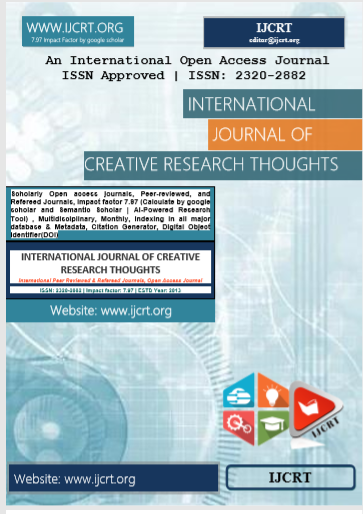 |
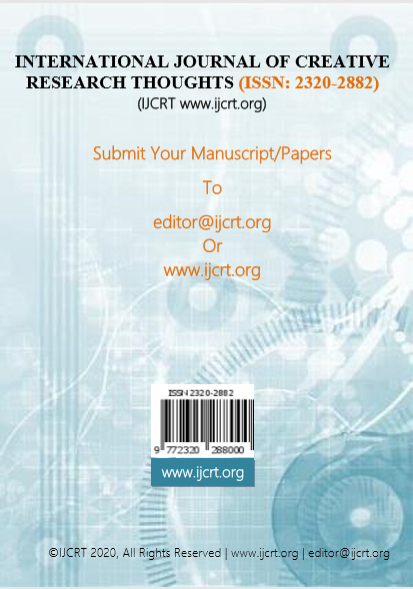 |
|---|---|
| IJCRT Journal front page | IJCRT Journal Back Page |
Paper Title: Smart Aerophonic And Hydroponic Farming
Author Name(s): Swapnali Bansode, Anushka Sonwane, Gauri Mhatre
Published Paper ID: - IJCRT2604445
Register Paper ID - 304369
Publisher Journal Name: IJPUBLICATION, IJCRT
DOI Member ID: 10.6084/m9.doi.one.IJCRT2604445 and DOI :
Author Country : Indian Author, India, 411011 , Pune, 411011 , | Research Area: Science and Technology Published Paper URL: http://ijcrt.org/viewfull.php?&p_id=IJCRT2604445 Published Paper PDF: download.php?file=IJCRT2604445 Published Paper PDF: http://www.ijcrt.org/papers/IJCRT2604445.pdf
Your Paper Publication Details:
Title: SMART AEROPHONIC AND HYDROPONIC FARMING
DOI (Digital Object Identifier) :
Pubished in Volume: 14 | Issue: 4 | Year: April 2026
Publisher Name : IJCRT | www.ijcrt.org | ISSN : 2320-2882
Subject Area: Science and Technology
Author type: Indian Author
Pubished in Volume: 14
Issue: 4
Pages: d753-d756
Year: April 2026
Downloads: 132
E-ISSN Number: 2320-2882
Abstract
The nature of the paper is theoretical in nature and based on secondary data, the finding of paper shows that in Jammu & Kashmir agriculture is still narrow, backward and less The results of this study are useful for growing crops not only in technical parts, but also in physical part, it was evaluated by questionnaire using technology acceptance model. Using of sensors and actuators in the greenhouse to capture different values allows for the control of the equipment, it can also be optimized for growth at optimal temperature and humidity of various crops planted.
Licence: creative commons attribution 4.0
License
Creative Commons Attribution 4.0 and The Open Definition

Keywords
Abstract, Introduction, conclusion, reference
License
Creative Commons Attribution 4.0 and The Open Definition
Paper Title: Advanced Vibratory System For Coal Hopper
Author Name(s): Er. Sandeep K. Mude, Priyanshu P. Agase, Dipak B. Pawar, Rupali R. Parakhe
Published Paper ID: - IJCRT2604444
Register Paper ID - 305350
Publisher Journal Name: IJPUBLICATION, IJCRT
DOI Member ID: 10.6084/m9.doi.one.IJCRT2604444 and DOI :
Author Country : Indian Author, India, 440024 , Nagpur, 440024 , | Research Area: Science and Technology Published Paper URL: http://ijcrt.org/viewfull.php?&p_id=IJCRT2604444 Published Paper PDF: download.php?file=IJCRT2604444 Published Paper PDF: http://www.ijcrt.org/papers/IJCRT2604444.pdf
Your Paper Publication Details:
Title: ADVANCED VIBRATORY SYSTEM FOR COAL HOPPER
DOI (Digital Object Identifier) :
Pubished in Volume: 14 | Issue: 4 | Year: April 2026
Publisher Name : IJCRT | www.ijcrt.org | ISSN : 2320-2882
Subject Area: Science and Technology
Author type: Indian Author
Pubished in Volume: 14
Issue: 4
Pages: d747-d752
Year: April 2026
Downloads: 123
E-ISSN Number: 2320-2882
Abstract
Blockages in gravity-fed coal hoppers due to arching and ratholing cause significant downtime and safety hazards in mining operations. This paper presents the design and implementation of a cost-effective, automated vibratory discharge system to solve this problem at a Western Coalfields Limited (WCL) site in Chandrapur, India. The system is centred on a single vibratory motor, sized using a first-principles force calculation that determined a required centrifugal force of 7.8-8.0 kN to overcome coal cohesion and wall friction. The motor is controlled by an ESP32 microcontroller via a solid-state relay circuit, enabling safe and programmable operation. Implementation results demonstrate that the system successfully transformed discharge from intermittent and manual to continuous and automated, eliminating prolonged blockages and the need for hazardous manual intervention. Post-implementation, blockages were eliminated and manual rodding interventions were reduced from approximately to zero. The study concludes that a well-calculated, single-motor vibratory system with embedded control is a transformative and practical retrofit for enhancing the reliability and safety of industrial bulk material handling.
Licence: creative commons attribution 4.0
License
Creative Commons Attribution 4.0 and The Open Definition
Keywords
Coal Hopper ,ESP32,Solid-State Relay ,Granular Flow Unjamming , Industril Safety.
License
Creative Commons Attribution 4.0 and The Open Definition
Paper Title: YaatreMitra: AI-Driven Smart Travel Companion for Karnataka
Author Name(s): Prof. Pratik Suresh Deshmukh, Lavannya Ajay Deshpande, Shravani Shadanan Tattu, Manas Sanjay Rahate, Aryan Subhash Wasnik
Published Paper ID: - IJCRT2604443
Register Paper ID - 304451
Publisher Journal Name: IJPUBLICATION, IJCRT
DOI Member ID: 10.6084/m9.doi.one.IJCRT2604443 and DOI :
Author Country : Indian Author, India, 444601 , Amravati, 444601 , | Research Area: Science and Technology Published Paper URL: http://ijcrt.org/viewfull.php?&p_id=IJCRT2604443 Published Paper PDF: download.php?file=IJCRT2604443 Published Paper PDF: http://www.ijcrt.org/papers/IJCRT2604443.pdf
Your Paper Publication Details:
Title: YAATREMITRA: AI-DRIVEN SMART TRAVEL COMPANION FOR KARNATAKA
DOI (Digital Object Identifier) :
Pubished in Volume: 14 | Issue: 4 | Year: April 2026
Publisher Name : IJCRT | www.ijcrt.org | ISSN : 2320-2882
Subject Area: Science and Technology
Author type: Indian Author
Pubished in Volume: 14
Issue: 4
Pages: d739-d746
Year: April 2026
Downloads: 167
E-ISSN Number: 2320-2882
Abstract
Karnataka tourism has a rich culture and diversity. However, travelers often face challenges. These include limited access to reliable information, difficulties in planning itineraries, language barriers, unreliable transport schedules, and a lack of real-time guidance, particularly for those who do not speak Kannada. YaatreMitra is an AI-Driven Smart Travel Companion for Karnataka that addresses these issues. It uses an adaptive AI platform to create personalized itineraries based on user preferences such as budget, duration, and interests. It also provides live updates on weather, traffic, and transport, along with dynamic suggestions for routes and plans. Additionally, it gives location-based recommendations for nearby attractions and verified options for hotels and restaurants. The platform includes a text and voice translation tool for Kannada, enabling better communication and improving overall travel convenience, accessibility, and user experience throughout Karnataka.
Licence: creative commons attribution 4.0
License
Creative Commons Attribution 4.0 and The Open Definition
Keywords
AI-driven travel companion, Smart travel system, Adaptive AI platform, Dynamic route suggestions, Location- based recommendations.
License
Creative Commons Attribution 4.0 and The Open Definition
Paper Title: Leadership Masterclass for Youth in Amish Tripathi's Mythological Fiction: The Shiva Trilogy
Author Name(s): Shivani, Dr. Saurav Bhattacharyya
Published Paper ID: - IJCRT2604442
Register Paper ID - 304793
Publisher Journal Name: IJPUBLICATION, IJCRT
DOI Member ID: 10.6084/m9.doi.one.IJCRT2604442 and DOI :
Author Country : Indian Author, India, 842001 , MUZAFFARPUR, 842001 , | Research Area: Medical Science All Published Paper URL: http://ijcrt.org/viewfull.php?&p_id=IJCRT2604442 Published Paper PDF: download.php?file=IJCRT2604442 Published Paper PDF: http://www.ijcrt.org/papers/IJCRT2604442.pdf
Your Paper Publication Details:
Title: LEADERSHIP MASTERCLASS FOR YOUTH IN AMISH TRIPATHI'S MYTHOLOGICAL FICTION: THE SHIVA TRILOGY
DOI (Digital Object Identifier) :
Pubished in Volume: 14 | Issue: 4 | Year: April 2026
Publisher Name : IJCRT | www.ijcrt.org | ISSN : 2320-2882
Subject Area: Medical Science All
Author type: Indian Author
Pubished in Volume: 14
Issue: 4
Pages: d733-d738
Year: April 2026
Downloads: 135
E-ISSN Number: 2320-2882
Abstract
Amish Tripathi's Shiva Trilogy--consisting of The Immortals of Meluha (2010) The Secret of the Nagas (2011) and The Oath of the Vayuputras (2013)--depicts Lord Shiva not just as a deified figure but as an actual human being who progressed from being the chief of a Tibetan tribe through his journey from being Neelkanth and ultimately becoming a person who exemplifies leadership. Though the trilogy does not serve as an historically accurate retelling of how Lord Shiva became Neelkanth, it does contain numerous practical lessons regarding the art of ethical decision-making, duty (as expressed through karma), humility, justice, and human agency. Through a close analysis of key figures of the trilogy (Shiva, Sati, Parvateshwar) and the dilemmas they faced (Somras, the Naga), this article identifies seven common traits exhibited by the leading characters. This is compared and contrasted with the philosophy contained in the Bhagavad Gita (a sacred text of Hinduism) and contemporary leadership models. The analysis of the transformational journey of Shiva provides evidence that true leaders gain their leadership by virtue of their actions alone and not merely through their birthright. Therefore, the lessons learned from the Shiva Trilogy are particularly useful for young readers who will be facing the challenges of navigating ethical dilemmas in the 21st Century. Based upon the message contained in the Shiva Trilogy, it is concluded that ancient Indian wisdom, skillfully packaged in an enjoyable format, provides a body of knowledge that can be readily applied by future generations in leading by example.
Licence: creative commons attribution 4.0
License
Creative Commons Attribution 4.0 and The Open Definition
Keywords
Youth reader, Leadership, Mythology, Fiction, Protagonist, Novel, Ethical dilemmas.
License
Creative Commons Attribution 4.0 and The Open Definition
Paper Title: Gender Disparities in MSME Development: A Comparative Study of Women and Male Entrepreneurs in North 24 Parganas, West Bengal
Author Name(s): Prasiddha Das
Published Paper ID: - IJCRT2604441
Register Paper ID - 305246
Publisher Journal Name: IJPUBLICATION, IJCRT
DOI Member ID: 10.6084/m9.doi.one.IJCRT2604441 and DOI : https://doi.org/10.56975/ijcrt.v14i4.305246
Author Country : Indian Author, India, 743122 , North Barackpore (M), 743122 , | Research Area: Arts1 All Published Paper URL: http://ijcrt.org/viewfull.php?&p_id=IJCRT2604441 Published Paper PDF: download.php?file=IJCRT2604441 Published Paper PDF: http://www.ijcrt.org/papers/IJCRT2604441.pdf
Your Paper Publication Details:
Title: GENDER DISPARITIES IN MSME DEVELOPMENT: A COMPARATIVE STUDY OF WOMEN AND MALE ENTREPRENEURS IN NORTH 24 PARGANAS, WEST BENGAL
DOI (Digital Object Identifier) : https://doi.org/10.56975/ijcrt.v14i4.305246
Pubished in Volume: 14 | Issue: 4 | Year: April 2026
Publisher Name : IJCRT | www.ijcrt.org | ISSN : 2320-2882
Subject Area: Arts1 All
Author type: Indian Author
Pubished in Volume: 14
Issue: 4
Pages: d720-d732
Year: April 2026
Downloads: 150
E-ISSN Number: 2320-2882
Abstract
Micro, Small, and Medium Enterprises (MSMEs) play a crucial role in driving economic growth and creating jobs in India, but gender-based disparities still influence entrepreneurial success. This research investigates the differences between male and female entrepreneurs in North 24 Parganas, West Bengal, with a focus on access to financing, institutional assistance, digital technology use, and overall business performance. Employing a mixed-methods design, the study analyses primary data from 22 MSME owners using descriptive and inferential statistics, complemented by GIS-based spatial analysis. Results indicate that women entrepreneurs encounter more significant barriers than men in obtaining formal credit, government support, and digital resources, which contributes to slower business expansion. The study also identifies notable differences between rural and urban areas, with urban regions demonstrating stronger MSME development, while rural areas lag behind. These geographic imbalances have a more pronounced impact on women-led enterprises. The findings underscore the importance of tailored policies that consider both gender and regional context to enhance financial access, improve digital skills, and support equitable growth of MSMEs.
Licence: creative commons attribution 4.0
License
Creative Commons Attribution 4.0 and The Open Definition
Keywords
MSMEs, Gender Disparity, Women Entrepreneurs, Financial Inclusion, Spatial Inequality
License
Creative Commons Attribution 4.0 and The Open Definition
Paper Title: SmartMediBook: AI Powered Appointment Booking System
Author Name(s): Haniya Shaikh, Salima Naik, Sakshi Nadankar, Iqra Shaikh, Dr. Varsha Shah
Published Paper ID: - IJCRT2604440
Register Paper ID - 305424
Publisher Journal Name: IJPUBLICATION, IJCRT
DOI Member ID: 10.6084/m9.doi.one.IJCRT2604440 and DOI :
Author Country : Indian Author, India, 400050 , Mumbai, 400050 , | Research Area: Science and Technology Published Paper URL: http://ijcrt.org/viewfull.php?&p_id=IJCRT2604440 Published Paper PDF: download.php?file=IJCRT2604440 Published Paper PDF: http://www.ijcrt.org/papers/IJCRT2604440.pdf
Your Paper Publication Details:
Title: SMARTMEDIBOOK: AI POWERED APPOINTMENT BOOKING SYSTEM
DOI (Digital Object Identifier) :
Pubished in Volume: 14 | Issue: 4 | Year: April 2026
Publisher Name : IJCRT | www.ijcrt.org | ISSN : 2320-2882
Subject Area: Science and Technology
Author type: Indian Author
Pubished in Volume: 14
Issue: 4
Pages: d711-d719
Year: April 2026
Downloads: 131
E-ISSN Number: 2320-2882
Abstract
SmartMediBook is a web-based healthcare appointment booking system designed to digitize and streamline medical scheduling. Traditional methods relying on manual booking often result in delays, inefficiencies, and poor patient experience. The proposed system provides a centralized and user-friendly platform for efficient appointment management. It allows users to register, log in, check doctor availability, and book appointments in real time. The system maintains structured records of patients, doctors, and appointments, ensuring better data organization.Developed using the MERN stack (React.js, Node.js, Express.js, and MongoDB), the application follows the MVC architecture for scalability and maintainability. A key feature is an AI-based chatbot that assists users in booking appointments and accessing services seamlessly. The system design is supported by ER diagrams, UML diagrams, and sequence diagrams for clear representation. APIs are tested using Postman, and deployment is done using MongoDB Atlas and Render.The system improves efficiency, reduces waiting time, and enhances accessibility, offering a reliable solution for modern digital healthcare services.
Licence: creative commons attribution 4.0
License
Creative Commons Attribution 4.0 and The Open Definition
Keywords
Healthcare System, Appointment Booking, MERN Stack, AI Chatbot, Web Application, Digital Healthcare
License
Creative Commons Attribution 4.0 and The Open Definition
Paper Title: AUDIO STEGANOGRAPHY BY CRYPTOGRAPHY ALGORITHM
Author Name(s): SHRUTIKA S GELEWAR, RUSHIKESH S KULKARNI, SHRUTI R DESHMUKH, MOHNISH J KHOBRAGADE, MRS SHREYA R GANGANE
Published Paper ID: - IJCRT2604439
Register Paper ID - 303751
Publisher Journal Name: IJPUBLICATION, IJCRT
DOI Member ID: 10.6084/m9.doi.one.IJCRT2604439 and DOI :
Author Country : Indian Author, India, 444701 , AMRAVATI, 444701 , | Research Area: Science and Technology Published Paper URL: http://ijcrt.org/viewfull.php?&p_id=IJCRT2604439 Published Paper PDF: download.php?file=IJCRT2604439 Published Paper PDF: http://www.ijcrt.org/papers/IJCRT2604439.pdf
Your Paper Publication Details:
Title: AUDIO STEGANOGRAPHY BY CRYPTOGRAPHY ALGORITHM
DOI (Digital Object Identifier) :
Pubished in Volume: 14 | Issue: 4 | Year: April 2026
Publisher Name : IJCRT | www.ijcrt.org | ISSN : 2320-2882
Subject Area: Science and Technology
Author type: Indian Author
Pubished in Volume: 14
Issue: 4
Pages: d706-d710
Year: April 2026
Downloads: 137
E-ISSN Number: 2320-2882
Abstract
Steganographic methods conceal confidential information within seemingly innocuous media like music files without alerting potential interceptors. This suggested framework employs the Data Encryption Standard's cryptography method to secure information prior to incorporating it within an outer shell for enhanced protection measures. The least significant bit (LSB) coding technique is employed for converting digital information into audible signals through audio sample manipulation. A comprehensive framework ensures an inherently protected communication channel; this security comes about due to both steganographic techniques for concealing messages within non-obvious data structures and cryptographic methods used in conjunction with these hidden elements to safeguard information transmission over open networks.
Licence: creative commons attribution 4.0
License
Creative Commons Attribution 4.0 and The Open Definition
Keywords
Steganography, Cryptographic, Data Encryption Standard (DES), Least Significant Bit (LSB), Cover File.
License
Creative Commons Attribution 4.0 and The Open Definition
Paper Title: Strategic Approaches to Mobile Phase Selection in High-Performance Liquid Chromatography: Principles, Optimization, and Recent Advances
Author Name(s): Ms.Bhagyashree B. Wadikar, Ms. Namrata Jayshing Jadhav, Ms. Bhavana Rahul Patil, Mr. Vinod S. Pattankude, Dr. Dhanraj R. Jadge
Published Paper ID: - IJCRT2604438
Register Paper ID - 305466
Publisher Journal Name: IJPUBLICATION, IJCRT
DOI Member ID: 10.6084/m9.doi.one.IJCRT2604438 and DOI :
Author Country : Indian Author, India, 416112 , Peth vadgaon, 416112 , | Research Area: Pharmacy All Published Paper URL: http://ijcrt.org/viewfull.php?&p_id=IJCRT2604438 Published Paper PDF: download.php?file=IJCRT2604438 Published Paper PDF: http://www.ijcrt.org/papers/IJCRT2604438.pdf
Your Paper Publication Details:
Title: STRATEGIC APPROACHES TO MOBILE PHASE SELECTION IN HIGH-PERFORMANCE LIQUID CHROMATOGRAPHY: PRINCIPLES, OPTIMIZATION, AND RECENT ADVANCES
DOI (Digital Object Identifier) :
Pubished in Volume: 14 | Issue: 4 | Year: April 2026
Publisher Name : IJCRT | www.ijcrt.org | ISSN : 2320-2882
Subject Area: Pharmacy All
Author type: Indian Author
Pubished in Volume: 14
Issue: 4
Pages: d695-d705
Year: April 2026
Downloads: 113
E-ISSN Number: 2320-2882
Abstract
High-Performance Liquid Chromatography (HPLC) is a widely utilized analytical technique for the separation, identification, and quantification of compounds across pharmaceutical, environmental, and biochemical domains. Among the various factors influencing chromatographic performance, mobile phase selection plays a critical role in determining retention behavior, resolution, selectivity, and peak shape. This review focuses on the fundamental principles governing mobile phase selection, including polarity, pH, buffer systems, organic modifiers, and additives. Different chromatographic modes such as normal phase, reverse phase, ion-exchange, and ion-pair chromatography are discussed in relation to mobile phase characteristics. The article also highlights the impact of mobile phase composition on chromatographic outcomes and outlines key optimization strategies including isocratic and gradient elution, as well as modern approaches like Design of Experiments and AI-assisted method development. Practical aspects such as mobile phase preparation, filtration, and degassing are also addressed. Recent advances including ionic liquids, green chromatography, and UHPLC techniques are reviewed along with current challenges in method development. Overall, this review provides a comprehensive understanding of strategic mobile phase selection for achieving efficient and reproducible HPLC analysis.
Licence: creative commons attribution 4.0
License
Creative Commons Attribution 4.0 and The Open Definition
Keywords
HPLC, Mobile phase selection, Chromatographic optimization, Gradient elution, Buffer systems, Pharmaceutical analysis
License
Creative Commons Attribution 4.0 and The Open Definition
Paper Title: Human-In-The-Loop Artificial Intelligence: Designing Responsible, Adaptive, And Trustworthy Intelligent Systems
Author Name(s): RITESH PRAVIN PAITHANKAR, BHAKTI BHAGWAN KOR, TULSI PANDHARINATH PATIL, NIRAJ ISHWAR KHARAT, SUMIT BALIRAM RATHOD
Published Paper ID: - IJCRT2604437
Register Paper ID - 302365
Publisher Journal Name: IJPUBLICATION, IJCRT
DOI Member ID: 10.6084/m9.doi.one.IJCRT2604437 and DOI :
Author Country : Indian Author, India, 431105 , AURANGABAD, 431105 , | Research Area: Science and Technology Published Paper URL: http://ijcrt.org/viewfull.php?&p_id=IJCRT2604437 Published Paper PDF: download.php?file=IJCRT2604437 Published Paper PDF: http://www.ijcrt.org/papers/IJCRT2604437.pdf
Your Paper Publication Details:
Title: HUMAN-IN-THE-LOOP ARTIFICIAL INTELLIGENCE: DESIGNING RESPONSIBLE, ADAPTIVE, AND TRUSTWORTHY INTELLIGENT SYSTEMS
DOI (Digital Object Identifier) :
Pubished in Volume: 14 | Issue: 4 | Year: April 2026
Publisher Name : IJCRT | www.ijcrt.org | ISSN : 2320-2882
Subject Area: Science and Technology
Author type: Indian Author
Pubished in Volume: 14
Issue: 4
Pages: d690-d694
Year: April 2026
Downloads: 141
E-ISSN Number: 2320-2882
Abstract
As artificial intelligence systems become increasingly autonomous, concerns regarding transparency, fairness, and accountability have gained significant attention. Human-in-the-Loop Artificial Intelligence introduces a collaborative framework in which human expertise is integrated into the lifecycle of intelligent systems. Rather than replacing human judgment, this approach combines computational efficiency with contextual reasoning and ethical oversight. This paper presents a comprehensive analysis of Human-in-the-Loop AI, including its theoretical foundation, architectural design, operational workflow, real-world applications, advantages, and associated challenges. The study highlights how structured human involvement enhances reliability, reduces bias, and improves decision accountability in critical domains such as healthcare, finance, governance, and autonomous systems. The paper concludes by emphasizing the importance of hybrid intelligence models for responsible and sustainable AI deployment.
Licence: creative commons attribution 4.0
License
Creative Commons Attribution 4.0 and The Open Definition
Keywords
Human-in-the-Loop AI, Responsible Artificial Intelligence, Hybrid Intelligence Systems, Ethical AI, Decision Support Systems
License
Creative Commons Attribution 4.0 and The Open Definition
Paper Title: The Sovereign Edge: Architecting the Next Decade of Agentic Intelligence for India's MSME Ecosystem
Author Name(s): Shankarapu Manjunatha
Published Paper ID: - IJCRT2604436
Register Paper ID - 305105
Publisher Journal Name: IJPUBLICATION, IJCRT
DOI Member ID: 10.6084/m9.doi.one.IJCRT2604436 and DOI :
Author Country : Indian Author, India, 517325 , Madanapalle, 517325 , | Research Area: Science and Technology Published Paper URL: http://ijcrt.org/viewfull.php?&p_id=IJCRT2604436 Published Paper PDF: download.php?file=IJCRT2604436 Published Paper PDF: http://www.ijcrt.org/papers/IJCRT2604436.pdf
Your Paper Publication Details:
Title: THE SOVEREIGN EDGE: ARCHITECTING THE NEXT DECADE OF AGENTIC INTELLIGENCE FOR INDIA'S MSME ECOSYSTEM
DOI (Digital Object Identifier) :
Pubished in Volume: 14 | Issue: 4 | Year: April 2026
Publisher Name : IJCRT | www.ijcrt.org | ISSN : 2320-2882
Subject Area: Science and Technology
Author type: Indian Author
Pubished in Volume: 14
Issue: 4
Pages: d682-d689
Year: April 2026
Downloads: 148
E-ISSN Number: 2320-2882
Abstract
This paper explores the emergence of agentic artificial intelligence and sovereign AI models in transforming India's MSME ecosystem. It analyzes the transition from traditional AI systems to decentralized, cost-effective architectures such as small language models and multi-agent systems. The study examines real-world applications including supply chain optimization, financial inclusion, regulatory compliance, and sustainability. Furthermore, it highlights the role of digital public infrastructure such as ONDC and Bhashini in democratizing access to AI. The research concludes that agentic and sovereign AI frameworks can significantly enhance productivity, reduce operational costs, and enable inclusive economic growth for MSMEs in India.
Licence: creative commons attribution 4.0
License
Creative Commons Attribution 4.0 and The Open Definition
Keywords
Agentic AI; MSMEs; Sovereign AI; Small Language Models; Digital Public Infrastructure; India
License
Creative Commons Attribution 4.0 and The Open Definition
Call For Paper September 2026
Call For Papers
September 2026
Volume 14 | Issue 9
Last Date :
31-Oct-2026
Submit Manuscript Online Impact Factor: 7.97 Review Results : Within 02-03 Days Paper Publication : Within 02-03 Days
September 2026
Volume 14 | Issue 9
Last Date :
31-Oct-2026
Submit Manuscript Online Impact Factor: 7.97 Review Results : Within 02-03 Days Paper Publication : Within 02-03 Days
Published Issue Details
For Authors
Forms / Downloads
Other IMP Links
Indexing Partner
Research Area
LICENSE





ISSN and 7.97 Impact Factor Details
ISSN: 2320-2882 Impact Factor: 7.97 and ISSN APPROVED Journal Starting Year (ESTD) : 2013


ISSN and 7.97 Impact Factor Details
ISSN: 2320-2882 Impact Factor: 7.97 and ISSN APPROVED Journal Starting Year (ESTD) : 2013
DOI Details
CONFERENCE
CONFERENCE MANAGMENT & PUBLICATION CONFERENCE PROPOSAL
RECENT CONFERENCE

CONFERENCE PROPOSAL CONFERENCE PROCEEDINGS
CONFERENCE PROPOSAL CONFERENCE PROCEEDINGS
For Reviewer /Referral (RMS) Earn 500 per paper
Important Links
NEWS & Conference
Digital Library
IJCRT RMS | Earn 500 Per Paper.

Open Access


LICENSE
Indexing Partner
Scholarly open access journals, Peer-reviewed, and Refereed Journals, Impact factor 7.97 (Calculate by google scholar and Semantic Scholar | AI-Powered Research Tool) , Multidisciplinary, Monthly, Indexing in all major database & Metadata, Citation Generator, Digital Object Identifier(DOI)