Important Details
IJCRT - International Peer Reviewed, Open Access Journal, Multidisciplinary, Monthly, Nominal(Low) Fees for Professional Research Services International Journal of Creative Research Thoughts - IJCRT Peer Review Journal, Refereed Journal, Peer Reviewed Journal , Referred Journal and Indexed Journal, Open access, Online and Print Journal,international Journal Open Access, Accepted by Indian and foreign university ,IJCRT Followed Norms, guidelines, requirement, listing criteria and methodology of score/point also applied from: Scopus , Web of Science , UGC Approved , UGC CARE, UGC-CARE .
UGC Approved Journal No: 49023 (18)
UGC approval Link
https://ijcrt.org/ugc%20approval.jpg
All Policy and Approval
Please Like Our Facebook Page | CrossRef DOI and Hard copy of Certificate Provide if required. | www.IJCRT.org | editor@IJCRT.org | IJCRT WhatsApp +91 94294 58311
Publication Details:
- Paper Submission : 31-Oct-2026. Call For Paper (Volume 14 | Issue 9 | Month- September 2026)
- Acceptance/Rejection Notification: Within 02-04 Days.
- Paper Publish: Within 02-04 Days after submitting all documents.
-
Submit Your Paper Any time There No deadline.
-
Publication fees : 1570 INR for Indian author & 59$ for foreign International author.
Please Like Our Facebook Page | CrossRef DOI and Hard copy of Certificate Provide if required.
Licence and Indexing
Indexing In Google Scholar, SSRN, ResearcherID-Publons, Semantic Scholar | AI-Powered Research Tool, Microsoft Academic, Academia.edu, arXiv.org, Research Gate, CiteSeerX, ResearcherID Thomson Reuters, Mendeley : reference manager, DocStoc, ISSUU, Scribd, and many more | High Impact Factor: 7.97 | Digital object identifier (DOI) and Hard Copy of certificate Provided.



























Licence
DOI
ISSN Approved impact factor: 7.97 
Creative Common 
Valid as per new UGC Gazette regulations 

INTERNATIONAL JOURNAL OF CREATIVE RESEARCH THOUGHTS - IJCRT (IJCRT.ORG)
International Peer Reviewed & Refereed Journals, Open Access Journal
IJCRT Peer-Reviewed (Refereed) Journal as Per New UGC Rules.
ISSN Approved Journal No: 2320-2882 | Impact factor: 7.97 | ESTD Year: 2013
Call For Paper - Volume 14 | Issue 9 | Month- September 2026
Scholarly open access journals, Peer-reviewed, and Refereed Journals, Impact factor 7.97 (Calculate by google scholar and Semantic Scholar | AI-Powered Research Tool) , Multidisciplinary, Monthly, Indexing in all major database & Metadata, Citation Generator, Digital Object Identifier(CrossRef DOI)
IJCRT WhatsApp Contact
IJCRT Search Xplore - Search all paper by Paper Name , Author Name, and Title
Volume 14 | Issue 4 |
Volume 14 | Issue 4 | Month
Downlaod After Publication 1) Table of content index in PDF
2) Table of content index in HTML 2)Table of content index in HTML
3) Front Page 3) Front Page
4) Back Page 4) Back Page
5) Editor Board Member 5)Editor Board Member
6) OLD Style Issue 6)OLD Style Issue
 |
 |
|---|---|
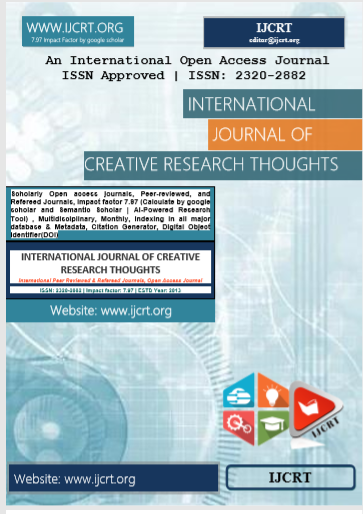
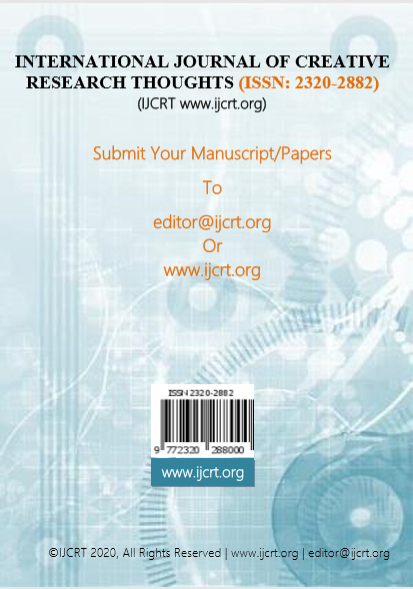
| IJCRT Journal front page | IJCRT Journal Back Page |
Paper Title: AI-Powered PlantDoc Bot For Early Crop Disease Detection
Author Name(s): Anish Patange, Sanket Lavhate, Soham Yadav, Chetan Aher
Published Paper ID: - IJCRT2604415
Register Paper ID - 305106
Publisher Journal Name: IJPUBLICATION, IJCRT
DOI Member ID: 10.6084/m9.doi.one.IJCRT2604415 and DOI : https://doi.org/10.56975/ijcrt.v14i4.305106
Author Country : Indian Author, India, 411028 , Pune, 411028 , | Research Area: Science and Technology Published Paper URL: http://ijcrt.org/viewfull.php?&p_id=IJCRT2604415 Published Paper PDF: download.php?file=IJCRT2604415 Published Paper PDF: http://www.ijcrt.org/papers/IJCRT2604415.pdf
Your Paper Publication Details:
Title: AI-POWERED PLANTDOC BOT FOR EARLY CROP DISEASE DETECTION
DOI (Digital Object Identifier) : https://doi.org/10.56975/ijcrt.v14i4.305106
Pubished in Volume: 14 | Issue: 4 | Year: April 2026
Publisher Name : IJCRT | www.ijcrt.org | ISSN : 2320-2882
Subject Area: Science and Technology
Author type: Indian Author
Pubished in Volume: 14
Issue: 4
Pages: d479-d486
Year: April 2026
Downloads: 267
E-ISSN Number: 2320-2882
Abstract
Every year, plant diseases cause large losses in crop yield, posing a serious threat to global food security. Effective intervention depends on a prompt and precise diagnosis of the disease, but farmers often lack access to specialists in plant pathology, particularly in rural areas. In order to help with plant disease diagnosis, this paper introduces PlantDocBot, a multimodal AI-driven chatbot that can accept both textual symptom descriptions and leaf images. The system combines Natural Language Processing (NLP) for symptom-based diagnosis and a Convolutional Neural Network (CNN) for image-based disease identification in an intuitive chat interface. The use of transfer learning (MobileNet/ResNet-based models) for effective image classification and a fine-tuned transformer (BERT-based) to understand symptoms reported by farmers are two important innovations. Once a disease has been identified, a treatment recommendation module suggests evidence-based treatments based on a carefully curated knowledge base. With a Streamkit-built frontend prototype that allows image upload and real-time communication, we deployed PlantDocBot using HuggingFace Transformers for natural language processing and TensorFlow for CNN model training. A brief user study reveals the chatbot's responses are pertinent and useful, and evaluation on benchmark datasets demonstrates high disease detection accuracy (up to 95% top-1 accuracy). Small-scale farmers can now access real-time, affordable diagnosis thanks to PlantDocBot's scalable approach to democratizing plant disease expertise. To further close the knowledge gap in agriculture, future work will investigate voice interfaces, multilingual support, and increased coverage of disease.
Licence: creative commons attribution 4.0
License
Creative Commons Attribution 4.0 and The Open Definition

Keywords
PlantDocBot, Plant disease classification, Computer vision in agriculture, BERT, Transfer learning, Smart farming
License
Creative Commons Attribution 4.0 and The Open Definition
Paper Title: AI-Based Farmer Query Support and Advisory System
Author Name(s): Yash Srivastava, Dr. Swati Patel
Published Paper ID: - IJCRT2604414
Register Paper ID - 305242
Publisher Journal Name: IJPUBLICATION, IJCRT
DOI Member ID: 10.6084/m9.doi.one.IJCRT2604414 and DOI : https://doi.org/10.56975/ijcrt.v14i4.305242
Author Country : Indian Author, India, 412207 , Pune, 412207 , | Research Area: Science and Technology Published Paper URL: http://ijcrt.org/viewfull.php?&p_id=IJCRT2604414 Published Paper PDF: download.php?file=IJCRT2604414 Published Paper PDF: http://www.ijcrt.org/papers/IJCRT2604414.pdf
Your Paper Publication Details:
Title: AI-BASED FARMER QUERY SUPPORT AND ADVISORY SYSTEM
DOI (Digital Object Identifier) : https://doi.org/10.56975/ijcrt.v14i4.305242
Pubished in Volume: 14 | Issue: 4 | Year: April 2026
Publisher Name : IJCRT | www.ijcrt.org | ISSN : 2320-2882
Subject Area: Science and Technology
Author type: Indian Author
Pubished in Volume: 14
Issue: 4
Pages: d469-d478
Year: April 2026
Downloads: 160
E-ISSN Number: 2320-2882
Abstract
The rapid evolution of digital agriculture had necessitated the development of intel-ligent systems that could bridge the in-formation gap for smallholder farmers. This project presents an AI-Based Farmer Query Support and Advisory System, a combined framework designed to provide real-time and data-driven agricultural guidance through advanced computational techniques. To leverage Large Language Models (LLMs) and Retrieval-Augmented Generation (RAG), this system ensures that queries related to crop management, pest control, and soil health are answered with high factual accuracy, minimizing the risks of AI hallucinations often found in standard generative models [1], [2], [11]. A core challenge in global agriculture is the linguistic barrier; as a result, this sys-tem implements multilingual and cross-lingual architectures to support low-resource languages, ensuring that farmers can interact in their native dialects while the system retrieves expert knowledge from scientifically validated English cor-pora [3], [8], [21]. To enhance the robust-ness of its recommendations, the frame-work utilizes Multi-Modal Fusion and IoT-based real-time data integration [9], [15]. This allows the "Advisory and Rec-ommendation Engine" to process diverse inputs , ranging from voice and text que-ries to real-time weather forecasts and soil sensor data , to generate site-specific ad-vice [4], [7], [22]. Furthermore, the system incorporates Deep Learning models, specifically Long Short-Term Memory (LSTM) and Gated Recurrent Units (GRU), to provide accu-rate agricultural commodity price fore-casting and yield predictions [5], [12]. This predictive capability empowers farmers with market intelligence and poli-cy scheme optimization, facilitating better financial decision-making [15], [19]. By ensuring accessibility in remote regions with limited connectivity, this architecture includes an Offline Edge AI framework, enabling localized processing of sensor data and immediate advisory delivery [6], [22]. The integration of a Feedback and Learn-ing Module creates a closed-loop system where user interactions and expert-vetted "Golden Q&A" datasets are used to itera-tively improve the model's performance [4], [11]. By combining state-of-the-art AI innovation with practical agricultural ex-tension needs, this system serves as a scalable roadmap for the digital transfor-mation of global agrifood systems, ulti-mately enhancing productivity, sustaina-bility, and food security for smallholder farmers [18], [20], [23].
Licence: creative commons attribution 4.0
License
Creative Commons Attribution 4.0 and The Open Definition
Keywords
Large Language Models (LLMs) [1, 21], Retrieval-Augmented Generation (RAG) [3, 23], Random Forest Classifier [2, 12], Nearest Neighbor [3, 21], Multi-Modal Fusion [15, 17], Agricultural Advisory System [7, 10], Voice-based Farmer Sup-port [8, 15], Smallholder Farmers [4, 11, 20], and Market Intelligence [5, 15].
License
Creative Commons Attribution 4.0 and The Open Definition
Paper Title: The Khumri System Prevalent in the Jaunsar-Bawar Region: A Critical Study
Author Name(s): RINKUDAS
Published Paper ID: - IJCRT2604413
Register Paper ID - 305444
Publisher Journal Name: IJPUBLICATION, IJCRT
DOI Member ID: 10.6084/m9.doi.one.IJCRT2604413 and DOI :
Author Country : Indian Author, India, 248196 , DEHRADUN, 248196 , | Research Area: Arts1 All Published Paper URL: http://ijcrt.org/viewfull.php?&p_id=IJCRT2604413 Published Paper PDF: download.php?file=IJCRT2604413 Published Paper PDF: http://www.ijcrt.org/papers/IJCRT2604413.pdf
Your Paper Publication Details:
Title: THE KHUMRI SYSTEM PREVALENT IN THE JAUNSAR-BAWAR REGION: A CRITICAL STUDY
DOI (Digital Object Identifier) :
Pubished in Volume: 14 | Issue: 4 | Year: April 2026
Publisher Name : IJCRT | www.ijcrt.org | ISSN : 2320-2882
Subject Area: Arts1 All
Author type: Indian Author
Pubished in Volume: 14
Issue: 4
Pages: d464-d468
Year: April 2026
Downloads: 117
E-ISSN Number: 2320-2882
Abstract
The Khumri System Prevalent in the Jaunsar-Bawar Region: A Critical Study
Licence: creative commons attribution 4.0
License
Creative Commons Attribution 4.0 and The Open Definition
Keywords
The Khumri System Prevalent in the Jaunsar-Bawar Region: A Critical Study
License
Creative Commons Attribution 4.0 and The Open Definition
Paper Title: Community as resources: Developing relationship between school and community
Author Name(s): Dr. Umakant Prasad, Sanjukta Sarkar
Published Paper ID: - IJCRT2604412
Register Paper ID - 305390
Publisher Journal Name: IJPUBLICATION, IJCRT
DOI Member ID: 10.6084/m9.doi.one.IJCRT2604412 and DOI : https://doi.org/10.56975/ijcrt.v14i4.305390
Author Country : Indian Author, India, 731235 , Bolpur, 731235 , | Research Area: Social Science All Published Paper URL: http://ijcrt.org/viewfull.php?&p_id=IJCRT2604412 Published Paper PDF: download.php?file=IJCRT2604412 Published Paper PDF: http://www.ijcrt.org/papers/IJCRT2604412.pdf
Your Paper Publication Details:
Title: COMMUNITY AS RESOURCES: DEVELOPING RELATIONSHIP BETWEEN SCHOOL AND COMMUNITY
DOI (Digital Object Identifier) : https://doi.org/10.56975/ijcrt.v14i4.305390
Pubished in Volume: 14 | Issue: 4 | Year: April 2026
Publisher Name : IJCRT | www.ijcrt.org | ISSN : 2320-2882
Subject Area: Social Science All
Author type: Indian Author
Pubished in Volume: 14
Issue: 4
Pages: d457-d463
Year: April 2026
Downloads: 118
E-ISSN Number: 2320-2882
Abstract
This study explores school-community partnerships to promote inclusive and quality education and to make inclusion more meaningfully successful as successful inclusive education requires mobilizing the cooperation of families, as well as the support of the community, voluntary organizations, and the general public. Leveraging community resources and local partnerships fosters high-quality educational and enrichment opportunities; this is because it broadens the scope of experiences typically offered to all students particularly those with special needs while simultaneously enhancing their access to local expertise (Kaushik, 2019). Parents should also play a role in formulating policies related to inclusion. They should be involved in supporting the changes necessary to develop inclusive schools. Teachers holding senior positions bear a responsibility toward the wider community as well; they should not only strive to improve or develop their own schools but also collaborate with stakeholders outside the school premises (Sharma, 2021). When families and communities stand united with educational institutions, they ensure that inclusion is not merely a policy mandate but a lived reality, providing every child, regardless of ability, with the equal opportunity to learn, grow, and thrive.
Licence: creative commons attribution 4.0
License
Creative Commons Attribution 4.0 and The Open Definition
Keywords
Inclusive education, Inclusive practices, School-community partnerships, Community resources, Family support
License
Creative Commons Attribution 4.0 and The Open Definition
Paper Title: AI-Based Post Bereavement Navigation System in India
Author Name(s): N. L. Sri Lasya, M. Joel Manohar, V. Jhansi Prakash, SK. Nagul Shareef, Ch. Chandra Mohan
Published Paper ID: - IJCRT2604411
Register Paper ID - 305273
Publisher Journal Name: IJPUBLICATION, IJCRT
DOI Member ID: 10.6084/m9.doi.one.IJCRT2604411 and DOI :
Author Country : Indian Author, India, 520007 , Vijayawada, 520007 , | Research Area: Science and Technology Published Paper URL: http://ijcrt.org/viewfull.php?&p_id=IJCRT2604411 Published Paper PDF: download.php?file=IJCRT2604411 Published Paper PDF: http://www.ijcrt.org/papers/IJCRT2604411.pdf
Your Paper Publication Details:
Title: AI-BASED POST BEREAVEMENT NAVIGATION SYSTEM IN INDIA
DOI (Digital Object Identifier) :
Pubished in Volume: 14 | Issue: 4 | Year: April 2026
Publisher Name : IJCRT | www.ijcrt.org | ISSN : 2320-2882
Subject Area: Science and Technology
Author type: Indian Author
Pubished in Volume: 14
Issue: 4
Pages: d450-d456
Year: April 2026
Downloads: 112
E-ISSN Number: 2320-2882
Abstract
Licence: creative commons attribution 4.0
License
Creative Commons Attribution 4.0 and The Open Definition
Keywords
Bereavement, Conversational AI, Retrieval-Augmented Generation, Financial Guidance, Digital Asset Management, Natural Language Processing, India.
License
Creative Commons Attribution 4.0 and The Open Definition
Paper Title: ENHANCING HIGHWAY BRIDGE SAFETY THROUGH ADVANCED WIRELESS SENSOR NETWORK-BASED MONITORING AND MAINTENANCE SYSTEM
Author Name(s): Janarthan P., Rajesh R., Ms.Vinitha M
Published Paper ID: - IJCRT2604410
Register Paper ID - 304880
Publisher Journal Name: IJPUBLICATION, IJCRT
DOI Member ID: 10.6084/m9.doi.one.IJCRT2604410 and DOI :
Author Country : Indian Author, India, 636453 , mettur, 636453 , | Research Area: Science and Technology Published Paper URL: http://ijcrt.org/viewfull.php?&p_id=IJCRT2604410 Published Paper PDF: download.php?file=IJCRT2604410 Published Paper PDF: http://www.ijcrt.org/papers/IJCRT2604410.pdf
Your Paper Publication Details:
Title: ENHANCING HIGHWAY BRIDGE SAFETY THROUGH ADVANCED WIRELESS SENSOR NETWORK-BASED MONITORING AND MAINTENANCE SYSTEM
DOI (Digital Object Identifier) :
Pubished in Volume: 14 | Issue: 4 | Year: April 2026
Publisher Name : IJCRT | www.ijcrt.org | ISSN : 2320-2882
Subject Area: Science and Technology
Author type: Indian Author
Pubished in Volume: 14
Issue: 4
Pages: d441-d449
Year: April 2026
Downloads: 110
E-ISSN Number: 2320-2882
Abstract
The safety and reliability of highway bridges are critical for modern transportation systems, as structural failures can lead to serious economic losses and safety hazards. This work proposes an advanced monitoring and maintenance framework based on Wireless Sensor Networks (WSNs) to continuously observe the structural health of highway bridges. In the proposed system, multiple sensors such as strain gauges, vibration sensors, temperature sensors, and displacement sensors are strategically installed on different parts of the bridge to collect real-time structural data. The sensed information is transmitted wirelessly to a central monitoring unit where embedded processing and data analysis techniques evaluate the bridge condition and detect abnormal structural behaviour at an early stage. The system enables continuous condition assessment, early fault detection, and predictive maintenance, thereby reducing the risk of sudden structural failure and minimizing maintenance costs. By integrating wireless communication, embedded processing, and real-time monitoring, the proposed approach significantly improves bridge safety, operational efficiency, and long-term infrastructure management.
Licence: creative commons attribution 4.0
License
Creative Commons Attribution 4.0 and The Open Definition
Keywords
Wireless Sensor Networks (WSN), Structural Health Monitoring, Bridge Safety, Embedded Monitoring System, Real-Time Data Acquisition, Vibration Sensors, Strain Measurement, Predictive Maintenance, Infrastructure Monitoring, Remote Bridge Monitoring.
License
Creative Commons Attribution 4.0 and The Open Definition
Paper Title: Yuva aur maanasik svaasthya
Author Name(s): Dr. Shalini Yadav
Published Paper ID: - IJCRT2604409
Register Paper ID - 304923
Publisher Journal Name: IJPUBLICATION, IJCRT
DOI Member ID: 10.6084/m9.doi.one.IJCRT2604409 and DOI : https://doi.org/10.56975/ijcrt.v14i4.304923
Author Country : Indian Author, India, 122003 , Gurugram, Haryana , 122003 , | Research Area: Arts1 All Published Paper URL: http://ijcrt.org/viewfull.php?&p_id=IJCRT2604409 Published Paper PDF: download.php?file=IJCRT2604409 Published Paper PDF: http://www.ijcrt.org/papers/IJCRT2604409.pdf
Your Paper Publication Details:
Title: YUVA AUR MAANASIK SVAASTHYA
DOI (Digital Object Identifier) : https://doi.org/10.56975/ijcrt.v14i4.304923
Pubished in Volume: 14 | Issue: 4 | Year: April 2026
Publisher Name : IJCRT | www.ijcrt.org | ISSN : 2320-2882
Subject Area: Arts1 All
Author type: Indian Author
Pubished in Volume: 14
Issue: 4
Pages: d437-d440
Year: April 2026
Downloads: 135
E-ISSN Number: 2320-2882
Abstract
Yuva aur maanasik svaasthya
Licence: creative commons attribution 4.0
License
Creative Commons Attribution 4.0 and The Open Definition
Keywords
Yuva aur maanasik svaasthya
License
Creative Commons Attribution 4.0 and The Open Definition
Paper Title: ROLE AND IMPACT OF GEOGRAPHICAL INDICATION LAW IN PROTECTING TRADITIONAL KNOWLEDGE
Author Name(s): Preet kasana, Dr. Kritika Nagpal
Published Paper ID: - IJCRT2604408
Register Paper ID - 305410
Publisher Journal Name: IJPUBLICATION, IJCRT
DOI Member ID: 10.6084/m9.doi.one.IJCRT2604408 and DOI :
Author Country : Indian Author, India, 201005 , Ghaziabad, 201005 , | Research Area: Others area Published Paper URL: http://ijcrt.org/viewfull.php?&p_id=IJCRT2604408 Published Paper PDF: download.php?file=IJCRT2604408 Published Paper PDF: http://www.ijcrt.org/papers/IJCRT2604408.pdf
Your Paper Publication Details:
Title: ROLE AND IMPACT OF GEOGRAPHICAL INDICATION LAW IN PROTECTING TRADITIONAL KNOWLEDGE
DOI (Digital Object Identifier) :
Pubished in Volume: 14 | Issue: 4 | Year: April 2026
Publisher Name : IJCRT | www.ijcrt.org | ISSN : 2320-2882
Subject Area: Others area
Author type: Indian Author
Pubished in Volume: 14
Issue: 4
Pages: d425-d436
Year: April 2026
Downloads: 123
E-ISSN Number: 2320-2882
Abstract
In the present paper, it has been argued how the law on Geographical Indications (GI) provides the best way of protecting Traditional Knowledge (TK). It has been illustrated with reference to the Indian legislation enacted to provide domestic protection to the GIs and its provisions which recognize GIs as a sui generis form of IPRs. Unlike any other Intellectual Property Right (IPR), the protection granted by GIs to an object rests upon a whole community instead of an individual. The evolution of the law on GIs starting from the Uruguay Round of GATT till the Doha Work Programme has been discussed in brief in order to demonstrate the ongoing conflict between the developed and developing countries over the extent of protection accorded to a GI object under the law. Further, criteria for the protection of TK under the GI have also been analyzed. The discussion is based on several aspects like equity and justice, protection of biological diversity, avoidance of biopiracy, etc. The interrelation between GI and TK has been established with respect to two types of protection, namely, constructive and defensive. Examples have been taken from the state of Assam (India) to illustrate how the registration of certain objects under GIs have not only provided economic incentives to the locals but also facilitated the transmission of traditional skills within generations as well as ensured community identification and self-governance. However, it must be pointed out that while GI provides a label or reputation to a product, it is not able to protect the knowledge base and the skill sets used in manufacturing the goods. Finally, it has been concluded that even though GI may not replace TK completely, the former should be treated as an important complement to the latter in ensuring adequate protection. In fact, GI law must be made more robust in consonance with the overall intellectual property rights regime.
Licence: creative commons attribution 4.0
License
Creative Commons Attribution 4.0 and The Open Definition
Keywords
Geographical Indications, Traditional Knowledge, TRIPS Agreement, Intellectual Property Rights, Biopiracy, Cultural Heritage, GI Act 1999, Muga Silk, Assam, Sui Generis Protection
License
Creative Commons Attribution 4.0 and The Open Definition
Paper Title: Justice and Social Order: Plato's Ideal State vs. the Indian Caste Structure
Author Name(s): Dr.Binay krishna Roy
Published Paper ID: - IJCRT2604407
Register Paper ID - 305591
Publisher Journal Name: IJPUBLICATION, IJCRT
DOI Member ID: 10.6084/m9.doi.one.IJCRT2604407 and DOI :
Author Country : Indian Author, India, 721444 , SHIULIBAR, 721444 , | Research Area: Arts1 All Published Paper URL: http://ijcrt.org/viewfull.php?&p_id=IJCRT2604407 Published Paper PDF: download.php?file=IJCRT2604407 Published Paper PDF: http://www.ijcrt.org/papers/IJCRT2604407.pdf
Your Paper Publication Details:
Title: JUSTICE AND SOCIAL ORDER: PLATO'S IDEAL STATE VS. THE INDIAN CASTE STRUCTURE
DOI (Digital Object Identifier) :
Pubished in Volume: 14 | Issue: 4 | Year: April 2026
Publisher Name : IJCRT | www.ijcrt.org | ISSN : 2320-2882
Subject Area: Arts1 All
Author type: Indian Author
Pubished in Volume: 14
Issue: 4
Pages: d417-d424
Year: April 2026
Downloads: 140
E-ISSN Number: 2320-2882
Abstract
This paper examines whether Plato's theory of class, as presented in The Republic, can be used to justify the Indian caste system. Plato divides society into three classes--rulers, auxiliaries, and producers--based on natural ability and the principle of justice, where each person performs the role best suited to their nature. Similarly, the Indian caste system (varna system) also organizes society into hierarchical groups with specific duties. At a superficial level, both systems appear similar because they emphasize division of labour and social order. However, this paper argues that the philosophical foundations of the two are significantly different. Plato's model allows for mobility based on merit and education, whereas the caste system is largely hereditary and rigid. Moreover, Plato's idea of justice is rooted in harmony and efficiency, while the caste system has historically been associated with social inequality and exclusion. By revisiting Plato in the Indian context, this study critically evaluates whether his class theory can genuinely justify caste. It concludes that although there are structural similarities, Plato's theory cannot be used to defend the caste system in its traditional form.
Licence: creative commons attribution 4.0
License
Creative Commons Attribution 4.0 and The Open Definition
Keywords
Key Words: Ambedkar,caste, class, justice, Plato
License
Creative Commons Attribution 4.0 and The Open Definition
Paper Title: Rabindranath Tagore and Women's Empowerment
Author Name(s): Dr Divya Singh
Published Paper ID: - IJCRT2604406
Register Paper ID - 305080
Publisher Journal Name: IJPUBLICATION, IJCRT
DOI Member ID: 10.6084/m9.doi.one.IJCRT2604406 and DOI : https://doi.org/10.56975/ijcrt.v14i4.305080
Author Country : Indian Author, India, 211002 , Allahabad, 211002 , | Research Area: Arts All Published Paper URL: http://ijcrt.org/viewfull.php?&p_id=IJCRT2604406 Published Paper PDF: download.php?file=IJCRT2604406 Published Paper PDF: http://www.ijcrt.org/papers/IJCRT2604406.pdf
Your Paper Publication Details:
Title: RABINDRANATH TAGORE AND WOMEN'S EMPOWERMENT
DOI (Digital Object Identifier) : https://doi.org/10.56975/ijcrt.v14i4.305080
Pubished in Volume: 14 | Issue: 4 | Year: April 2026
Publisher Name : IJCRT | www.ijcrt.org | ISSN : 2320-2882
Subject Area: Arts All
Author type: Indian Author
Pubished in Volume: 14
Issue: 4
Pages: d409-d416
Year: April 2026
Downloads: 155
E-ISSN Number: 2320-2882
Abstract
Rabindranath Tagore, India's most celebrated literary figure, was far more than a poet and novelist. He was a visionary thinker who championed women's empowerment in colonial India when such advocacy was revolutionary. This paper examines Tagore's philosophy on women's rights and development through an analysis of his writings. The paper traces the introduction of the concept of true liberation for women through education and independence, showing how Tagore worked toward challenging societal norms that confined women to domestic roles. It explores how Tagore envisioned building women's strength and identity beyond traditional expectations. The paper analyzes his concept of the new woman, educated, independent, and socially conscious, as a transformative force for Indian society. Through examination of notable quotes on women, the paper demonstrates how Tagore articulated a vision grounded in voices of strength and autonomy. The paper presents women's empowerment in the words of Rabindranath Tagore, showing his multifaceted approach to gender equality. The discussion section synthesizes Tagore's interconnected ideas about education, economic independence, and intellectual freedom. The paper concludes with suggestions that Tagore's nineteenth-century vision remains deeply relevant to contemporary struggles for women's empowerment.
Licence: creative commons attribution 4.0
License
Creative Commons Attribution 4.0 and The Open Definition
Keywords
Rabindranath Tagore, women's empowerment, true liberation, education, challenging societal norms, gender equality.
License
Creative Commons Attribution 4.0 and The Open Definition
Call For Paper September 2026
Call For Papers
September 2026
Volume 14 | Issue 9
Last Date :
31-Oct-2026
Submit Manuscript Online Impact Factor: 7.97 Review Results : Within 02-03 Days Paper Publication : Within 02-03 Days
September 2026
Volume 14 | Issue 9
Last Date :
31-Oct-2026
Submit Manuscript Online Impact Factor: 7.97 Review Results : Within 02-03 Days Paper Publication : Within 02-03 Days
Published Issue Details
For Authors
Forms / Downloads
Other IMP Links
Indexing Partner
Research Area
LICENSE





ISSN and 7.97 Impact Factor Details
ISSN: 2320-2882 Impact Factor: 7.97 and ISSN APPROVED Journal Starting Year (ESTD) : 2013


ISSN and 7.97 Impact Factor Details
ISSN: 2320-2882 Impact Factor: 7.97 and ISSN APPROVED Journal Starting Year (ESTD) : 2013
DOI Details
CONFERENCE
CONFERENCE MANAGMENT & PUBLICATION CONFERENCE PROPOSAL
RECENT CONFERENCE

CONFERENCE PROPOSAL CONFERENCE PROCEEDINGS
CONFERENCE PROPOSAL CONFERENCE PROCEEDINGS
For Reviewer /Referral (RMS) Earn 500 per paper
Important Links
NEWS & Conference
Digital Library
IJCRT RMS | Earn 500 Per Paper.

Open Access


LICENSE
Indexing Partner
Scholarly open access journals, Peer-reviewed, and Refereed Journals, Impact factor 7.97 (Calculate by google scholar and Semantic Scholar | AI-Powered Research Tool) , Multidisciplinary, Monthly, Indexing in all major database & Metadata, Citation Generator, Digital Object Identifier(DOI)