Important Details
IJCRT - International Peer Reviewed, Open Access Journal, Multidisciplinary, Monthly, Nominal(Low) Fees for Professional Research Services International Journal of Creative Research Thoughts - IJCRT Peer Review Journal, Refereed Journal, Peer Reviewed Journal , Referred Journal and Indexed Journal, Open access, Online and Print Journal,international Journal Open Access, Accepted by Indian and foreign university ,IJCRT Followed Norms, guidelines, requirement, listing criteria and methodology of score/point also applied from: Scopus , Web of Science , UGC Approved , UGC CARE, UGC-CARE .
UGC Approved Journal No: 49023 (18)
UGC approval Link
https://ijcrt.org/ugc%20approval.jpg
All Policy and Approval
Please Like Our Facebook Page | CrossRef DOI and Hard copy of Certificate Provide if required. | www.IJCRT.org | editor@IJCRT.org | IJCRT WhatsApp +91 94294 58311
Publication Details:
- Paper Submission : 31-Oct-2026. Call For Paper (Volume 14 | Issue 9 | Month- September 2026)
- Acceptance/Rejection Notification: Within 02-04 Days.
- Paper Publish: Within 02-04 Days after submitting all documents.
-
Submit Your Paper Any time There No deadline.
-
Publication fees : 1570 INR for Indian author & 59$ for foreign International author.
Please Like Our Facebook Page | CrossRef DOI and Hard copy of Certificate Provide if required.
Licence and Indexing
Indexing In Google Scholar, SSRN, ResearcherID-Publons, Semantic Scholar | AI-Powered Research Tool, Microsoft Academic, Academia.edu, arXiv.org, Research Gate, CiteSeerX, ResearcherID Thomson Reuters, Mendeley : reference manager, DocStoc, ISSUU, Scribd, and many more | High Impact Factor: 7.97 | Digital object identifier (DOI) and Hard Copy of certificate Provided.



























Licence
DOI
ISSN Approved impact factor: 7.97 
Creative Common 
Valid as per new UGC Gazette regulations 

INTERNATIONAL JOURNAL OF CREATIVE RESEARCH THOUGHTS - IJCRT (IJCRT.ORG)
International Peer Reviewed & Refereed Journals, Open Access Journal
IJCRT Peer-Reviewed (Refereed) Journal as Per New UGC Rules.
ISSN Approved Journal No: 2320-2882 | Impact factor: 7.97 | ESTD Year: 2013
Call For Paper - Volume 14 | Issue 9 | Month- September 2026
Scholarly open access journals, Peer-reviewed, and Refereed Journals, Impact factor 7.97 (Calculate by google scholar and Semantic Scholar | AI-Powered Research Tool) , Multidisciplinary, Monthly, Indexing in all major database & Metadata, Citation Generator, Digital Object Identifier(CrossRef DOI)
IJCRT WhatsApp Contact
IJCRT Search Xplore - Search all paper by Paper Name , Author Name, and Title
Volume 13 | Issue 4 |
Volume 13 | Issue 4 | Month
Downlaod After Publication 1) Table of content index in PDF
2) Table of content index in HTML 2)Table of content index in HTML
3) Front Page 3) Front Page
4) Back Page 4) Back Page
5) Editor Board Member 5)Editor Board Member
6) OLD Style Issue 6)OLD Style Issue
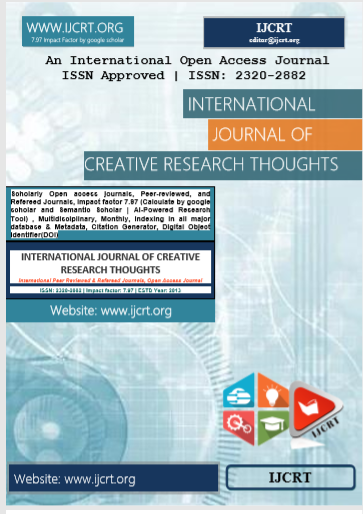 |
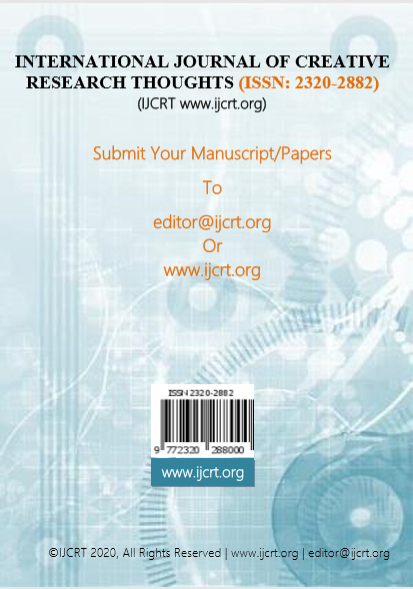 |
|---|---|
| IJCRT Journal front page | IJCRT Journal Back Page |
Paper Title: Assessment and Exploring of Women's Safety using Machine Learning Techniques
Author Name(s): Bhavana Sunil Jadhav, Prof. Manisha Patil, Dr.Geetika Narang, Prof. Rutika Shah
Published Paper ID: - IJCRT2504853
Register Paper ID - 282605
Publisher Journal Name: IJPUBLICATION, IJCRT
DOI Member ID: 10.6084/m9.doi.one.IJCRT2504853 and DOI :
Author Country : Indian Author, India, 415010 , Satara, 415010 , | Research Area: Science and Technology Published Paper URL: http://ijcrt.org/viewfull.php?&p_id=IJCRT2504853 Published Paper PDF: download.php?file=IJCRT2504853 Published Paper PDF: http://www.ijcrt.org/papers/IJCRT2504853.pdf
Your Paper Publication Details:
Title: ASSESSMENT AND EXPLORING OF WOMEN'S SAFETY USING MACHINE LEARNING TECHNIQUES
DOI (Digital Object Identifier) :
Pubished in Volume: 13 | Issue: 4 | Year: April 2025
Publisher Name : IJCRT | www.ijcrt.org | ISSN : 2320-2882
Subject Area: Science and Technology
Author type: Indian Author
Pubished in Volume: 13
Issue: 4
Pages: h217-h220
Year: April 2025
Downloads: 213
E-ISSN Number: 2320-2882
Abstract
Women's safety is a critical concern in modern society, and leveraging machine learning (ML) technologies offers innovative solutions to enhance personal security. This paper explores the application of machine learning for real-time detection of dangerous or threatening situations, aimed at improving the safety of women. The proposed system integrates various techniques such as computer vision, audio analysis, wearable sensors, and natural language processing to detect potential risks, including physical assaults, verbal threats, and abnormal behavior. Machine learning models analyze real-time data, such as video feeds, audio signals, and motion patterns from wearable devices, to identify distress signals and trigger immediate alerts. In addition, geofencing and behavioral prediction models enable proactive monitoring of users' movements, sending notifications if dangerous situations are detected or if a user deviates from safe routines. While promising, the system faces challenges related to data privacy, accuracy, and real-time processing requirements. Despite these challenges, machine learning presents a transformative opportunity to enhance women's safety, offering efficient, scalable, and personalized protection through automated threat detection and immediate emergency response mechanisms.
Licence: creative commons attribution 4.0
License
Creative Commons Attribution 4.0 and The Open Definition

Keywords
Machine Learning, Artificial Intelligence, Natural Language Processing
License
Creative Commons Attribution 4.0 and The Open Definition
Paper Title: The Interrelationship of Economy and Justice Dispensation in India
Author Name(s): Anupama Goel, Padmaja Dubey
Published Paper ID: - IJCRT2504852
Register Paper ID - 280740
Publisher Journal Name: IJPUBLICATION, IJCRT
DOI Member ID: 10.6084/m9.doi.one.IJCRT2504852 and DOI :
Author Country : Indian Author, India, 110078 , New Delhi, 110078 , | Research Area: Social Science All Published Paper URL: http://ijcrt.org/viewfull.php?&p_id=IJCRT2504852 Published Paper PDF: download.php?file=IJCRT2504852 Published Paper PDF: http://www.ijcrt.org/papers/IJCRT2504852.pdf
Your Paper Publication Details:
Title: THE INTERRELATIONSHIP OF ECONOMY AND JUSTICE DISPENSATION IN INDIA
DOI (Digital Object Identifier) :
Pubished in Volume: 13 | Issue: 4 | Year: April 2025
Publisher Name : IJCRT | www.ijcrt.org | ISSN : 2320-2882
Subject Area: Social Science All
Author type: Indian Author
Pubished in Volume: 13
Issue: 4
Pages: h210-h216
Year: April 2025
Downloads: 189
E-ISSN Number: 2320-2882
Abstract
The intricate interplay between economic systems and judicial mechanisms has significantly shaped the dispensation of justice in India, reflecting the socio-economic and cultural evolution of the country. This research explores the historical progression of this dynamic relationship, from the community-centric practices of ancient India to the exploitative judicial policies of colonial rule, and the judiciary's pivotal role in post-independence economic reforms and liberalization. The study highlights how ancient texts like the Dharmashastras and Kautilya's Arthashastra enshrined principles of economic equity and legal fairness, promoting community trust through localized dispute resolution. The colonial era, however, disrupted these practices, prioritizing mercantile interests over indigenous rights. In post-independence India, the judiciary emerged as a custodian of socio-economic justice, balancing constitutional mandates with economic reforms. As globalization and digitalization reshape economic paradigms, the judiciary faces new challenges, such as regulating cryptocurrencies, addressing gig economy disputes, and safeguarding intellectual property in a globalized market. This paper underscores the judiciary's adaptability and its enduring commitment to justice and equity amidst economic transitions. The findings advocate for enhanced judicial capacity-building, adoption of technology-driven solutions, and strengthened alternative dispute resolution mechanisms to uphold justice in a rapidly evolving economic landscape.
Licence: creative commons attribution 4.0
License
Creative Commons Attribution 4.0 and The Open Definition
Keywords
Economy, judicial system, socio-economic justice
License
Creative Commons Attribution 4.0 and The Open Definition
Paper Title: Smart Trash Manager
Author Name(s): Shubham Mengade, Vedant Mandavkar, Uday Kawde, Rahul Panchal, Roshani Bhaskarwar
Published Paper ID: - IJCRT2504851
Register Paper ID - 282596
Publisher Journal Name: IJPUBLICATION, IJCRT
DOI Member ID: 10.6084/m9.doi.one.IJCRT2504851 and DOI :
Author Country : Indian Author, India, 400708 , Navi Mumbai, 400708 , | Research Area: Science and Technology Published Paper URL: http://ijcrt.org/viewfull.php?&p_id=IJCRT2504851 Published Paper PDF: download.php?file=IJCRT2504851 Published Paper PDF: http://www.ijcrt.org/papers/IJCRT2504851.pdf
Your Paper Publication Details:
Title: SMART TRASH MANAGER
DOI (Digital Object Identifier) :
Pubished in Volume: 13 | Issue: 4 | Year: April 2025
Publisher Name : IJCRT | www.ijcrt.org | ISSN : 2320-2882
Subject Area: Science and Technology
Author type: Indian Author
Pubished in Volume: 13
Issue: 4
Pages: h201-h209
Year: April 2025
Downloads: 216
E-ISSN Number: 2320-2882
Abstract
Increasing population and density are making conventional garbage collection procedures inefficient. Overflowing public bins harm both people and nature. This paper presents a Smart Trash Manager System which solves these problems by using a centralized system integrated with IoT. It enables live monitoring of bin levels, their GPS location, and automated alerts before reaching capacity of bins. The developed system works with smart bins which have a Node MCU microcontroller. Smart bin uses ultrasonic sensors for filled level data, GPS module for geolocation and Twilio for SMS Alerts to respective worker. The alerts are also visible on system dashboard which is overviewed by Municipal officer, from the office. The Software Interface have multiple functional pages including but not limited to live bin statuses in an interactive map, worker data analytics, live bin monitoring list, attendance. The solution also considers municipal corporation workers and supervisors by providing a centralized system, thus streamlining the collection process, resulting in saving time and energy.
Licence: creative commons attribution 4.0
License
Creative Commons Attribution 4.0 and The Open Definition
Keywords
Internet of Things (IoT), Municipal solid waste, Smart Cities, Smart waste management, Sustainability
License
Creative Commons Attribution 4.0 and The Open Definition
Paper Title: Conformational Plasticity Of Amino Acids: A computational Review Of Small Molecule Interactions
Author Name(s): Dr Anita Kabi
Published Paper ID: - IJCRT2504850
Register Paper ID - 282630
Publisher Journal Name: IJPUBLICATION, IJCRT
DOI Member ID: 10.6084/m9.doi.one.IJCRT2504850 and DOI : http://doi.one/10.1729/Journal.44823
Author Country : Indian Author, India, 768019 , Sambalpur, 768019 , | Research Area: Chemistry All Published Paper URL: http://ijcrt.org/viewfull.php?&p_id=IJCRT2504850 Published Paper PDF: download.php?file=IJCRT2504850 Published Paper PDF: http://www.ijcrt.org/papers/IJCRT2504850.pdf
Your Paper Publication Details:
Title: CONFORMATIONAL PLASTICITY OF AMINO ACIDS: A COMPUTATIONAL REVIEW OF SMALL MOLECULE INTERACTIONS
DOI (Digital Object Identifier) : http://doi.one/10.1729/Journal.44823
Pubished in Volume: 13 | Issue: 4 | Year: April 2025
Publisher Name : IJCRT | www.ijcrt.org | ISSN : 2320-2882
Subject Area: Chemistry All
Author type: Indian Author
Pubished in Volume: 13
Issue: 4
Pages: h185-h200
Year: April 2025
Downloads: 217
E-ISSN Number: 2320-2882
Abstract
The basic building blocks of proteins, amino acids, have dynamic conformational flexibility that has a big impact on biological structure and function with small molecules can modulate these conformations, leading to altered biochemical behavior with implications in drug design, enzymatic regulation, and molecular recognition. This review presents a comprehensive computational investigation into the conformational changes of amino acids induced by small molecule interactions. Utilizing molecular dynamics (MD) simulations, quantum mechanical (QM) calculations, and hybrid QM/MM approaches, we explore how non-covalent interactions--such as hydrogen bonding, ?-? stacking, and van der Waals forces--affect the torsional angles and side-chain orientations of amino acids in isolated and solvated environments. Emphasis is placed on the role of solvent effects, energy landscapes, and potential energy surface (PES) mapping in elucidating these conformational shifts. Case studies involving biologically relevant ligands demonstrate the diverse effects of small molecules on the structural plasticity of amino acids. By integrating data from recent computational studies, this review highlights emerging trends, methodological advancements, and key challenges in the field. The findings provide critical insights for rational drug design, peptide engineering, and understanding protein-ligand interactions at the molecular level.
Licence: creative commons attribution 4.0
License
Creative Commons Attribution 4.0 and The Open Definition
Keywords
Amino Acid Conformational Changes, Small Molecule Interaction Computational Chemistry, Molecular Dynamics Simulations, Quantum Mechanical Studies, Protein-Ligand Interactions, Conformational Flexibility, Non-Covalent Interactions, QM/MM Methods, Drug Design Insights, Structural Biology, Energy Landscape Analysis, Bioinformatics, Molecular Modeling, Theoretical Chemistry
License
Creative Commons Attribution 4.0 and The Open Definition
Paper Title: Transportation Info Management System And Smart Bus Attendance System Using RFID & Google Firebase
Author Name(s): Thota Sampath, Malladi Yasaswini, Tumati Sumanth, Vemula Sahithi, Tella Sumallika
Published Paper ID: - IJCRT2504849
Register Paper ID - 282274
Publisher Journal Name: IJPUBLICATION, IJCRT
DOI Member ID: 10.6084/m9.doi.one.IJCRT2504849 and DOI :
Author Country : Indian Author, India, 521330 , Gudlavalleru, 521330 , | Research Area: Science and Technology Published Paper URL: http://ijcrt.org/viewfull.php?&p_id=IJCRT2504849 Published Paper PDF: download.php?file=IJCRT2504849 Published Paper PDF: http://www.ijcrt.org/papers/IJCRT2504849.pdf
Your Paper Publication Details:
Title: TRANSPORTATION INFO MANAGEMENT SYSTEM AND SMART BUS ATTENDANCE SYSTEM USING RFID & GOOGLE FIREBASE
DOI (Digital Object Identifier) :
Pubished in Volume: 13 | Issue: 4 | Year: April 2025
Publisher Name : IJCRT | www.ijcrt.org | ISSN : 2320-2882
Subject Area: Science and Technology
Author type: Indian Author
Pubished in Volume: 13
Issue: 4
Pages: h180-h184
Year: April 2025
Downloads: 200
E-ISSN Number: 2320-2882
Abstract
This paper presents the development of a Smart Bus Attendance and Transportation Management System using RFID technology and Google Firebase that streamlines student transportation management in educational institutions. Traditional manual attendance systems are prone to errors and inefficiencies; our proposed solution offers real-time attendance logging, automated E-Pass generation, and centralized data access for students and administrators. Each student carries an RFID tag scanned at boarding and deboarding, with the data instantly stored and updated in Firebase. The integration of bar-code scanning enhances identity verification, while the dashboard allows route analysis, performance monitoring, and secure data retrieval. Designed with scalability and usability in mind, the system supports both mobile and web access, ensuring better communication, reduced administrative workload, and increased transport security. This solution represents a modern, cost-effective approach to automate student transportation, enabling data-driven decisions and improving overall operational efficiency.
Licence: creative commons attribution 4.0
License
Creative Commons Attribution 4.0 and The Open Definition
Keywords
RFID Technology, Google Firebase, Real-Time Monitoring, ESP32 Micro-controller, Cloud-Based Attendance System.
License
Creative Commons Attribution 4.0 and The Open Definition
Paper Title: Comparative Analysis Of Trauma And Resistance By Juxtaposing Graphic Novels Maus And Bhimayana
Author Name(s): Asmita Debnath, Kavya Purushothaman
Published Paper ID: - IJCRT2504848
Register Paper ID - 282486
Publisher Journal Name: IJPUBLICATION, IJCRT
DOI Member ID: 10.6084/m9.doi.one.IJCRT2504848 and DOI :
Author Country : Indian Author, India, 700036 , Kolkata, 700036 , | Research Area: Medical Science All Published Paper URL: http://ijcrt.org/viewfull.php?&p_id=IJCRT2504848 Published Paper PDF: download.php?file=IJCRT2504848 Published Paper PDF: http://www.ijcrt.org/papers/IJCRT2504848.pdf
Your Paper Publication Details:
Title: COMPARATIVE ANALYSIS OF TRAUMA AND RESISTANCE BY JUXTAPOSING GRAPHIC NOVELS MAUS AND BHIMAYANA
DOI (Digital Object Identifier) :
Pubished in Volume: 13 | Issue: 4 | Year: April 2025
Publisher Name : IJCRT | www.ijcrt.org | ISSN : 2320-2882
Subject Area: Medical Science All
Author type: Indian Author
Pubished in Volume: 13
Issue: 4
Pages: h174-h179
Year: April 2025
Downloads: 191
E-ISSN Number: 2320-2882
Abstract
Graphic novels have emerged as competent tools for documenting trauma and resistance, through unique ways of depicting marginalized histories. This paper simultaneously examines Art Spiegelman's novel Maus and Srividya Natarajan and S. Anand's Bhimayana as acts of resistance literature, exploring how they use visual storytelling to represent oppression, memory, and inherited trauma. Bhimayana uses the Tribal Pardhan Gond art form to highlight caste-based discrimination of the Untouchables in India. Whereas, Maus employs documentary-style realism to narrate the Holocaust's lasting impact on an individual. Through a comparative analysis of their artistic styles, this study argues that Maus and Bhimayana not only document historical injustices but also pose as counter-narratives that resist erasure and demand social awareness. By bridging trauma studies and visual culture, this paper contributes to the increasing discourse on marginalized voices in literature and the political significance of graphic storytelling.
Licence: creative commons attribution 4.0
License
Creative Commons Attribution 4.0 and The Open Definition
Keywords
Visual narratives, Trauma, Resistance, Memory, Oppression, Counter Narratives
License
Creative Commons Attribution 4.0 and The Open Definition
Paper Title: Geopolitical Challenges and Strategic Dynamics of India-Nepal Relations Amidst China's Expanding Influence
Author Name(s): Sanjana Gupta, Dr Nilanjana Saha
Published Paper ID: - IJCRT2504847
Register Paper ID - 282279
Publisher Journal Name: IJPUBLICATION, IJCRT
DOI Member ID: 10.6084/m9.doi.one.IJCRT2504847 and DOI :
Author Country : Indian Author, India, 201017 , Ghaziabad , 201017 , | Research Area: Social Science All Published Paper URL: http://ijcrt.org/viewfull.php?&p_id=IJCRT2504847 Published Paper PDF: download.php?file=IJCRT2504847 Published Paper PDF: http://www.ijcrt.org/papers/IJCRT2504847.pdf
Your Paper Publication Details:
Title: GEOPOLITICAL CHALLENGES AND STRATEGIC DYNAMICS OF INDIA-NEPAL RELATIONS AMIDST CHINA'S EXPANDING INFLUENCE
DOI (Digital Object Identifier) :
Pubished in Volume: 13 | Issue: 4 | Year: April 2025
Publisher Name : IJCRT | www.ijcrt.org | ISSN : 2320-2882
Subject Area: Social Science All
Author type: Indian Author
Pubished in Volume: 13
Issue: 4
Pages: h166-h173
Year: April 2025
Downloads: 202
E-ISSN Number: 2320-2882
Abstract
This paper explores the evolving geopolitical and strategic dimensions of India-Nepal relations in the context of China's growing influence in South Asia. Rooted in deep historical, cultural, and geographical ties, India and Nepal have traditionally enjoyed close bilateral relations. However, the recent shift in Nepal's foreign policy orientation, marked by increased economic, diplomatic, and military engagement with China particularly through the Belt and Road Initiative which has introduced new complexities to this dynamic. The paper analyzes the historical foundations of India-Nepal ties, the strategic implications of China's expansive presence in Nepal, and the consequent geopolitical challenges India faces. It further examines Nepal's balancing act in leveraging both relationships to advance its national interests. Finally, the study discusses potential future scenarios, emphasizing the prospects for trilateral cooperation to mitigate regional tensions and foster sustainable development. Through a critical assessment of contemporary developments, the paper underscores the importance of recalibrating India's strategic approach to maintain its traditional influence while accommodating shifting regional dynamics.
Licence: creative commons attribution 4.0
License
Creative Commons Attribution 4.0 and The Open Definition
Keywords
Belt and Road Initiative (BRI), Neighbourhood First Policy, Trilateral Cooperation, Border Disputes, Development Diplomacy, Foreign Policy Balancing,Soft Power Influence
License
Creative Commons Attribution 4.0 and The Open Definition
Paper Title: Exploring the Role of Metacognitive Skills in Enhancing Academic Performance
Author Name(s): KM DEEPSHIKHA SILMANA, Dr. Mamta Bhardwaj
Published Paper ID: - IJCRT2504846
Register Paper ID - 282266
Publisher Journal Name: IJPUBLICATION, IJCRT
DOI Member ID: 10.6084/m9.doi.one.IJCRT2504846 and DOI : https://doi.org/10.56975/ijcrt.v13i4.282266
Author Country : Indian Author, India, 246001 , PAURI, 246001 , | Research Area: Social Science All Published Paper URL: http://ijcrt.org/viewfull.php?&p_id=IJCRT2504846 Published Paper PDF: download.php?file=IJCRT2504846 Published Paper PDF: http://www.ijcrt.org/papers/IJCRT2504846.pdf
Your Paper Publication Details:
Title: EXPLORING THE ROLE OF METACOGNITIVE SKILLS IN ENHANCING ACADEMIC PERFORMANCE
DOI (Digital Object Identifier) : https://doi.org/10.56975/ijcrt.v13i4.282266
Pubished in Volume: 13 | Issue: 4 | Year: April 2025
Publisher Name : IJCRT | www.ijcrt.org | ISSN : 2320-2882
Subject Area: Social Science All
Author type: Indian Author
Pubished in Volume: 13
Issue: 4
Pages: h159-h165
Year: April 2025
Downloads: 251
E-ISSN Number: 2320-2882
Abstract
Understanding and being aware of our learning processes is crucial for achieving academic success. It is of utmost importance to develop metacognitive skills that allow us to improve how we learn and think, leading to even better accomplishments in our educational journey. These incredible skills provide us with a deep level of understanding regarding what works best for us individually, enabling us to adapt more effectively to different tasks. By becoming masters of metacognition, we enhance our ability to manage our learning and make intelligent decisions about which strategies to employ while considering our unique goals and preferences. Furthermore, when we possess strong metacognitive skills, we elevate our critical thinking abilities and become incredibly discerning when evaluating the vast array of information that we encounter. With the power of metacognition, we can effectively tackle complex problems, leading to improved problem-solving abilities and fostering resilience and confidence within ourselves. Moreover, the cultivation of metacognitive skills extends its benefits far beyond the realm of academics, as these skills prove to be instrumental in lifelong learning. The ability to think introspectively and tailor our learning approaches to suit our strengths and weaknesses proves incredibly advantageous as we pursue higher education and actively engage in professional endeavors. In conclusion, developing metacognitive skills plays a crucial role in achieving academic success, while also preparing us to gracefully navigate the complexities of the modern world as individuals committed to lifelong learning.
Licence: creative commons attribution 4.0
License
Creative Commons Attribution 4.0 and The Open Definition
Keywords
Metacognition, metacognitive skill, academic performance, different learning environments, etc.
License
Creative Commons Attribution 4.0 and The Open Definition
Paper Title: Campus Collab
Author Name(s): Piyush Jha, Sahil Wadhwana, Nitish Choudhary, Satyam Jha, Sheetal Mahadik
Published Paper ID: - IJCRT2504845
Register Paper ID - 282677
Publisher Journal Name: IJPUBLICATION, IJCRT
DOI Member ID: 10.6084/m9.doi.one.IJCRT2504845 and DOI :
Author Country : Indian Author, India, 401305 , Mumbai, 401305 , | Research Area: Science and Technology Published Paper URL: http://ijcrt.org/viewfull.php?&p_id=IJCRT2504845 Published Paper PDF: download.php?file=IJCRT2504845 Published Paper PDF: http://www.ijcrt.org/papers/IJCRT2504845.pdf
Your Paper Publication Details:
Title: CAMPUS COLLAB
DOI (Digital Object Identifier) :
Pubished in Volume: 13 | Issue: 4 | Year: April 2025
Publisher Name : IJCRT | www.ijcrt.org | ISSN : 2320-2882
Subject Area: Science and Technology
Author type: Indian Author
Pubished in Volume: 13
Issue: 4
Pages: h152-h158
Year: April 2025
Downloads: 192
E-ISSN Number: 2320-2882
Abstract
Campus Collab is a web-based platform designed to streamline the process of uploading, sharing, and managing academic projects for college students. It provides a centralized and structured system where students can showcase their work, find collaborators, and receive feedback from peers and faculty. Built using modern web technologies such as React.js, Node.js, Express.js, and MongoDB, the platform ensures scalability, efficiency, and an intuitive user experience. Key features include project upload and management, interactive feedback mechanisms, user profiles, and a responsive design for seamless accessibility across devices. By fostering collaboration and engagement within the academic community, Campus Collab enhances learning experiences and simplifies project management, ultimately creating a dynamic ecosystem for students and educators to interact, innovate, and grow.
Licence: creative commons attribution 4.0
License
Creative Commons Attribution 4.0 and The Open Definition
Keywords
Student Collaboration, Project Sharing Platform, User Profile Management, RESTful APIs, File Upload System, Frontend and Backend Integration, CRUD Operations, JWT Authentication, MERN Stack
License
Creative Commons Attribution 4.0 and The Open Definition
Paper Title: An Intelligent Attendance System Based On Convolutional Neural Networks For Real-Time Multiple Student Face Identifications
Author Name(s): Ms.Sonali Salunkhe, Prof. Rupali Maske, Prof. Barkha M. Shahaji, Prof. Vishal Shinde
Published Paper ID: - IJCRT2504844
Register Paper ID - 282577
Publisher Journal Name: IJPUBLICATION, IJCRT
DOI Member ID: 10.6084/m9.doi.one.IJCRT2504844 and DOI :
Author Country : Indian Author, India, 415002 , Satara, 415002 , | Research Area: Science and Technology Published Paper URL: http://ijcrt.org/viewfull.php?&p_id=IJCRT2504844 Published Paper PDF: download.php?file=IJCRT2504844 Published Paper PDF: http://www.ijcrt.org/papers/IJCRT2504844.pdf
Your Paper Publication Details:
Title: AN INTELLIGENT ATTENDANCE SYSTEM BASED ON CONVOLUTIONAL NEURAL NETWORKS FOR REAL-TIME MULTIPLE STUDENT FACE IDENTIFICATIONS
DOI (Digital Object Identifier) :
Pubished in Volume: 13 | Issue: 4 | Year: April 2025
Publisher Name : IJCRT | www.ijcrt.org | ISSN : 2320-2882
Subject Area: Science and Technology
Author type: Indian Author
Pubished in Volume: 13
Issue: 4
Pages: h141-h151
Year: April 2025
Downloads: 243
E-ISSN Number: 2320-2882
Abstract
Student attendance tracking is a crucial aspect of academic institutions, ensuring discipline and monitoring student participation. Traditional attendance systems, including manual roll calls and RFID-based methods, are time consuming, prone to human error, and susceptible to fraudulent practices such as proxy attendance. To address these limitations, this research proposes an automated student attendance system utilizing Faster R-CNN (Region-based Convolutional Neural Network) for efficient and accurate face detection, combined with side-angle detection to enhance recognition when students are not directly facing the camera. The system employs a highresolution camera to capture real-time classroom footage. Faster R-CNN is leveraged for fast and precise multi-face detection, ensuring robustness even in large classrooms with multiple students present. However, traditional face recognition models struggle with side-angle or partially occluded faces, leading to misidentification or missed attendance marking. To overcome this challenge, our system integrates a side-angle detection mechanism using deep learning techniques to analyze and classify facial orientations. This mechanism compensates for varying head poses by either applying pose normalization or using angle-aware embedding's, ensuring accurate recognition of students even when they are not facing the camera directly. Once a face is successfully recognized, the system crossreferences it with an existing student database and automatically updates attendance records. The processed data is securely stored in a database, providing real-time access for faculty and administrators. The proposed method significantly improves attendance accuracy, minimizes false negatives, and ensures reliability across different environmental conditions, such as varying lighting and occlusions. Additionally, the system enhances security by preventing unauthorized attendance marking and eliminating the possibility of proxy attendance. This research demonstrates that integrating Faster R-CNN with side-angle detection improves face recognition performance in classroom environments, making it a viable and efficient solution for real-world deployment. The proposed system not only automates attendance tracking but also enhances student monitoring and management in educational institutions, paving the way for intelligent classroom automation.
Licence: creative commons attribution 4.0
License
Creative Commons Attribution 4.0 and The Open Definition
Keywords
Face Detection, Recognition, attendance
License
Creative Commons Attribution 4.0 and The Open Definition
Call For Paper September 2026
Call For Papers
September 2026
Volume 14 | Issue 9
Last Date :
31-Oct-2026
Submit Manuscript Online Impact Factor: 7.97 Review Results : Within 02-03 Days Paper Publication : Within 02-03 Days
September 2026
Volume 14 | Issue 9
Last Date :
31-Oct-2026
Submit Manuscript Online Impact Factor: 7.97 Review Results : Within 02-03 Days Paper Publication : Within 02-03 Days
Published Issue Details
For Authors
Forms / Downloads
Other IMP Links
Indexing Partner
Research Area
LICENSE





ISSN and 7.97 Impact Factor Details
ISSN: 2320-2882 Impact Factor: 7.97 and ISSN APPROVED Journal Starting Year (ESTD) : 2013


ISSN and 7.97 Impact Factor Details
ISSN: 2320-2882 Impact Factor: 7.97 and ISSN APPROVED Journal Starting Year (ESTD) : 2013
DOI Details
CONFERENCE
CONFERENCE MANAGMENT & PUBLICATION CONFERENCE PROPOSAL
RECENT CONFERENCE

CONFERENCE PROPOSAL CONFERENCE PROCEEDINGS
CONFERENCE PROPOSAL CONFERENCE PROCEEDINGS
For Reviewer /Referral (RMS) Earn 500 per paper
Important Links
NEWS & Conference
Digital Library
IJCRT RMS | Earn 500 Per Paper.

Open Access


LICENSE
Indexing Partner
Scholarly open access journals, Peer-reviewed, and Refereed Journals, Impact factor 7.97 (Calculate by google scholar and Semantic Scholar | AI-Powered Research Tool) , Multidisciplinary, Monthly, Indexing in all major database & Metadata, Citation Generator, Digital Object Identifier(DOI)