Important Details
IJCRT - International Peer Reviewed, Open Access Journal, Multidisciplinary, Monthly, Nominal(Low) Fees for Professional Research Services International Journal of Creative Research Thoughts - IJCRT Peer Review Journal, Refereed Journal, Peer Reviewed Journal , Referred Journal and Indexed Journal, Open access, Online and Print Journal,international Journal Open Access, Accepted by Indian and foreign university ,IJCRT Followed Norms, guidelines, requirement, listing criteria and methodology of score/point also applied from: Scopus , Web of Science , UGC Approved , UGC CARE, UGC-CARE .
UGC Approved Journal No: 49023 (18)
UGC approval Link
https://ijcrt.org/ugc%20approval.jpg
All Policy and Approval
Please Like Our Facebook Page | CrossRef DOI and Hard copy of Certificate Provide if required. | www.IJCRT.org | editor@IJCRT.org | IJCRT WhatsApp +91 94294 58311
Publication Details:
- Paper Submission : 31-Oct-2026. Call For Paper (Volume 14 | Issue 9 | Month- September 2026)
- Acceptance/Rejection Notification: Within 02-04 Days.
- Paper Publish: Within 02-04 Days after submitting all documents.
-
Submit Your Paper Any time There No deadline.
-
Publication fees : 1570 INR for Indian author & 59$ for foreign International author.
Please Like Our Facebook Page | CrossRef DOI and Hard copy of Certificate Provide if required.
Licence and Indexing
Indexing In Google Scholar, SSRN, ResearcherID-Publons, Semantic Scholar | AI-Powered Research Tool, Microsoft Academic, Academia.edu, arXiv.org, Research Gate, CiteSeerX, ResearcherID Thomson Reuters, Mendeley : reference manager, DocStoc, ISSUU, Scribd, and many more | High Impact Factor: 7.97 | Digital object identifier (DOI) and Hard Copy of certificate Provided.



























Licence
DOI
ISSN Approved impact factor: 7.97 
Creative Common 
Valid as per new UGC Gazette regulations 

INTERNATIONAL JOURNAL OF CREATIVE RESEARCH THOUGHTS - IJCRT (IJCRT.ORG)
International Peer Reviewed & Refereed Journals, Open Access Journal
IJCRT Peer-Reviewed (Refereed) Journal as Per New UGC Rules.
ISSN Approved Journal No: 2320-2882 | Impact factor: 7.97 | ESTD Year: 2013
Call For Paper - Volume 14 | Issue 9 | Month- September 2026
Scholarly open access journals, Peer-reviewed, and Refereed Journals, Impact factor 7.97 (Calculate by google scholar and Semantic Scholar | AI-Powered Research Tool) , Multidisciplinary, Monthly, Indexing in all major database & Metadata, Citation Generator, Digital Object Identifier(CrossRef DOI)
IJCRT WhatsApp Contact
IJCRT Search Xplore - Search all paper by Paper Name , Author Name, and Title
Volume 14 | Issue 4 |
Volume 14 | Issue 4 | Month
Downlaod After Publication 1) Table of content index in PDF
2) Table of content index in HTML 2)Table of content index in HTML
3) Front Page 3) Front Page
4) Back Page 4) Back Page
5) Editor Board Member 5)Editor Board Member
6) OLD Style Issue 6)OLD Style Issue
 |
 |
|---|---|
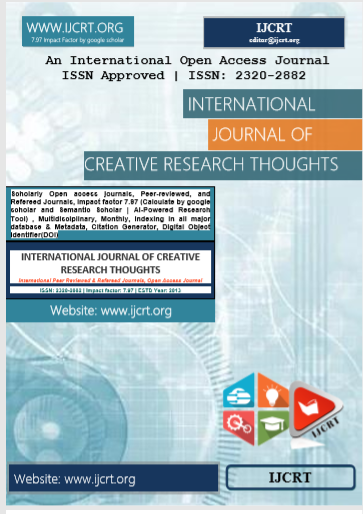
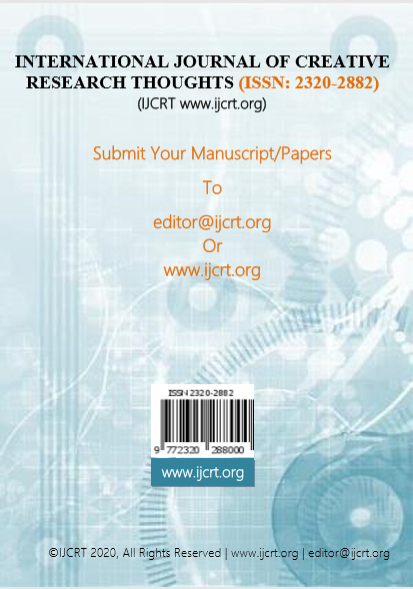
| IJCRT Journal front page | IJCRT Journal Back Page |
Paper Title: Design And Implementation Of An AI-Based Career Guidance System Using Machine Learning For Personalized Career Recommendations
Author Name(s): Vinay KM, Dr. Latha B M, Neha N, Sakshi Kateelu Manjunath Rao, Srujan K M
Published Paper ID: - IJCRT26A4063
Register Paper ID - 306620
Publisher Journal Name: IJPUBLICATION, IJCRT
DOI Member ID: 10.6084/m9.doi.one.IJCRT26A4063 and DOI :
Author Country : Indian Author, India, 577601 , Harihar, 577601 , | Research Area: Science and Technology Published Paper URL: http://ijcrt.org/viewfull.php?&p_id=IJCRT26A4063 Published Paper PDF: download.php?file=IJCRT26A4063 Published Paper PDF: http://www.ijcrt.org/papers/IJCRT26A4063.pdf
Your Paper Publication Details:
Title: DESIGN AND IMPLEMENTATION OF AN AI-BASED CAREER GUIDANCE SYSTEM USING MACHINE LEARNING FOR PERSONALIZED CAREER RECOMMENDATIONS
DOI (Digital Object Identifier) :
Pubished in Volume: 14 | Issue: 4 | Year: April 2026
Publisher Name : IJCRT | www.ijcrt.org | ISSN : 2320-2882
Subject Area: Science and Technology
Author type: Indian Author
Pubished in Volume: 14
Issue: 4
Pages: j153-j162
Year: April 2026
Downloads: 92
E-ISSN Number: 2320-2882
Abstract
Career decision-making remains a persistent challenge for undergraduate students in fast-evolving academic environments. Conventional counseling frameworks employ static questionnaires and manual evaluations that fail to capture the dynamic, multi-dimensional nature of a student's aptitude, interests, and extracurricular engagement. This paper presents Find Your Flow, a novel AI-powered career guidance and portfolio management platform designed to address these limitations. The system integrates a GPT-based large language model (LLM) recommendation engine with cosine-similarity-based career cluster mapping, academic score normalization, and real-time activity tracking to generate personalized, context-aware career pathways. Complementing the recommendation core, an interactive digital portfolio builder enables students to systematically record skills, certifications, projects, and achievements. The platform adopts a microservice-oriented architecture utilizing React.js, Node.js, and Supabase PostgreSQL, ensuring scalability and maintainability. Comprehensive testing--spanning unit, integration, system, performance, security, and usability phases--validated the system's reliability. User evaluation revealed high satisfaction regarding recommendation accuracy and interface intuitiveness. The proposed system demonstrably bridges existing gaps in personalization, real-time data integration, and holistic academic support, offering a compelling foundation for future deployment across educational institutions.
Licence: creative commons attribution 4.0
License
Creative Commons Attribution 4.0 and The Open Definition

Keywords
AI-based career guidance; large language models; GPT; personalized recommendation; portfolio management; cosine similarity; Supabase; student-centric platform; career cluster mapping; educational technology.
License
Creative Commons Attribution 4.0 and The Open Definition
Paper Title: Institutionalized Suffering, Dehumanization Of The Poor In Charles Dickens Oliver Twist And Hard Times
Author Name(s): A.Shivani, Dr. K P Sai Leela
Published Paper ID: - IJCRT26A4062
Register Paper ID - 306645
Publisher Journal Name: IJPUBLICATION, IJCRT
DOI Member ID: 10.6084/m9.doi.one.IJCRT26A4062 and DOI :
Author Country : Indian Author, India, 585313 , Kalaburagi, 585313 , | Research Area: Arts1 All Published Paper URL: http://ijcrt.org/viewfull.php?&p_id=IJCRT26A4062 Published Paper PDF: download.php?file=IJCRT26A4062 Published Paper PDF: http://www.ijcrt.org/papers/IJCRT26A4062.pdf
Your Paper Publication Details:
Title: INSTITUTIONALIZED SUFFERING, DEHUMANIZATION OF THE POOR IN CHARLES DICKENS OLIVER TWIST AND HARD TIMES
DOI (Digital Object Identifier) :
Pubished in Volume: 14 | Issue: 4 | Year: April 2026
Publisher Name : IJCRT | www.ijcrt.org | ISSN : 2320-2882
Subject Area: Arts1 All
Author type: Indian Author
Pubished in Volume: 14
Issue: 4
Pages: j148-j152
Year: April 2026
Downloads: 84
E-ISSN Number: 2320-2882
Abstract
This paper examines the systemic dehumanization of the poor in Victorian England through a close reading of Charles Dickens' Oliver Twist and Hard Times. Drawing on the lived realities of workhouses, educational institutions, and industrial factories, the study explores how institutions that were originally conceived to uplift the underprivileged instead became instruments of exploitation and oppression. The first section analyses Oliver Twist to expose the brutal conditions of Victorian workhouses, where children like Oliver were denied basic dignities, forced into crime, and punished for poverty they never chose. Dickens presents Fagin's den and the workhouse system as reflections of a morally bankrupt society that criminalized need while protecting privilege. Oliver's iconic plea for more food becomes a powerful symbol of the collective suffering of the voiceless poor under an unjust social order. The second section analyses Hard Times to investigate how Victorian educational and industrial institutions dehumanized both the mind and body. Through the characters of Gradgrind, Louisa, Tom, and Stephen Blackpool, Dickens critiques a fact-driven education system that suppressed imagination and moral development, producing individuals incapable of meaningful human connection. Simultaneously, the factories of Coketown reduced workers to mere machinery, stripping them of physical wellbeing, emotional dignity, and social mobility. Together, these novels reveal Dickens as a sharp social critic who used fiction to expose the failures of Victorian institutions. The paper concludes that poverty in Dickens' world was never a personal failing but a structural injustice perpetuated by a society indifferent to human suffering.
Licence: creative commons attribution 4.0
License
Creative Commons Attribution 4.0 and The Open Definition
Keywords
Oliver Twist, Hard Times, Failure of Workhouse, Education, and Exploitation of the Poor.
License
Creative Commons Attribution 4.0 and The Open Definition
Paper Title: Effect Of Social Media On Attention Span Amongst Undergraduate Students
Author Name(s): Ashwini Nayak, Evangeline Supriya
Published Paper ID: - IJCRT26A4061
Register Paper ID - 306693
Publisher Journal Name: IJPUBLICATION, IJCRT
DOI Member ID: 10.6084/m9.doi.one.IJCRT26A4061 and DOI :
Author Country : Indian Author, India, 576124 , Udupi, 576124 , | Research Area: Health Science All Published Paper URL: http://ijcrt.org/viewfull.php?&p_id=IJCRT26A4061 Published Paper PDF: download.php?file=IJCRT26A4061 Published Paper PDF: http://www.ijcrt.org/papers/IJCRT26A4061.pdf
Your Paper Publication Details:
Title: EFFECT OF SOCIAL MEDIA ON ATTENTION SPAN AMONGST UNDERGRADUATE STUDENTS
DOI (Digital Object Identifier) :
Pubished in Volume: 14 | Issue: 4 | Year: April 2026
Publisher Name : IJCRT | www.ijcrt.org | ISSN : 2320-2882
Subject Area: Health Science All
Author type: Indian Author
Pubished in Volume: 14
Issue: 4
Pages: j141-j147
Year: April 2026
Downloads: 91
E-ISSN Number: 2320-2882
Abstract
The rapid proliferation of social media platforms has significantly transformed patterns of information consumption, raising concerns about its impact on attention span among undergraduate students. This study examines the relationship between social media usage--particularly engagement with short-form content--and attentional control, cognitive performance, and academic functioning. Drawing on principles from cognitive load theory and media multitasking research, the study hypothesizes that excessive and fragmented media exposure contributes to reduced sustained attention and increased distractibility. Prior research indicates that frequent social media use is associated with diminished cognitive control and poorer academic outcomes (Ophir et al., 2009; Rosen et al., 2014). Similarly, emerging evidence suggests that algorithm-driven, rapid content consumption may condition users toward shorter attention cycles and reduced deep-processing capacity (Firth et al., 2019; Mark, 2023). Using a quantitative research design, data were collected from undergraduate students through standardized attention measures, including the Sustained Attention to Response Task (SART), Stroop task performance, and self-reported media usage patterns. Results indicate a significant main effect of time spent on social media on attentional performance, with higher usage correlating with increased commission errors, greater Stroop interference, and lower perceived attentional control. Furthermore, a high proportion of short-form content consumption was found to exacerbate attentional fragmentation. These findings support the argument that habitual engagement with fast-paced digital media environments may impair sustained attention and executive functioning over time. The study highlights the need for increased awareness, digital self-regulation strategies, and educational interventions aimed at promoting healthier media consumption habits among students. Future research should explore longitudinal effects and potential moderating variables such as self-control and academic discipline.
Licence: creative commons attribution 4.0
License
Creative Commons Attribution 4.0 and The Open Definition
Keywords
social media, attention span, undergraduate students, cognitive load, media multitasking, short-form content, executive functioning
License
Creative Commons Attribution 4.0 and The Open Definition
Paper Title: Comparative Study On Sleep Quality And Cognitive Functioning In Patients With And Without Anxiety Disorders
Author Name(s): Dr.Teri prasanth kumar PT, Ms.Kavya Vijayan
Published Paper ID: - IJCRT26A4060
Register Paper ID - 306749
Publisher Journal Name: IJPUBLICATION, IJCRT
DOI Member ID: 10.6084/m9.doi.one.IJCRT26A4060 and DOI :
Author Country : Indian Author, India, 560056 , Bangalore, 560056 , | Research Area: Health Science All Published Paper URL: http://ijcrt.org/viewfull.php?&p_id=IJCRT26A4060 Published Paper PDF: download.php?file=IJCRT26A4060 Published Paper PDF: http://www.ijcrt.org/papers/IJCRT26A4060.pdf
Your Paper Publication Details:
Title: COMPARATIVE STUDY ON SLEEP QUALITY AND COGNITIVE FUNCTIONING IN PATIENTS WITH AND WITHOUT ANXIETY DISORDERS
DOI (Digital Object Identifier) :
Pubished in Volume: 14 | Issue: 4 | Year: April 2026
Publisher Name : IJCRT | www.ijcrt.org | ISSN : 2320-2882
Subject Area: Health Science All
Author type: Indian Author
Pubished in Volume: 14
Issue: 4
Pages: j129-j140
Year: April 2026
Downloads: 118
E-ISSN Number: 2320-2882
Abstract
Background: Sleep is a core biological function playing a critical role in physical health, emotional stability, and cognitive performance. Although the anxiety-sleep disturbance link is well-documented, specific cognitive costs,especially within such domains as executive function and working memory are under investigation to a lesser extent within comparative contexts. Objective: Sleep quality and cognitive functioning in individuals with clinically diagnosed anxiety disorders (GAD, Panic Disorder, or Social Anxiety Disorder) were compared with that of neurotypical controls in this study. Methodology: In a comparative cross-sectional design (N=60), sleep quality was assessed both by the Pittsburgh Sleep Quality Index (PSQI) and actigraphy. Cognitive functioning was investigated by a standardized neuropsychological battery with sustained attention, working memory, and executive control as to be measured (by Stroop Test, Digit Span, and TMT-B). Results: Findings point out those anxiety disorder patients showed significantly poorer sleep quality, typified by higher sleep latency and reduced REM efficiency, compared to the control group. Besides, the anxiety group showed salient deficits in attentional control, working memory capacity, and mental flexibility. The statistical analysis implies a strong associative relationship between sleep degradation and cognitive impairment, pointing to sleep quality as a potential mediator of executive dysfunction in anxious populations. Conclusion: The results underscore the significant role of the anxiety-sleep-cognition relationship. Theoretically, the current study elucidates the "cognitive cost" of sleep fragmentation in clinical anxiety. The findings also have practical implications, advocating for the "sleep first" clinical approach and, thus, suggesting that the correction of sleep hygiene practices and sleep interventions ought to characterize cognitive and anxiety treatment.
Licence: creative commons attribution 4.0
License
Creative Commons Attribution 4.0 and The Open Definition
Keywords
Anxiety Disorders, Sleep Quality, Executive Function, Cognitive Impairment, PSQI, Neuropsychology.
License
Creative Commons Attribution 4.0 and The Open Definition
Paper Title: Study of the impact of effective integration of technological innovations on teaching-learning practices and development of students' creativity and innovation skills in the context of Education 5.0
Author Name(s): Anupam Mishra, Dr. Rama Kant Singh
Published Paper ID: - IJCRT26A4059
Register Paper ID - 306715
Publisher Journal Name: IJPUBLICATION, IJCRT
DOI Member ID: 10.6084/m9.doi.one.IJCRT26A4059 and DOI :
Author Country : Indian Author, India, 221403 , DIST- S. R. N. BHADOHI, 221403 , | Research Area: Social Science All Published Paper URL: http://ijcrt.org/viewfull.php?&p_id=IJCRT26A4059 Published Paper PDF: download.php?file=IJCRT26A4059 Published Paper PDF: http://www.ijcrt.org/papers/IJCRT26A4059.pdf
Your Paper Publication Details:
Title: STUDY OF THE IMPACT OF EFFECTIVE INTEGRATION OF TECHNOLOGICAL INNOVATIONS ON TEACHING-LEARNING PRACTICES AND DEVELOPMENT OF STUDENTS' CREATIVITY AND INNOVATION SKILLS IN THE CONTEXT OF EDUCATION 5.0
DOI (Digital Object Identifier) :
Pubished in Volume: 14 | Issue: 4 | Year: April 2026
Publisher Name : IJCRT | www.ijcrt.org | ISSN : 2320-2882
Subject Area: Social Science All
Author type: Indian Author
Pubished in Volume: 14
Issue: 4
Pages: j119-j128
Year: April 2026
Downloads: 94
E-ISSN Number: 2320-2882
Abstract
Study of the impact of effective integration of technological innovations on teaching-learning practices and development of students' creativity and innovation skills in the context of Education 5.0
Licence: creative commons attribution 4.0
License
Creative Commons Attribution 4.0 and The Open Definition
Keywords
Study of the impact of effective integration of technological innovations on teaching-learning practices and development of students' creativity and innovation skills in the context of Education 5.0
License
Creative Commons Attribution 4.0 and The Open Definition
Paper Title: Constitutionalism, Digital Governance and Algorithmic Accountability in the Age of AI
Author Name(s): Ms. Mayuri Yogendra Chude, Mr. Akhand Pratap Singh
Published Paper ID: - IJCRT26A4058
Register Paper ID - 306741
Publisher Journal Name: IJPUBLICATION, IJCRT
DOI Member ID: 10.6084/m9.doi.one.IJCRT26A4058 and DOI :
Author Country : Indian Author, India, 303121 , Jaipur, 303121 , | Research Area: Others area Published Paper URL: http://ijcrt.org/viewfull.php?&p_id=IJCRT26A4058 Published Paper PDF: download.php?file=IJCRT26A4058 Published Paper PDF: http://www.ijcrt.org/papers/IJCRT26A4058.pdf
Your Paper Publication Details:
Title: CONSTITUTIONALISM, DIGITAL GOVERNANCE AND ALGORITHMIC ACCOUNTABILITY IN THE AGE OF AI
DOI (Digital Object Identifier) :
Pubished in Volume: 14 | Issue: 4 | Year: April 2026
Publisher Name : IJCRT | www.ijcrt.org | ISSN : 2320-2882
Subject Area: Others area
Author type: Indian Author
Pubished in Volume: 14
Issue: 4
Pages: j112-j118
Year: April 2026
Downloads: 108
E-ISSN Number: 2320-2882
Abstract
The rapid integration of AI technology with government processes is changing the very shapes of public rule, posing new challenges to constitutionalism in contemporary democracies. Building on recent constitutional jurisprudence, notably the acknowledgement of the right to privacy and developing principles of procedural fairness, this study seeks to understand the black box and bias issues contained in automated decision making systems. This paper concludes that the "black box" aspect of AI degrades constitutional protections through lack of explainability and the undermining of institutional accountability. The paper further discusses regulatory responses to potential algorithmic harms both digital governance and data protection measures India, focusing on the limitations of such responses in addressing algorithmic harms in data protection and digital governance policy. The paper advocates a normative constitutional view by advocating for algorithmic transparency, auditability, and human accountability to be embedded as basic safety nets in oversight of governance functions. It urges the modernization of constitutional morality in a post IT world that will necessitate the redefinition of constitutional morality in view of technology in order to keep AI-based governance inclusively human rooted, rights-bound, and accountable democratically. Applying AI to constitutional ethics context, the study contributes and informs the current debate on how to ground technological progress in principles of justice and equality within the constitutional framework of India.
Licence: creative commons attribution 4.0
License
Creative Commons Attribution 4.0 and The Open Definition
Keywords
Algorithmic Governance, Constitutionalism, Artificial Intelligence, Rule of Law, Transparency, Fundamental Rights
License
Creative Commons Attribution 4.0 and The Open Definition
Paper Title: GLOBALIZATION, WOMEN, AND ENTREPRENEURSHIP: UNLEASHING ECONOMIC POTENTIAL
Author Name(s): Rohini
Published Paper ID: - IJCRT26A4057
Register Paper ID - 305513
Publisher Journal Name: IJPUBLICATION, IJCRT
DOI Member ID: 10.6084/m9.doi.one.IJCRT26A4057 and DOI :
Author Country : Indian Author, India, 744105 , Sri Vijaya Puram, 744105 , | Research Area: Social Science All Published Paper URL: http://ijcrt.org/viewfull.php?&p_id=IJCRT26A4057 Published Paper PDF: download.php?file=IJCRT26A4057 Published Paper PDF: http://www.ijcrt.org/papers/IJCRT26A4057.pdf
Your Paper Publication Details:
Title: GLOBALIZATION, WOMEN, AND ENTREPRENEURSHIP: UNLEASHING ECONOMIC POTENTIAL
DOI (Digital Object Identifier) :
Pubished in Volume: 14 | Issue: 4 | Year: April 2026
Publisher Name : IJCRT | www.ijcrt.org | ISSN : 2320-2882
Subject Area: Social Science All
Author type: Indian Author
Pubished in Volume: 14
Issue: 4
Pages: j107-j111
Year: April 2026
Downloads: 96
E-ISSN Number: 2320-2882
Abstract
This research investigates the multifaceted impact of globalization on women within the organized sector, with a primary focus on their economic empowerment and transformative roles. Through an exploration of relevant literature and data analysis employing descriptive analytics, the study reveals the complex interplay between globalization and women's economic status, emphasizing both opportunities and challenges. Findings underline the persistence of the gender pay gap and the pressures on work-life balance. Moreover, globalization has instigated transformative changes, expanding women's access to education and catalyzing shifts in societal roles. This research informs future policy development and research initiatives for fostering women's empowerment in the globalized workforce.
Licence: creative commons attribution 4.0
License
Creative Commons Attribution 4.0 and The Open Definition
Keywords
Globalization, Women, Organized Sector, Economic Empowerment, Descriptive Analytics, Gender Pay Gap
License
Creative Commons Attribution 4.0 and The Open Definition
Paper Title: INTELLIGENT PESTICIDE SPRINKLING SYSTEM DETERMINED BY THE INFECTION LEVEL OF THE PLANT
Author Name(s): Manohar BR, Prajwalkumar MP, Sharath G, Nithesh, Prof. Divyashree N
Published Paper ID: - IJCRT26A4056
Register Paper ID - 306073
Publisher Journal Name: IJPUBLICATION, IJCRT
DOI Member ID: 10.6084/m9.doi.one.IJCRT26A4056 and DOI :
Author Country : Indian Author, India, 560064 , Bangalore, 560064 , | Research Area: Science and Technology Published Paper URL: http://ijcrt.org/viewfull.php?&p_id=IJCRT26A4056 Published Paper PDF: download.php?file=IJCRT26A4056 Published Paper PDF: http://www.ijcrt.org/papers/IJCRT26A4056.pdf
Your Paper Publication Details:
Title: INTELLIGENT PESTICIDE SPRINKLING SYSTEM DETERMINED BY THE INFECTION LEVEL OF THE PLANT
DOI (Digital Object Identifier) :
Pubished in Volume: 14 | Issue: 4 | Year: April 2026
Publisher Name : IJCRT | www.ijcrt.org | ISSN : 2320-2882
Subject Area: Science and Technology
Author type: Indian Author
Pubished in Volume: 14
Issue: 4
Pages: j99-j106
Year: April 2026
Downloads: 107
E-ISSN Number: 2320-2882
Abstract
Precision agriculture aims to optimize resource usage while improving crop productivity and sustainability. Traditional pesticide spraying methods often result in excessive chemical usage due to lack of real-time monitoring of plant health. This paper proposes an intelligent pesticide sprinkling system that determines spraying requirements based on plant infection levels. The system integrates an Arduino-based embedded controller, environmental sensors, and automated spraying mechanisms to enable real-time decisionmaking. Sensor data is continuously monitored and processed using threshold-based logic to detect infection conditions. When infection is identified, the system activates a pump and solenoid valve to perform targeted spraying. The proposed system reduces pesticide usage, minimizes environmental impact, and improves crop yield. Experimental observations indicate improved efficiency and reduced manual intervention, demonstrating the effectiveness of the proposed solution for small-scale and precision farming applications.
Licence: creative commons attribution 4.0
License
Creative Commons Attribution 4.0 and The Open Definition
Keywords
smart agriculture, LoRaWAN, edge computing, precision irrigation, terrain-aware systems, Internet of Things (IoT).
License
Creative Commons Attribution 4.0 and The Open Definition
Paper Title: Psycho Social Factors Contributing To Alcohol Dependence
Author Name(s): Navya C R, Dr. M. Premalatha
Published Paper ID: - IJCRT26A4055
Register Paper ID - 305627
Publisher Journal Name: IJPUBLICATION, IJCRT
DOI Member ID: 10.6084/m9.doi.one.IJCRT26A4055 and DOI :
Author Country : Indian Author, India, 641050 , Coimbatore, 641050 , | Research Area: Social Science All Published Paper URL: http://ijcrt.org/viewfull.php?&p_id=IJCRT26A4055 Published Paper PDF: download.php?file=IJCRT26A4055 Published Paper PDF: http://www.ijcrt.org/papers/IJCRT26A4055.pdf
Your Paper Publication Details:
Title: PSYCHO SOCIAL FACTORS CONTRIBUTING TO ALCOHOL DEPENDENCE
DOI (Digital Object Identifier) :
Pubished in Volume: 14 | Issue: 4 | Year: April 2026
Publisher Name : IJCRT | www.ijcrt.org | ISSN : 2320-2882
Subject Area: Social Science All
Author type: Indian Author
Pubished in Volume: 14
Issue: 4
Pages: j94-j98
Year: April 2026
Downloads: 88
E-ISSN Number: 2320-2882
Abstract
Alcohol dependency is a major public health issue that affects individual families and society. The study focuses on the psychosocial factors influencing alcohol dependence among patients in a de-addiction centre in Coimbatore. It highlights that alcohol dependence is influenced not only by biological factors but also by psychological aspects such as stress,anxiety, and depression , along with the social factors like peer pressure, family environment, and social economic conditions. The research adopted descriptive research design with a sample of 60 respondent selected through purposive sampling ,data were collected using a structured questionnaire and analysed using frequency and percentage methods. The findings show that most respondents are middle aged and married and many began drinking at an early age. A large number consume alcohol daily. Psychological factors such as stress and emotional problems along with social influences like peer pressure and family impact play a major role in alcohol dependence . The study concludes that alcohol dependence is caused by multiple psychosocial factors and a requires a holistic approach including awareness, counselling and a community based interventions for effective preventions and treatment.
Licence: creative commons attribution 4.0
License
Creative Commons Attribution 4.0 and The Open Definition
Keywords
Alcoholic dependence, Peer pressure, Stress
License
Creative Commons Attribution 4.0 and The Open Definition
Paper Title: Protein Misfolding & Neurodegenerative Disease
Author Name(s): Rishit Yadav
Published Paper ID: - IJCRT26A4054
Register Paper ID - 305606
Publisher Journal Name: IJPUBLICATION, IJCRT
DOI Member ID: 10.6084/m9.doi.one.IJCRT26A4054 and DOI :
Author Country : Indian Author, India, 110092 , Gautam Budh Nagar, 110092 , | Research Area: Humanities All Published Paper URL: http://ijcrt.org/viewfull.php?&p_id=IJCRT26A4054 Published Paper PDF: download.php?file=IJCRT26A4054 Published Paper PDF: http://www.ijcrt.org/papers/IJCRT26A4054.pdf
Your Paper Publication Details:
Title: PROTEIN MISFOLDING & NEURODEGENERATIVE DISEASE
DOI (Digital Object Identifier) :
Pubished in Volume: 14 | Issue: 4 | Year: April 2026
Publisher Name : IJCRT | www.ijcrt.org | ISSN : 2320-2882
Subject Area: Humanities All
Author type: Indian Author
Pubished in Volume: 14
Issue: 4
Pages: j80-j93
Year: April 2026
Downloads: 95
E-ISSN Number: 2320-2882
Abstract
The study of the impact of the pH of the protein egg albumin denaturing process on spectrophotometric absorbance is explored in the paper. One of the egg albumins was taken as a model protein, and it was exposed to the buffer solutions at pH levels of 2 to 10. 010 minutes, and the absorbance was calculated to obtain the degree of protein aggregation and turbidity. The stability of the proteins was observed to be greatest at approximately neutral pH (pH 6), in which the smallest absorbance was recorded, and so, denaturation was not significant. On the other hand, greater acidic (pH 2) and greater alkaline (pH 10) yielded greater absorbance, which is a sign of increased aggregation of proteins. The conclusions demonstrate that severe pH conditions result in severe disorganization of the protein structure and foster denaturation.
Licence: creative commons attribution 4.0
License
Creative Commons Attribution 4.0 and The Open Definition
Call For Paper September 2026
Call For Papers
September 2026
Volume 14 | Issue 9
Last Date :
31-Oct-2026
Submit Manuscript Online Impact Factor: 7.97 Review Results : Within 02-03 Days Paper Publication : Within 02-03 Days
September 2026
Volume 14 | Issue 9
Last Date :
31-Oct-2026
Submit Manuscript Online Impact Factor: 7.97 Review Results : Within 02-03 Days Paper Publication : Within 02-03 Days
Published Issue Details
For Authors
Forms / Downloads
Other IMP Links
Indexing Partner
Research Area
LICENSE





ISSN and 7.97 Impact Factor Details
ISSN: 2320-2882 Impact Factor: 7.97 and ISSN APPROVED Journal Starting Year (ESTD) : 2013


ISSN and 7.97 Impact Factor Details
ISSN: 2320-2882 Impact Factor: 7.97 and ISSN APPROVED Journal Starting Year (ESTD) : 2013
DOI Details
CONFERENCE
CONFERENCE MANAGMENT & PUBLICATION CONFERENCE PROPOSAL
RECENT CONFERENCE

CONFERENCE PROPOSAL CONFERENCE PROCEEDINGS
CONFERENCE PROPOSAL CONFERENCE PROCEEDINGS
For Reviewer /Referral (RMS) Earn 500 per paper
Important Links
NEWS & Conference
Digital Library
IJCRT RMS | Earn 500 Per Paper.

Open Access


LICENSE
Indexing Partner
Scholarly open access journals, Peer-reviewed, and Refereed Journals, Impact factor 7.97 (Calculate by google scholar and Semantic Scholar | AI-Powered Research Tool) , Multidisciplinary, Monthly, Indexing in all major database & Metadata, Citation Generator, Digital Object Identifier(DOI)