Important Details
IJCRT - International Peer Reviewed, Open Access Journal, Multidisciplinary, Monthly, Nominal(Low) Fees for Professional Research Services International Journal of Creative Research Thoughts - IJCRT Peer Review Journal, Refereed Journal, Peer Reviewed Journal , Referred Journal and Indexed Journal, Open access, Online and Print Journal,international Journal Open Access, Accepted by Indian and foreign university ,IJCRT Followed Norms, guidelines, requirement, listing criteria and methodology of score/point also applied from: Scopus , Web of Science , UGC Approved , UGC CARE, UGC-CARE .
UGC Approved Journal No: 49023 (18)
UGC approval Link
https://ijcrt.org/ugc%20approval.jpg
All Policy and Approval
Please Like Our Facebook Page | CrossRef DOI and Hard copy of Certificate Provide if required. | www.IJCRT.org | editor@IJCRT.org | IJCRT WhatsApp +91 94294 58311
Publication Details:
- Paper Submission : 31-Oct-2026. Call For Paper (Volume 14 | Issue 9 | Month- September 2026)
- Acceptance/Rejection Notification: Within 02-04 Days.
- Paper Publish: Within 02-04 Days after submitting all documents.
-
Submit Your Paper Any time There No deadline.
-
Publication fees : 1570 INR for Indian author & 59$ for foreign International author.
Please Like Our Facebook Page | CrossRef DOI and Hard copy of Certificate Provide if required.
Licence and Indexing
Indexing In Google Scholar, SSRN, ResearcherID-Publons, Semantic Scholar | AI-Powered Research Tool, Microsoft Academic, Academia.edu, arXiv.org, Research Gate, CiteSeerX, ResearcherID Thomson Reuters, Mendeley : reference manager, DocStoc, ISSUU, Scribd, and many more | High Impact Factor: 7.97 | Digital object identifier (DOI) and Hard Copy of certificate Provided.



























Licence
DOI
ISSN Approved impact factor: 7.97 
Creative Common 
Valid as per new UGC Gazette regulations 

INTERNATIONAL JOURNAL OF CREATIVE RESEARCH THOUGHTS - IJCRT (IJCRT.ORG)
International Peer Reviewed & Refereed Journals, Open Access Journal
IJCRT Peer-Reviewed (Refereed) Journal as Per New UGC Rules.
ISSN Approved Journal No: 2320-2882 | Impact factor: 7.97 | ESTD Year: 2013
Call For Paper - Volume 14 | Issue 9 | Month- September 2026
Scholarly open access journals, Peer-reviewed, and Refereed Journals, Impact factor 7.97 (Calculate by google scholar and Semantic Scholar | AI-Powered Research Tool) , Multidisciplinary, Monthly, Indexing in all major database & Metadata, Citation Generator, Digital Object Identifier(CrossRef DOI)
IJCRT WhatsApp Contact
IJCRT Search Xplore - Search all paper by Paper Name , Author Name, and Title
Volume 14 | Issue 4 |
Volume 14 | Issue 4 | Month
Downlaod After Publication 1) Table of content index in PDF
2) Table of content index in HTML 2)Table of content index in HTML
3) Front Page 3) Front Page
4) Back Page 4) Back Page
5) Editor Board Member 5)Editor Board Member
6) OLD Style Issue 6)OLD Style Issue
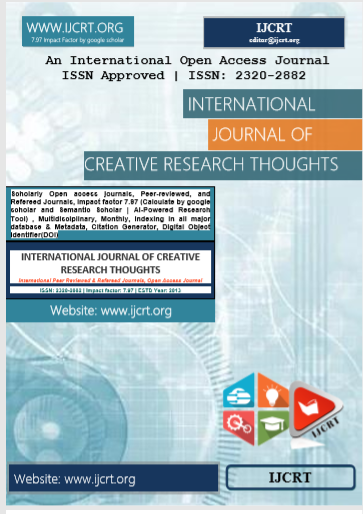 |
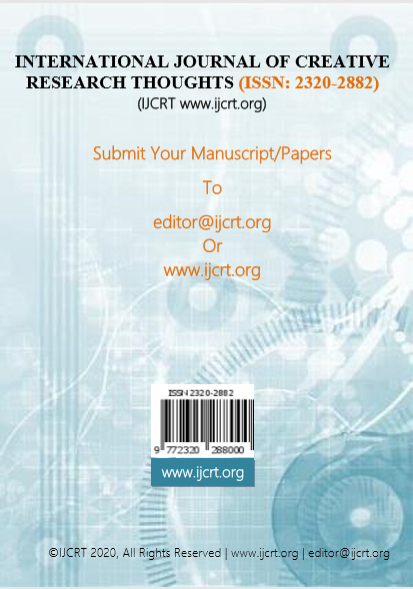 |
|---|---|
| IJCRT Journal front page | IJCRT Journal Back Page |
Paper Title: CHARACTERIZATION OF NOVEL ELETTARIA CARDAMOMUM LEAF MIDRIB REINFORCED POLYESTER COMPOSITES
Author Name(s): Gnanaseviyar S, Kabilan R, Vishnu K S, Prakash P, Balasubramanian B
Published Paper ID: - IJCRT2604615
Register Paper ID - 305628
Publisher Journal Name: IJPUBLICATION, IJCRT
DOI Member ID: 10.6084/m9.doi.one.IJCRT2604615 and DOI :
Author Country : Indian Author, India, 639114 , Karur, 639114 , | Research Area: Science and Technology Published Paper URL: http://ijcrt.org/viewfull.php?&p_id=IJCRT2604615 Published Paper PDF: download.php?file=IJCRT2604615 Published Paper PDF: http://www.ijcrt.org/papers/IJCRT2604615.pdf
Your Paper Publication Details:
Title: CHARACTERIZATION OF NOVEL ELETTARIA CARDAMOMUM LEAF MIDRIB REINFORCED POLYESTER COMPOSITES
DOI (Digital Object Identifier) :
Pubished in Volume: 14 | Issue: 4 | Year: April 2026
Publisher Name : IJCRT | www.ijcrt.org | ISSN : 2320-2882
Subject Area: Science and Technology
Author type: Indian Author
Pubished in Volume: 14
Issue: 4
Pages: f276-f282
Year: April 2026
Downloads: 89
E-ISSN Number: 2320-2882
Abstract
Natural fiber reinforced polymer composites have been the subject of much research due to the growing need for environmentally friendly and sustainable products. Elettaria cardamomum leaf midrib (ECLM) fibers were isolated and used as reinforcement in polyester matrix composites in this work. To improve the interfacial adhesion between the fibers and matrix, the fibers were treated with alkali. Compression molding was used after the hand lay-up method to create composites with different fiber weight fractions. The mechanical characteristics, including hardness, tensile strength, flexural strength, and impact strength, were assessed in accordance with ASTM guidelines.
Licence: creative commons attribution 4.0
License
Creative Commons Attribution 4.0 and The Open Definition

Keywords
Elettaria cardamomum fiber, Natural fiber reinforced composites, Polyester resin, Mechanical properties, Morphological analysis
License
Creative Commons Attribution 4.0 and The Open Definition
Paper Title: A Machine Learning Approach for Student Academic Performance Prediction
Author Name(s): Sweety Kumari, Gopal Khorwal
Published Paper ID: - IJCRT2604614
Register Paper ID - 304442
Publisher Journal Name: IJPUBLICATION, IJCRT
DOI Member ID: 10.6084/m9.doi.one.IJCRT2604614 and DOI :
Author Country : Indian Author, India, 302017 , Jaipur, 302017 , | Research Area: Science and Technology Published Paper URL: http://ijcrt.org/viewfull.php?&p_id=IJCRT2604614 Published Paper PDF: download.php?file=IJCRT2604614 Published Paper PDF: http://www.ijcrt.org/papers/IJCRT2604614.pdf
Your Paper Publication Details:
Title: A MACHINE LEARNING APPROACH FOR STUDENT ACADEMIC PERFORMANCE PREDICTION
DOI (Digital Object Identifier) :
Pubished in Volume: 14 | Issue: 4 | Year: April 2026
Publisher Name : IJCRT | www.ijcrt.org | ISSN : 2320-2882
Subject Area: Science and Technology
Author type: Indian Author
Pubished in Volume: 14
Issue: 4
Pages: f272-f275
Year: April 2026
Downloads: 107
E-ISSN Number: 2320-2882
Abstract
Predicting student academic performance is a growing area of interest in educational research. Traditional evaluation methods assess students only after examinations, which prevents early identification of at-risk learners. This paper proposes a simple yet effective machine learning-based prediction system that uses five basic student attributes attendance percentage, daily study hours, marks in previous examinations, assignment submission rate, and class participation score to predict whether a student will Pass, perform Averagely, or Fail in their upcoming examination. Three widely-used machine learning algorithms, namely Linear Regression, Decision Tree, and Random Forest, are trained and compared using a dataset of 200 students. Experimental results show that the Random Forest model achieves the highest prediction accuracy of 91%, followed by Decision Tree at 85% and Linear Regression at 78%. The proposed system requires no advanced infrastructure and is practical for adoption in any educational institution to enable timely academic intervention for struggling students.
Licence: creative commons attribution 4.0
License
Creative Commons Attribution 4.0 and The Open Definition
Keywords
Machine Learning, Student Performance Prediction, Decision Tree, Random Forest, Linear Regression, Educational Data Mining, Academic Analytics, Classification.
License
Creative Commons Attribution 4.0 and The Open Definition
Paper Title: EcoQuest: A Scalable Gamified and Adaptive Environmental Learning Platform
Author Name(s): Arya Mahindrakar, Pravin Jaybhaye, Sahil Bhosale
Published Paper ID: - IJCRT2604613
Register Paper ID - 305694
Publisher Journal Name: IJPUBLICATION, IJCRT
DOI Member ID: 10.6084/m9.doi.one.IJCRT2604613 and DOI :
Author Country : Indian Author, India, 411062 , Pune, 411062 , | Research Area: Science and Technology Published Paper URL: http://ijcrt.org/viewfull.php?&p_id=IJCRT2604613 Published Paper PDF: download.php?file=IJCRT2604613 Published Paper PDF: http://www.ijcrt.org/papers/IJCRT2604613.pdf
Your Paper Publication Details:
Title: ECOQUEST: A SCALABLE GAMIFIED AND ADAPTIVE ENVIRONMENTAL LEARNING PLATFORM
DOI (Digital Object Identifier) :
Pubished in Volume: 14 | Issue: 4 | Year: April 2026
Publisher Name : IJCRT | www.ijcrt.org | ISSN : 2320-2882
Subject Area: Science and Technology
Author type: Indian Author
Pubished in Volume: 14
Issue: 4
Pages: f247-f271
Year: April 2026
Downloads: 99
E-ISSN Number: 2320-2882
Abstract
Increasing intensity of environmental issues like climate change, degradation of biodiversity, and depletion of resources underscores the necessity of good environmental education systems. Nonetheless, most legacy and the majority of new digital learning tools still use the same traditional models of delivering static content that cannot support user engagement or adapt to a wide variety of learning behaviors. This weakness leads to less retention of knowledge and little effect on behavior in the long term. In this study, a complete EcoQuest platform, EcoQuest, a full-stack, gamified environmental education system, is proposed to overcome these limitations by integrating adaptive learning, real-time interaction, and intelligent assistance. The system is designed to provide individualized learning by dynamically changing the difficulty of questions according to their individual user performance metrics, thus making sure that learners are challenged and motivated throughout their progress. EcoQuest requires a systematic gamification system, comprising experience points (XP), level advancement, achievement badges, streak monitoring, and leaderboards. These aspects will support the regular participation and encourage the further involvement. Moreover, the platform allows real-time multiplayer quizzes with WebSocket-based communication, allowing collaborative and competitive learning experiences, which also increase the engagement of the users. Technically, the system is deployed with a modular design based on a React-powered frontend, a Node.js/Express backend, and a MongoDB database that can store and retrieve data in a scalable way. The use of Socket.io allows real-time communication, and the assistant (EcoBot) is an AI-based one that will use context-dependent answers within environmental-related issues only, which will make it relevant and domain-specific. The design decisions determine performance-oriented, such as caching and indexing of the database, which play a role in efficient functioning of the system and decreased latency. Functional assessment states that the platform has stable real-time synchronization, data processing efficiency, and responsiveness to user interaction in normal usage conditions. The findings prove that the combination of gamification, adaptive learning practices, and AI-guided support can greatly improve engagement and learning outcomes within environmental education platforms. EcoQuest sets a realistic template of building scalable, interactive, and user-focused learning platforms in other related areas.
Licence: creative commons attribution 4.0
License
Creative Commons Attribution 4.0 and The Open Definition
Keywords
Gamified Learning, Adaptive Learning System, Environmental Education, Real-Time Multiplayer Learning, AI-Based Chatbot, Full-Stack Web Application, WebSocket Communication, MongoDB, Role-Based Access Control
License
Creative Commons Attribution 4.0 and The Open Definition
Paper Title: India-China Relations In The NDA Era (2014-2019): Cooperation, Competition, And Conflict
Author Name(s): BIJAY MONDAL
Published Paper ID: - IJCRT2604612
Register Paper ID - 305826
Publisher Journal Name: IJPUBLICATION, IJCRT
DOI Member ID: 10.6084/m9.doi.one.IJCRT2604612 and DOI :
Author Country : Indian Author, India, 713346 , Pandaveswar, 713346 , | Research Area: Arts1 All Published Paper URL: http://ijcrt.org/viewfull.php?&p_id=IJCRT2604612 Published Paper PDF: download.php?file=IJCRT2604612 Published Paper PDF: http://www.ijcrt.org/papers/IJCRT2604612.pdf
Your Paper Publication Details:
Title: INDIA-CHINA RELATIONS IN THE NDA ERA (2014-2019): COOPERATION, COMPETITION, AND CONFLICT
DOI (Digital Object Identifier) :
Pubished in Volume: 14 | Issue: 4 | Year: April 2026
Publisher Name : IJCRT | www.ijcrt.org | ISSN : 2320-2882
Subject Area: Arts1 All
Author type: Indian Author
Pubished in Volume: 14
Issue: 4
Pages: f242-f246
Year: April 2026
Downloads: 90
E-ISSN Number: 2320-2882
Abstract
The India-China relation holds a unique position in the world, as cooperation and confrontation are the primary bases of their relationship. The present study focuses on the India-China relationship during the NDA period (2014-2019), under the leadership of Indian Prime Minister Narendra Modi. The objective of the paper is to examine whether the NDA era has been able to bring any changes in India's China policy, or has it merely maintained continuity. Based on the secondary sources, the paper has adopted a qualitative research method and case study approach. The study reveals that this phase portrays a measure adjustment period rather than a total rupture from the past policy. The Indian government has adopted a more assertive approach in its foreign policy during that time. This phase can be marked by a pattern of competitive coexistence.
Licence: creative commons attribution 4.0
License
Creative Commons Attribution 4.0 and The Open Definition
Keywords
NDA Government, Strategic Competition, National interest, economic interdependence, India-China relations, Indian foreign policy, Chinese foreign policy
License
Creative Commons Attribution 4.0 and The Open Definition
Paper Title: The Traumas in the Lives of Zainichi Koreans in Japan
Author Name(s): Munish Mohammad, Dr. Manoj Kumar
Published Paper ID: - IJCRT2604611
Register Paper ID - 305653
Publisher Journal Name: IJPUBLICATION, IJCRT
DOI Member ID: 10.6084/m9.doi.one.IJCRT2604611 and DOI :
Author Country : Indian Author, India, - , -, - , | Research Area: Arts All Published Paper URL: http://ijcrt.org/viewfull.php?&p_id=IJCRT2604611 Published Paper PDF: download.php?file=IJCRT2604611 Published Paper PDF: http://www.ijcrt.org/papers/IJCRT2604611.pdf
Your Paper Publication Details:
Title: THE TRAUMAS IN THE LIVES OF ZAINICHI KOREANS IN JAPAN
DOI (Digital Object Identifier) :
Pubished in Volume: 14 | Issue: 4 | Year: April 2026
Publisher Name : IJCRT | www.ijcrt.org | ISSN : 2320-2882
Subject Area: Arts All
Author type: Indian Author
Pubished in Volume: 14
Issue: 4
Pages: f236-f241
Year: April 2026
Downloads: 92
E-ISSN Number: 2320-2882
Abstract
This paper examines the historically rooted and socially reproduced traumas experienced by Zainichi Koreans--ethnic Koreans residing in Japan whose presence largely originates from migration during Japan's colonial rule of Korea (1910-1945). Drawing upon historical scholarship, contemporary academic literature, journalistic investigations, and mental-health research, the study argues that Zainichi trauma is embedded in colonial violence and sustained through postwar legal marginalization, structural discrimination, and contemporary hate speech. These traumatic experiences manifest socially and psychologically and are transmitted intergenerationally through narratives of loss, stigma, and survival. The paper analyzes major domains of trauma, including wartime forced labor and atomic bomb survivor exclusion, postwar juridical liminality, discrimination in education and employment, identity erasure, and political scapegoating. It further reviews empirical evidence linking discrimination to adverse mental-health outcomes and highlights community-based coping and resistance strategies. The paper concludes with policy recommendations emphasizing structural redress, historical acknowledgment, and culturally responsive mental-health interventions.
Licence: creative commons attribution 4.0
License
Creative Commons Attribution 4.0 and The Open Definition
Keywords
Trauma, Stigma, Resilience, Zainichi Koreans
License
Creative Commons Attribution 4.0 and The Open Definition
Paper Title: SHAKTI DEFENDER AI: INTELLIGENT MALWARE DETECTION USING MACHINE LEARNING WITH HYBRID STATIC AND DYNAMIC ANALYSIS
Author Name(s): Pratham Dubey, VIvek Magar, Anuj Gupta, Ankit Gupta
Published Paper ID: - IJCRT2604610
Register Paper ID - 306038
Publisher Journal Name: IJPUBLICATION, IJCRT
DOI Member ID: 10.6084/m9.doi.one.IJCRT2604610 and DOI :
Author Country : Indian Author, India, 400079 , MUMBAI, 400079 , | Research Area: Science and Technology Published Paper URL: http://ijcrt.org/viewfull.php?&p_id=IJCRT2604610 Published Paper PDF: download.php?file=IJCRT2604610 Published Paper PDF: http://www.ijcrt.org/papers/IJCRT2604610.pdf
Your Paper Publication Details:
Title: SHAKTI DEFENDER AI: INTELLIGENT MALWARE DETECTION USING MACHINE LEARNING WITH HYBRID STATIC AND DYNAMIC ANALYSIS
DOI (Digital Object Identifier) :
Pubished in Volume: 14 | Issue: 4 | Year: April 2026
Publisher Name : IJCRT | www.ijcrt.org | ISSN : 2320-2882
Subject Area: Science and Technology
Author type: Indian Author
Pubished in Volume: 14
Issue: 4
Pages: f227-f235
Year: April 2026
Downloads: 89
E-ISSN Number: 2320-2882
Abstract
The rapid increase in sophisticated malware poses a significant threat to modern digital systems. Traditional signature-based detection methods are ineffective against zero-day and polymorphic attacks. This paper presents "Shakti Defender AI," an intelligent malware detection system that integrates both static and dynamic analysis using machine learning techniques. The proposed system extracts features from Portable Executable (PE) files, opcode sequences, and real-time behavioral patterns such as API calls, registry activities, and network interactions. These features are processed using an ensemble of machine learning models including XGBoost, LightGBM, Random Forest, and an LSTM-based model for sequence analysis. Experimental results demonstrate high performance with an accuracy of 99.16%, along with strong precision and recall. The system is implemented as a user-friendly desktop application supporting multiple file types with real-time scanning and threat intelligence integration. The results indicate that the hybrid approach significantly improves malware detection capability compared to traditional and single-method approaches, making it suitable for real-world cybersecurity applications.
Licence: creative commons attribution 4.0
License
Creative Commons Attribution 4.0 and The Open Definition
Keywords
Malware Detection, Machine Learning, XGBoost, LightGBM, LSTM, Static Analysis, Dynamic Analysis, Cybersecurity
License
Creative Commons Attribution 4.0 and The Open Definition
Paper Title: INVISIBLE SCARS: EXPLORING GRIEF COUNSELLING FOR CHILDREN AFTER PARENTAL SEPARATION IN INDIA
Author Name(s): DIVVYA KAUUR GILL, DR. RICHA GUPTA
Published Paper ID: - IJCRT2604609
Register Paper ID - 305461
Publisher Journal Name: IJPUBLICATION, IJCRT
DOI Member ID: 10.6084/m9.doi.one.IJCRT2604609 and DOI :
Author Country : Indian Author, India, - , -, - , | Research Area: Humanities All Published Paper URL: http://ijcrt.org/viewfull.php?&p_id=IJCRT2604609 Published Paper PDF: download.php?file=IJCRT2604609 Published Paper PDF: http://www.ijcrt.org/papers/IJCRT2604609.pdf
Your Paper Publication Details:
Title: INVISIBLE SCARS: EXPLORING GRIEF COUNSELLING FOR CHILDREN AFTER PARENTAL SEPARATION IN INDIA
DOI (Digital Object Identifier) :
Pubished in Volume: 14 | Issue: 4 | Year: April 2026
Publisher Name : IJCRT | www.ijcrt.org | ISSN : 2320-2882
Subject Area: Humanities All
Author type: Indian Author
Pubished in Volume: 14
Issue: 4
Pages: f215-f226
Year: April 2026
Downloads: 99
E-ISSN Number: 2320-2882
Abstract
INVISIBLE SCARS: EXPLORING GRIEF COUNSELLING FOR CHILDREN AFTER PARENTAL SEPARATION IN INDIA
Licence: creative commons attribution 4.0
License
Creative Commons Attribution 4.0 and The Open Definition
Keywords
INVISIBLE SCARS: EXPLORING GRIEF COUNSELLING FOR CHILDREN AFTER PARENTAL SEPARATION IN INDIA
License
Creative Commons Attribution 4.0 and The Open Definition
Paper Title: Evaluation Of Low Cost Bio-Adsorbents For Fluoride Removal From Drinking Water In Kuttanadu, Kerala
Author Name(s): Adhya Jibi K, Adil Navas, Keerthi S B, Muhsin K h, Rohith S
Published Paper ID: - IJCRT2604608
Register Paper ID - 304766
Publisher Journal Name: IJPUBLICATION, IJCRT
DOI Member ID: 10.6084/m9.doi.one.IJCRT2604608 and DOI :
Author Country : Indian Author, India, 691502 , Kollam, 691502 , | Research Area: Science and Technology Published Paper URL: http://ijcrt.org/viewfull.php?&p_id=IJCRT2604608 Published Paper PDF: download.php?file=IJCRT2604608 Published Paper PDF: http://www.ijcrt.org/papers/IJCRT2604608.pdf
Your Paper Publication Details:
Title: EVALUATION OF LOW COST BIO-ADSORBENTS FOR FLUORIDE REMOVAL FROM DRINKING WATER IN KUTTANADU, KERALA
DOI (Digital Object Identifier) :
Pubished in Volume: 14 | Issue: 4 | Year: April 2026
Publisher Name : IJCRT | www.ijcrt.org | ISSN : 2320-2882
Subject Area: Science and Technology
Author type: Indian Author
Pubished in Volume: 14
Issue: 4
Pages: f205-f214
Year: April 2026
Downloads: 100
E-ISSN Number: 2320-2882
Abstract
Fluoride contamination in groundwater is a major environmental and public health concern in parts of India, especially in Kuttanadu, Kerala. The issue arises from both natural geological sources and the excessive use of phosphate fertilizers. Prolonged exposure to high fluoride levels can lead to serious health problems such as dental and skeletal fluorosis. This study focuses on developing a low-cost and eco-friendly solution for fluoride removal using bio- adsorbents derived from locally available seaweed. Sargassum was selected due to its high availability and the presence of functional groups that enhance adsorption capacity. The raw seaweed was processed through washing, drying, and thermal activation to improve its surface area and porosity. These modifications increase the number of active binding sites, thereby enhancing its effectiveness in removing fluoride from water. Batch adsorption experiments were conducted to evaluate the performance of activated Sargassum in comparison with rice husk ash. Key parameters such as pH, contact time, and initial fluoride concentration were optimized to determine the most effective conditions for fluoride removal. The study is expected to confirm that fluoride adsorption follows pseudo-second-order kinetics and that activated Sargassum shows higher removal efficiency. This research highlights the potential of seaweed-based adsorbents as a sustainable, cost- effective alternative for water treatment, supporting community-level solutions and promoting a circular economy approach.
Licence: creative commons attribution 4.0
License
Creative Commons Attribution 4.0 and The Open Definition
Keywords
Bio-adsorbent, Defluoridation, Sargassum, Groundwater, Kuttanad, Thermal activation, Water treatment, Adsorption kinetics, Sustainable materials, Fluoride removal efficiency
License
Creative Commons Attribution 4.0 and The Open Definition
Paper Title: Effect of Explicit Teaching Intervention on Basic Arithmetic Skills of Grade Two Students with Mathematics Learning Difficulties in Dukem City, Oromia, Ethiopia
Author Name(s): Getnet Begna, Dawit Negassa, Pavan Kumar Yadavalli
Published Paper ID: - IJCRT2604607
Register Paper ID - 305279
Publisher Journal Name: IJPUBLICATION, IJCRT
DOI Member ID: 10.6084/m9.doi.one.IJCRT2604607 and DOI :
Author Country : Indian Author, India, 795003 , Imphal East, 795003 , | Research Area: Social Science All Published Paper URL: http://ijcrt.org/viewfull.php?&p_id=IJCRT2604607 Published Paper PDF: download.php?file=IJCRT2604607 Published Paper PDF: http://www.ijcrt.org/papers/IJCRT2604607.pdf
Your Paper Publication Details:
Title: EFFECT OF EXPLICIT TEACHING INTERVENTION ON BASIC ARITHMETIC SKILLS OF GRADE TWO STUDENTS WITH MATHEMATICS LEARNING DIFFICULTIES IN DUKEM CITY, OROMIA, ETHIOPIA
DOI (Digital Object Identifier) :
Pubished in Volume: 14 | Issue: 4 | Year: April 2026
Publisher Name : IJCRT | www.ijcrt.org | ISSN : 2320-2882
Subject Area: Social Science All
Author type: Indian Author
Pubished in Volume: 14
Issue: 4
Pages: f189-f204
Year: April 2026
Downloads: 110
E-ISSN Number: 2320-2882
Abstract
This study evaluated the effectiveness of an explicit teaching intervention on the basic addition and subtraction performance of grade two students with mathematics learning difficulties in Dekem Primary Schools, Oromia Ethiopia. A quasi-experimental pretest-post-test control group design was employed with 90 students identified through low Basic Numerical and Calculation Ability scores. The 20-week intervention implemented a structured explicit teaching grounded in the Concert-Representation-Abstract instructional sequence. Achievement was assessed through standardized pretest and posttest measures of addition and subtraction. Findings showed significant gains for the intervention group, with mean improvement of 5.6 points in addition and 5.5 points in subtraction compared with control group, indicating a subtraction effect of explicit teaching intervention on basic arithmetic skills. The results support the efficacy of systemic, scaffolded teaching methods for students experiencing mathematics learning difficulties. The study recommends incorporating explicit teaching approaches into routine mathematics teaching and strengthening teacher professional development focused on evidence-based practice. Further investigation of context-responsive interventions that reflect the socio-cultural realities of Ethiopian classrooms also advised. Such efforts have the potential to enhance core mathematical skills and contribute to improved academic outcomes for students with mathematics learning difficulties.
Licence: creative commons attribution 4.0
License
Creative Commons Attribution 4.0 and The Open Definition
Keywords
Concert-Representational-Abstract (CRA) framework, basic arithmetic skills, explicit teaching intervention, mathematics learning difficulties.
License
Creative Commons Attribution 4.0 and The Open Definition
Paper Title: Smart Irrigation System
Author Name(s): Sanskruti Gade, Nayan Bhingare, Aditi Lunavat
Published Paper ID: - IJCRT2604606
Register Paper ID - 305616
Publisher Journal Name: IJPUBLICATION, IJCRT
DOI Member ID: 10.6084/m9.doi.one.IJCRT2604606 and DOI :
Author Country : Indian Author, India, 411041 , Pune, 411041 , | Research Area: Science and Technology Published Paper URL: http://ijcrt.org/viewfull.php?&p_id=IJCRT2604606 Published Paper PDF: download.php?file=IJCRT2604606 Published Paper PDF: http://www.ijcrt.org/papers/IJCRT2604606.pdf
Your Paper Publication Details:
Title: SMART IRRIGATION SYSTEM
DOI (Digital Object Identifier) :
Pubished in Volume: 14 | Issue: 4 | Year: April 2026
Publisher Name : IJCRT | www.ijcrt.org | ISSN : 2320-2882
Subject Area: Science and Technology
Author type: Indian Author
Pubished in Volume: 14
Issue: 4
Pages: f185-f188
Year: April 2026
Downloads: 100
E-ISSN Number: 2320-2882
Abstract
The rapid depletion of global freshwater resources, coupled with the increasing demands of a growing population, necessitates a paradigm shift in agricultural practices. Traditional irrigation methods are notoriously inefficient, often leading to overwatering, soil degradation, and massive water wastage. This paper proposes a comprehensive Smart Irrigation System leveraging the Internet of Things (IoT) and Machine Learning (ML) algorithms to optimize water usage in precision agriculture. The proposed architecture integrates a network of low-cost sensors to monitor real-time environmental parameters, including soil moisture, temperature, humidity, and pH levels. Data collected by the sensor nodes is transmitted via wireless communication modules to a centralized cloud platform for processing. To enhance decision-making beyond simple threshold-based logic, the system employs predictive modeling using algorithms such as Random Forest (RF), Support Vector Machines (SVM), K-Nearest Neighbors (KNN), and Artificial Neural Networks (ANN). The integration of ML allows the system to forecast irrigation needs based on historical data and weather predictions, achieving predictive accuracies exceeding 95%. Simulated results and real-world deployment scenarios demonstrate that the proposed system can reduce water consumption by up to 40% compared to traditional timer-based systems, while simultaneously improving crop yield. Furthermore, this paper addresses current deployment challenges such as scalability, connectivity, and implementation costs, and explores future trends including 5G integration, Edge Computing, and Artificial Intelligence of Things (AIoT).
Licence: creative commons attribution 4.0
License
Creative Commons Attribution 4.0 and The Open Definition
Keywords
- Internet of Things (IoT), Smart Irrigation, Precision Agriculture, Machine Learning, Wireless Sensor Networks (WSN), Water Conservation, Cloud Computing.
License
Creative Commons Attribution 4.0 and The Open Definition
Call For Paper September 2026
Call For Papers
September 2026
Volume 14 | Issue 9
Last Date :
31-Oct-2026
Submit Manuscript Online Impact Factor: 7.97 Review Results : Within 02-03 Days Paper Publication : Within 02-03 Days
September 2026
Volume 14 | Issue 9
Last Date :
31-Oct-2026
Submit Manuscript Online Impact Factor: 7.97 Review Results : Within 02-03 Days Paper Publication : Within 02-03 Days
Published Issue Details
For Authors
Forms / Downloads
Other IMP Links
Indexing Partner
Research Area
LICENSE





ISSN and 7.97 Impact Factor Details
ISSN: 2320-2882 Impact Factor: 7.97 and ISSN APPROVED Journal Starting Year (ESTD) : 2013


ISSN and 7.97 Impact Factor Details
ISSN: 2320-2882 Impact Factor: 7.97 and ISSN APPROVED Journal Starting Year (ESTD) : 2013
DOI Details
CONFERENCE
CONFERENCE MANAGMENT & PUBLICATION CONFERENCE PROPOSAL
RECENT CONFERENCE

CONFERENCE PROPOSAL CONFERENCE PROCEEDINGS
CONFERENCE PROPOSAL CONFERENCE PROCEEDINGS
For Reviewer /Referral (RMS) Earn 500 per paper
Important Links
NEWS & Conference
Digital Library
IJCRT RMS | Earn 500 Per Paper.

Open Access


LICENSE
Indexing Partner
Scholarly open access journals, Peer-reviewed, and Refereed Journals, Impact factor 7.97 (Calculate by google scholar and Semantic Scholar | AI-Powered Research Tool) , Multidisciplinary, Monthly, Indexing in all major database & Metadata, Citation Generator, Digital Object Identifier(DOI)