Important Details
IJCRT - International Peer Reviewed, Open Access Journal, Multidisciplinary, Monthly, Nominal(Low) Fees for Professional Research Services International Journal of Creative Research Thoughts - IJCRT Peer Review Journal, Refereed Journal, Peer Reviewed Journal , Referred Journal and Indexed Journal, Open access, Online and Print Journal,international Journal Open Access, Accepted by Indian and foreign university ,IJCRT Followed Norms, guidelines, requirement, listing criteria and methodology of score/point also applied from: Scopus , Web of Science , UGC Approved , UGC CARE, UGC-CARE .
UGC Approved Journal No: 49023 (18)
UGC approval Link
https://ijcrt.org/ugc%20approval.jpg
All Policy and Approval
Please Like Our Facebook Page | CrossRef DOI and Hard copy of Certificate Provide if required. | www.IJCRT.org | editor@IJCRT.org | IJCRT WhatsApp +91 94294 58311
Publication Details:
- Paper Submission : 31-Oct-2026. Call For Paper (Volume 14 | Issue 9 | Month- September 2026)
- Acceptance/Rejection Notification: Within 02-04 Days.
- Paper Publish: Within 02-04 Days after submitting all documents.
-
Submit Your Paper Any time There No deadline.
-
Publication fees : 1570 INR for Indian author & 59$ for foreign International author.
Please Like Our Facebook Page | CrossRef DOI and Hard copy of Certificate Provide if required.
Licence and Indexing
Indexing In Google Scholar, SSRN, ResearcherID-Publons, Semantic Scholar | AI-Powered Research Tool, Microsoft Academic, Academia.edu, arXiv.org, Research Gate, CiteSeerX, ResearcherID Thomson Reuters, Mendeley : reference manager, DocStoc, ISSUU, Scribd, and many more | High Impact Factor: 7.97 | Digital object identifier (DOI) and Hard Copy of certificate Provided.




























Licence
DOI
ISSN Approved impact factor: 7.97 
Creative Common 
Valid as per new UGC Gazette regulations 

INTERNATIONAL JOURNAL OF CREATIVE RESEARCH THOUGHTS - IJCRT (IJCRT.ORG)
International Peer Reviewed & Refereed Journals, Open Access Journal
IJCRT Peer-Reviewed (Refereed) Journal as Per New UGC Rules.
ISSN Approved Journal No: 2320-2882 | Impact factor: 7.97 | ESTD Year: 2013
Call For Paper - Volume 14 | Issue 9 | Month- September 2026
Scholarly open access journals, Peer-reviewed, and Refereed Journals, Impact factor 7.97 (Calculate by google scholar and Semantic Scholar | AI-Powered Research Tool) , Multidisciplinary, Monthly, Indexing in all major database & Metadata, Citation Generator, Digital Object Identifier(CrossRef DOI)
IJCRT WhatsApp Contact
IJCRT Search Xplore - Search all paper by Paper Name , Author Name, and Title
Volume 13 | Issue 5 |
Volume 13 | Issue 5 | Month
Downlaod After Publication 1) Table of content index in PDF
2) Table of content index in HTML 2)Table of content index in HTML
3) Front Page 3) Front Page
4) Back Page 4) Back Page
5) Editor Board Member 5)Editor Board Member
6) OLD Style Issue 6)OLD Style Issue
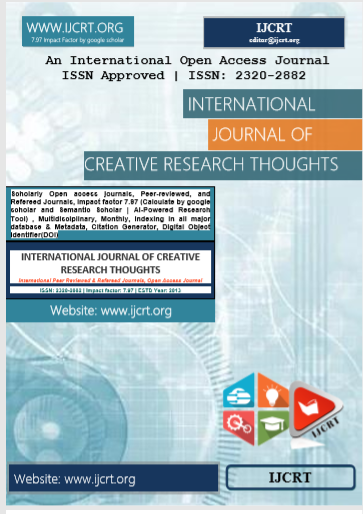 |
 |
|---|---|
| IJCRT Journal front page | IJCRT Journal Back Page |
Paper Title: "FROM VISION TO REALITY: IMPLEMENTING NET ZERO ENERGY BUILDINGS IN THE BUILT ENVIRONMENT"
Author Name(s): Srushti Ashok Nayak
Published Paper ID: - IJCRT2505929
Register Paper ID - 286589
Publisher Journal Name: IJPUBLICATION, IJCRT
DOI Member ID: 10.6084/m9.doi.one.IJCRT2505929 and DOI :
Author Country : Indian Author, India, 560085 , Bengaluru, 560085 , | Research Area: Others area Published Paper URL: http://ijcrt.org/viewfull.php?&p_id=IJCRT2505929 Published Paper PDF: download.php?file=IJCRT2505929 Published Paper PDF: http://www.ijcrt.org/papers/IJCRT2505929.pdf
Your Paper Publication Details:
Title: "FROM VISION TO REALITY: IMPLEMENTING NET ZERO ENERGY BUILDINGS IN THE BUILT ENVIRONMENT"
DOI (Digital Object Identifier) :
Pubished in Volume: 13 | Issue: 5 | Year: May 2025
Publisher Name : IJCRT | www.ijcrt.org | ISSN : 2320-2882
Subject Area: Others area
Author type: Indian Author
Pubished in Volume: 13
Issue: 5
Pages: i88-i92
Year: May 2025
Downloads: 185
E-ISSN Number: 2320-2882
Abstract
As global levels of greenhouse gases keep rising, the temperature of the planet increases, causing ice caps to melt and drastic changes in global weather patterns. Today, it is approximated that the world's built environment accounts for about one-third of all global greenhouse gas emissions and uses 40% of the world's energy. The dilemma for environmental architecture is how to satisfy increasing demand for creative architectural solutions with less strain on the ecosystem. The paper discusses studies of user experience in different categories of energy-efficient buildings with emphasis on indoor climate and overall satisfaction. Energy users have varying concerns. Two key solutions are suggested to minimize CO2 emissions and combat climate change by substituting fossil fuels with renewable ones whenever feasible. Zero energy buildings can exchange energy with the grid, having a net energy balance of zero each year. The paper discusses zero energy buildings in detail.
Licence: creative commons attribution 4.0
License
Creative Commons Attribution 4.0 and The Open Definition

Keywords
Ecological Design, Sustainable Development, Green Architecture, Zero energy building, materials, Ecosystem, Green design, Passive houses, Energy resources, Carbon emission, and Energy conservation.
License
Creative Commons Attribution 4.0 and The Open Definition
Paper Title: An Analysis of Gender-Based Awareness and The Economic Impact of the Pink Tax
Author Name(s): Aditi Aneesh, Dr.Mary Liya C.A
Published Paper ID: - IJCRT2505928
Register Paper ID - 286513
Publisher Journal Name: IJPUBLICATION, IJCRT
DOI Member ID: 10.6084/m9.doi.one.IJCRT2505928 and DOI :
Author Country : Indian Author, India, 683106 , Ernakulam, 683106 , | Research Area: Arts1 All Published Paper URL: http://ijcrt.org/viewfull.php?&p_id=IJCRT2505928 Published Paper PDF: download.php?file=IJCRT2505928 Published Paper PDF: http://www.ijcrt.org/papers/IJCRT2505928.pdf
Your Paper Publication Details:
Title: AN ANALYSIS OF GENDER-BASED AWARENESS AND THE ECONOMIC IMPACT OF THE PINK TAX
DOI (Digital Object Identifier) :
Pubished in Volume: 13 | Issue: 5 | Year: May 2025
Publisher Name : IJCRT | www.ijcrt.org | ISSN : 2320-2882
Subject Area: Arts1 All
Author type: Indian Author
Pubished in Volume: 13
Issue: 5
Pages: i74-i87
Year: May 2025
Downloads: 204
E-ISSN Number: 2320-2882
Abstract
The Pink Tax denotes a type of gender-based pricing where there is a differential in charge for similar goods and services for men and women. The study examines the consumer's awareness and economic impacts of discriminatory pricing in the Pink Tax context among both male and female consumers in Ernakulam district, India. Using a quota sample of 190 respondents and both descriptive and inferential statistical methods (i.e., Chi-square, ANOVA, and correlation analysis), this study discovered that men and women differ in terms of their awareness levels and that the Pink Tax has a real impact on consumer behaviour. The outcomes highlighted the need for public education and effective campaigns targeted at ameliorating the financial and social consequences of the Pink Tax as well as the need for ongoing policy changes; and consumer rights education and empowerment to address the gender gap and discriminatory pricing practices.
Licence: creative commons attribution 4.0
License
Creative Commons Attribution 4.0 and The Open Definition
Keywords
Pink Tax, Gender-Based Pricing, Economic Disparity, Consumer Awareness, Price Discrimination
License
Creative Commons Attribution 4.0 and The Open Definition
Paper Title: MUGHAL ARCHITECTURE: SYMBOL OF POWER AND CULTURE
Author Name(s): Jenifer Hussain
Published Paper ID: - IJCRT2505927
Register Paper ID - 286564
Publisher Journal Name: IJPUBLICATION, IJCRT
DOI Member ID: 10.6084/m9.doi.one.IJCRT2505927 and DOI :
Author Country : Indian Author, India, 784125 , Guwahati, 784125 , | Research Area: Arts All Published Paper URL: http://ijcrt.org/viewfull.php?&p_id=IJCRT2505927 Published Paper PDF: download.php?file=IJCRT2505927 Published Paper PDF: http://www.ijcrt.org/papers/IJCRT2505927.pdf
Your Paper Publication Details:
Title: MUGHAL ARCHITECTURE: SYMBOL OF POWER AND CULTURE
DOI (Digital Object Identifier) :
Pubished in Volume: 13 | Issue: 5 | Year: May 2025
Publisher Name : IJCRT | www.ijcrt.org | ISSN : 2320-2882
Subject Area: Arts All
Author type: Indian Author
Pubished in Volume: 13
Issue: 5
Pages: i69-i73
Year: May 2025
Downloads: 386
E-ISSN Number: 2320-2882
Abstract
The Mughal Empire, which ruled large parts of the Indian subcontinent from the early 16th to the 18th century, left a profound cultural and architectural legacy. This paper explores how Mughal architecture served as a powerful expression of imperial authority while simultaneously reflecting a fusion of diverse cultural traditions. By examining key architectural elements and the broader sociopolitical context, this study demonstrates how Mughal rulers used architectural patronage not only to assert dominance but also to cultivate a rich cultural identity. Drawing from Indo-Islamic, Persian, and Central Asian traditions, Mughal architecture developed a distinct style characterized by monumental structures, symmetrical planning, ornate decoration, and the symbolic use of gardens and domes. This paper also delves into the syncretic nature of Mughal structures, showcasing how religious and cultural inclusivity played a role in shaping architectural decisions. Through a detailed analysis of early Mughal constructions and their symbolic meanings, the study highlights how architecture functioned both as a tool of governance and as a canvas of cultural expression.
Licence: creative commons attribution 4.0
License
Creative Commons Attribution 4.0 and The Open Definition
Keywords
Mughal Architecture, Indo-Islamic Architecture, Symbol of Power, Mughal Empire
License
Creative Commons Attribution 4.0 and The Open Definition
Paper Title: Mahendra Bhishm Krit Me Payal..Upnayas Me Abhiyakti Kinner Vimarsh Ka Adhunik Sandharbh
Author Name(s): Ms Jumken Ninu, Prof. Oken Lego
Published Paper ID: - IJCRT2505926
Register Paper ID - 286545
Publisher Journal Name: IJPUBLICATION, IJCRT
DOI Member ID: 10.6084/m9.doi.one.IJCRT2505926 and DOI : https://doi.org/10.56975/ijcrt.v13i5.286545
Author Country : Indian Author, India, 791112 , Itanagar, 791112 , | Research Area: Medical Science All Published Paper URL: http://ijcrt.org/viewfull.php?&p_id=IJCRT2505926 Published Paper PDF: download.php?file=IJCRT2505926 Published Paper PDF: http://www.ijcrt.org/papers/IJCRT2505926.pdf
Your Paper Publication Details:
Title: MAHENDRA BHISHM KRIT ME PAYAL..UPNAYAS ME ABHIYAKTI KINNER VIMARSH KA ADHUNIK SANDHARBH
DOI (Digital Object Identifier) : https://doi.org/10.56975/ijcrt.v13i5.286545
Pubished in Volume: 13 | Issue: 5 | Year: May 2025
Publisher Name : IJCRT | www.ijcrt.org | ISSN : 2320-2882
Subject Area: Medical Science All
Author type: Indian Author
Pubished in Volume: 13
Issue: 5
Pages: i59-i68
Year: May 2025
Downloads: 278
E-ISSN Number: 2320-2882
Abstract
Mahendra Bhishm Krit Me Payal..Upnayas Me Abhiyakti Kinner Vimarsh Ka Adhunik Sandharbh
Licence: creative commons attribution 4.0
License
Creative Commons Attribution 4.0 and The Open Definition
Keywords
Mahendra Bhishm Krit Me Payal..Upnayas Me Abhiyakti Kinner Vimarsh Ka Adhunik Sandharbh
License
Creative Commons Attribution 4.0 and The Open Definition
Paper Title: Review on the Role of KNN and Random Forest in Intelligent Agriculture for Predictive Analytics
Author Name(s): Ms. Saloni Imle, Dr. R. R. Keole, Dr. A. P. Jadhao, Prof.D. G. Ingale
Published Paper ID: - IJCRT2505925
Register Paper ID - 286389
Publisher Journal Name: IJPUBLICATION, IJCRT
DOI Member ID: 10.6084/m9.doi.one.IJCRT2505925 and DOI :
Author Country : Indian Author, India, 442001 , Wardha , 442001 , | Research Area: Science and Technology Published Paper URL: http://ijcrt.org/viewfull.php?&p_id=IJCRT2505925 Published Paper PDF: download.php?file=IJCRT2505925 Published Paper PDF: http://www.ijcrt.org/papers/IJCRT2505925.pdf
Your Paper Publication Details:
Title: REVIEW ON THE ROLE OF KNN AND RANDOM FOREST IN INTELLIGENT AGRICULTURE FOR PREDICTIVE ANALYTICS
DOI (Digital Object Identifier) :
Pubished in Volume: 13 | Issue: 5 | Year: May 2025
Publisher Name : IJCRT | www.ijcrt.org | ISSN : 2320-2882
Subject Area: Science and Technology
Author type: Indian Author
Pubished in Volume: 13
Issue: 5
Pages: i48-i58
Year: May 2025
Downloads: 210
E-ISSN Number: 2320-2882
Abstract
Agriculture, a cornerstone of global food security and economic development, faces numerous challenges including unpredictable weather patterns, crop diseases, and climate change. In recent years, the integration of machine learning (ML) techniques has revolutionized traditional agricultural practices by enabling data-driven decision-making and precise forecasting. This review paper explores the application of two widely used supervised learning algorithms--K-Nearest Neighbors (KNN) and Random Forest--in the domains of crop and weather prediction. The paper presents a comparative analysis of these models based on their accuracy, efficiency, scalability, and suitability for various agricultural datasets. Through a detailed examination of recent studies and real-world implementations, we highlight the strengths and limitations of each algorithm in addressing specific agricultural problems. Additionally, the review discusses the challenges of data quality, model interpretability, and scalability, while proposing potential directions for future research, including hybrid approaches and real-time predictive systems. By offering insights into the effectiveness of KNN and Random Forest, this paper aims to support the development of intelligent agri solutions for enhanced productivity and sustainability.
Licence: creative commons attribution 4.0
License
Creative Commons Attribution 4.0 and The Open Definition
Keywords
Review, KNN ,Random ,Forest ,Intelligent ,Agriculture, Predictive Analytics
License
Creative Commons Attribution 4.0 and The Open Definition
Paper Title: "HERBAL GUMMIES FOR EMOTIONAL BALANCE: ASHWAGANDHA, VITAMIN D3, AND BRAHMI AS A NATURAL REMEDY FOR DEPRESSION"
Author Name(s): Renu Ramu Gupta, Karimraza Jakir Hussain Balwar, Chanchal Sanju Valmiki, Kavitha Lakshmanaperumal Chettiar, Ms.Nilam Nile
Published Paper ID: - IJCRT2505924
Register Paper ID - 286063
Publisher Journal Name: IJPUBLICATION, IJCRT
DOI Member ID: 10.6084/m9.doi.one.IJCRT2505924 and DOI :
Author Country : Indian Author, India, - , -, - , | Research Area: Science and Technology Published Paper URL: http://ijcrt.org/viewfull.php?&p_id=IJCRT2505924 Published Paper PDF: download.php?file=IJCRT2505924 Published Paper PDF: http://www.ijcrt.org/papers/IJCRT2505924.pdf
Your Paper Publication Details:
Title: "HERBAL GUMMIES FOR EMOTIONAL BALANCE: ASHWAGANDHA, VITAMIN D3, AND BRAHMI AS A NATURAL REMEDY FOR DEPRESSION"
DOI (Digital Object Identifier) :
Pubished in Volume: 13 | Issue: 5 | Year: May 2025
Publisher Name : IJCRT | www.ijcrt.org | ISSN : 2320-2882
Subject Area: Science and Technology
Author type: Indian Author
Pubished in Volume: 13
Issue: 5
Pages: i40-i47
Year: May 2025
Downloads: 189
E-ISSN Number: 2320-2882
Abstract
Herbal gummies formulated with Ashwagandha, Vitamin D3, and Brahmi offer a promising natural solution for managing emotional balance and alleviating symptoms of depression. Ashwagandha, an adaptogen, helps the body cope with stress, reduce anxiety, and promote a calm mental state. Brahmi, an herb traditionally used in Ayurvedic medicine, is believed to enhance cognitive function, improve memory, and reduce mental fatigue, further supporting emotional well-being. Vitamin D3 is vital for regulating mood and has been linked to reduced risk of depression, especially during periods of low sunlight exposure. This combination of ingredients works synergistically to help stabilize mood, enhance mental clarity, and support overall emotional health, providing a natural alternative to conventional antidepressants. The formulated chewable gummies exhibited excellent physicochemical properties, including uniform hardness, optimal moisture content, and a palatable organoleptic profile, ensuring high patient acceptability.
Licence: creative commons attribution 4.0
License
Creative Commons Attribution 4.0 and The Open Definition
Keywords
Chewable gummies, antidepressant formulation, Ashwagandha, Brahmi, Vitamin D, mental health innovation.
License
Creative Commons Attribution 4.0 and The Open Definition
Paper Title: PROS AND CONS OF AI IN DAILY LIFE
Author Name(s): Dharshini SS, Dharshan S, Haritha Senthilnathan, Suma Madam
Published Paper ID: - IJCRT2505923
Register Paper ID - 286163
Publisher Journal Name: IJPUBLICATION, IJCRT
DOI Member ID: 10.6084/m9.doi.one.IJCRT2505923 and DOI :
Author Country : Indian Author, India, 560 069 , Bangalore, 560 069 , | Research Area: Others area Published Paper URL: http://ijcrt.org/viewfull.php?&p_id=IJCRT2505923 Published Paper PDF: download.php?file=IJCRT2505923 Published Paper PDF: http://www.ijcrt.org/papers/IJCRT2505923.pdf
Your Paper Publication Details:
Title: PROS AND CONS OF AI IN DAILY LIFE
DOI (Digital Object Identifier) :
Pubished in Volume: 13 | Issue: 5 | Year: May 2025
Publisher Name : IJCRT | www.ijcrt.org | ISSN : 2320-2882
Subject Area: Others area
Author type: Indian Author
Pubished in Volume: 13
Issue: 5
Pages: i29-i39
Year: May 2025
Downloads: 220
E-ISSN Number: 2320-2882
Abstract
Artificial Intelligence (AI) has become deeply embedded in everyday life, enhancing convenience, efficiency, and decision-making across sectors like healthcare, education, and transportation. From virtual assistants to personalized algorithms, AI is reshaping how people interact with technology. However, it also presents serious challenges, including job displacement, privacy concerns, algorithmic bias, and lack of transparency. This paper explores both the benefits and drawbacks of AI, emphasizing the need for ethical development, inclusive policies, and public education to ensure its responsible use.
Licence: creative commons attribution 4.0
License
Creative Commons Attribution 4.0 and The Open Definition
Keywords
Keywords Artificial Intelligence (AI), Daily Life, Smart Technology, Automation, Machine Learning, AI Ethics, AI in Healthcare, AI Challenges, Data Privacy, Human-AI Interaction, Job Automation, Intelligent Systems
License
Creative Commons Attribution 4.0 and The Open Definition
Paper Title: Credit Card Fraud Detection Using Machine Learning
Author Name(s): BIRLA X, SYED GHULAM RASOOL SM, SAIF RAHMAN U.F, MOHAMED SAHITH S, MOHAMED AYMAN
Published Paper ID: - IJCRT2505922
Register Paper ID - 286261
Publisher Journal Name: IJPUBLICATION, IJCRT
DOI Member ID: 10.6084/m9.doi.one.IJCRT2505922 and DOI :
Author Country : Indian Author, India, 600055 , AVADI, 600055 , | Research Area: Science and Technology Published Paper URL: http://ijcrt.org/viewfull.php?&p_id=IJCRT2505922 Published Paper PDF: download.php?file=IJCRT2505922 Published Paper PDF: http://www.ijcrt.org/papers/IJCRT2505922.pdf
Your Paper Publication Details:
Title: CREDIT CARD FRAUD DETECTION USING MACHINE LEARNING
DOI (Digital Object Identifier) :
Pubished in Volume: 13 | Issue: 5 | Year: May 2025
Publisher Name : IJCRT | www.ijcrt.org | ISSN : 2320-2882
Subject Area: Science and Technology
Author type: Indian Author
Pubished in Volume: 13
Issue: 5
Pages: i24-i28
Year: May 2025
Downloads: 190
E-ISSN Number: 2320-2882
Abstract
The rapid increase in online financial transactions has elevated the risk of credit card fraud, posing significant challenges for financial institutions and consumers. Traditional fraud detection methods often fail to identify complex and evolving fraudulent patterns. This paper introduces a machine learning-based framework that enhances fraud detection accuracy by leveraging advanced classification algorithms, data preprocessing, and model evaluation techniques. Using a real-world credit card transaction dataset, models such as Random Forest, Support Vector Machine, and XGBoost were implemented and evaluated using performance metrics like precision, recall, and F1-score. Our approach demonstrates improved detection capabilities, providing financial institutions with a powerful tool to mitigate fraud risks.
Licence: creative commons attribution 4.0
License
Creative Commons Attribution 4.0 and The Open Definition
Keywords
Credit Card Fraud, Machine Learning, Fraud Detection, Classification, Anomaly Detection, Data Preprocessing, Imbalanced Data, Cybersecurity, Financial Risk, Predictive Modelling
License
Creative Commons Attribution 4.0 and The Open Definition
Paper Title: Artificial Intelligence in Higher Education: Usage Patterns, Challenges, and Ethical Considerations among College Students
Author Name(s): Rathi Chelamoolayil
Published Paper ID: - IJCRT2505921
Register Paper ID - 286396
Publisher Journal Name: IJPUBLICATION, IJCRT
DOI Member ID: 10.6084/m9.doi.one.IJCRT2505921 and DOI :
Author Country : Indian Author, India, 673601 , Kozhikode, 673601 , | Research Area: Management All Published Paper URL: http://ijcrt.org/viewfull.php?&p_id=IJCRT2505921 Published Paper PDF: download.php?file=IJCRT2505921 Published Paper PDF: http://www.ijcrt.org/papers/IJCRT2505921.pdf
Your Paper Publication Details:
Title: ARTIFICIAL INTELLIGENCE IN HIGHER EDUCATION: USAGE PATTERNS, CHALLENGES, AND ETHICAL CONSIDERATIONS AMONG COLLEGE STUDENTS
DOI (Digital Object Identifier) :
Pubished in Volume: 13 | Issue: 5 | Year: May 2025
Publisher Name : IJCRT | www.ijcrt.org | ISSN : 2320-2882
Subject Area: Management All
Author type: Indian Author
Pubished in Volume: 13
Issue: 5
Pages: i17-i23
Year: May 2025
Downloads: 192
E-ISSN Number: 2320-2882
Abstract
Abstract This research investigates the use of artificial intelligence (AI) tools among Calicut district college students. It uses a mixed-method framework using surveys and interviews among 30 students to study usage patterns, benefits, ethical issues, and institutional reactions. The results show high use of AI, especially ChatGPT, for academic activities such as research and writing. While AI enhances efficiency, students are wary of dependency, information inaccuracy, and cheating. The research highlights the importance of ethics training in AI and institutional regulations to strike a balance between innovation and academic ethics.
Licence: creative commons attribution 4.0
License
Creative Commons Attribution 4.0 and The Open Definition
Keywords
Keywords: artificial intelligence, higher education, academic integrity, ChatGPT, student learning, ethics in AI, AI tools
License
Creative Commons Attribution 4.0 and The Open Definition
Paper Title: Impurity Profiling Of Pharmaceutical Drug Substances
Author Name(s): Dr.Archana Bele, Sakshi Chaudhari, Navira Kazi
Published Paper ID: - IJCRT2505920
Register Paper ID - 286528
Publisher Journal Name: IJPUBLICATION, IJCRT
DOI Member ID: 10.6084/m9.doi.one.IJCRT2505920 and DOI : https://doi.org/10.56975/ijcrt.v13i5.286528
Author Country : Indian Author, India, 401303 , Thane, 401303 , | Research Area: Pharmacy All Published Paper URL: http://ijcrt.org/viewfull.php?&p_id=IJCRT2505920 Published Paper PDF: download.php?file=IJCRT2505920 Published Paper PDF: http://www.ijcrt.org/papers/IJCRT2505920.pdf
Your Paper Publication Details:
Title: IMPURITY PROFILING OF PHARMACEUTICAL DRUG SUBSTANCES
DOI (Digital Object Identifier) : https://doi.org/10.56975/ijcrt.v13i5.286528
Pubished in Volume: 13 | Issue: 5 | Year: May 2025
Publisher Name : IJCRT | www.ijcrt.org | ISSN : 2320-2882
Subject Area: Pharmacy All
Author type: Indian Author
Pubished in Volume: 13
Issue: 5
Pages: i1-i16
Year: May 2025
Downloads: 244
E-ISSN Number: 2320-2882
Abstract
Impurity profiling of any compound that lies under the pharmaceutical category is important to make sure that the drug is safe, efficient, and follows all regulatory compliance. This study presents comprehensive knowledge to identify and quantify impurities in any formulation that is intended for clinical use. We can use various advanced analytical techniques, like the UV spectrophotometer, to identify impurities through absorbed light at specific wavelengths. High-performance liquid chromatography coupled with mass spectrometry was employed to separate, identify, and characterize the impurities present. This study involves optimization of chromatographic conditions to improve resolution and sensitivity along with application of statistical analysis for data elucidation. Impurity levels were ensured against previously published standard pharmacopeia to make sure the drug follows safety guidelines. The results were validated by detecting the presence of several known and unknown impurities. This study helps to identify and eradicate impurity involving the pharmaceutical process of drug development.
Licence: creative commons attribution 4.0
License
Creative Commons Attribution 4.0 and The Open Definition
Keywords
Impurity, ICH Guidelines, Chromatography, Pharmaceutical drug
License
Creative Commons Attribution 4.0 and The Open Definition
Call For Paper September 2026
Call For Papers
September 2026
Volume 14 | Issue 9
Last Date :
31-Oct-2026
Submit Manuscript Online Impact Factor: 7.97 Review Results : Within 02-03 Days Paper Publication : Within 02-03 Days
September 2026
Volume 14 | Issue 9
Last Date :
31-Oct-2026
Submit Manuscript Online Impact Factor: 7.97 Review Results : Within 02-03 Days Paper Publication : Within 02-03 Days
Published Issue Details
For Authors
Forms / Downloads
Other IMP Links
Indexing Partner
Research Area
LICENSE





ISSN and 7.97 Impact Factor Details
ISSN: 2320-2882 Impact Factor: 7.97 and ISSN APPROVED Journal Starting Year (ESTD) : 2013


ISSN and 7.97 Impact Factor Details
ISSN: 2320-2882 Impact Factor: 7.97 and ISSN APPROVED Journal Starting Year (ESTD) : 2013
DOI Details
CONFERENCE
CONFERENCE MANAGMENT & PUBLICATION CONFERENCE PROPOSAL
RECENT CONFERENCE

CONFERENCE PROPOSAL CONFERENCE PROCEEDINGS
CONFERENCE PROPOSAL CONFERENCE PROCEEDINGS
For Reviewer /Referral (RMS) Earn 500 per paper
Important Links
NEWS & Conference
Digital Library
IJCRT RMS | Earn 500 Per Paper.

Open Access


LICENSE
Indexing Partner
Scholarly open access journals, Peer-reviewed, and Refereed Journals, Impact factor 7.97 (Calculate by google scholar and Semantic Scholar | AI-Powered Research Tool) , Multidisciplinary, Monthly, Indexing in all major database & Metadata, Citation Generator, Digital Object Identifier(DOI)