Important Details
IJCRT - International Peer Reviewed, Open Access Journal, Multidisciplinary, Monthly, Nominal(Low) Fees for Professional Research Services International Journal of Creative Research Thoughts - IJCRT Peer Review Journal, Refereed Journal, Peer Reviewed Journal , Referred Journal and Indexed Journal, Open access, Online and Print Journal,international Journal Open Access, Accepted by Indian and foreign university ,IJCRT Followed Norms, guidelines, requirement, listing criteria and methodology of score/point also applied from: Scopus , Web of Science , UGC Approved , UGC CARE, UGC-CARE .
UGC Approved Journal No: 49023 (18)
UGC approval Link
https://ijcrt.org/ugc%20approval.jpg
All Policy and Approval
Please Like Our Facebook Page | CrossRef DOI and Hard copy of Certificate Provide if required. | www.IJCRT.org | editor@IJCRT.org | IJCRT WhatsApp +91 94294 58311
Publication Details:
- Paper Submission : 31-Oct-2026. Call For Paper (Volume 14 | Issue 9 | Month- September 2026)
- Acceptance/Rejection Notification: Within 02-04 Days.
- Paper Publish: Within 02-04 Days after submitting all documents.
-
Submit Your Paper Any time There No deadline.
-
Publication fees : 1570 INR for Indian author & 59$ for foreign International author.
Please Like Our Facebook Page | CrossRef DOI and Hard copy of Certificate Provide if required.
Licence and Indexing
Indexing In Google Scholar, SSRN, ResearcherID-Publons, Semantic Scholar | AI-Powered Research Tool, Microsoft Academic, Academia.edu, arXiv.org, Research Gate, CiteSeerX, ResearcherID Thomson Reuters, Mendeley : reference manager, DocStoc, ISSUU, Scribd, and many more | High Impact Factor: 7.97 | Digital object identifier (DOI) and Hard Copy of certificate Provided.



























Licence
DOI
ISSN Approved impact factor: 7.97 
Creative Common 
Valid as per new UGC Gazette regulations 

INTERNATIONAL JOURNAL OF CREATIVE RESEARCH THOUGHTS - IJCRT (IJCRT.ORG)
International Peer Reviewed & Refereed Journals, Open Access Journal
IJCRT Peer-Reviewed (Refereed) Journal as Per New UGC Rules.
ISSN Approved Journal No: 2320-2882 | Impact factor: 7.97 | ESTD Year: 2013
Call For Paper - Volume 14 | Issue 9 | Month- September 2026
Scholarly open access journals, Peer-reviewed, and Refereed Journals, Impact factor 7.97 (Calculate by google scholar and Semantic Scholar | AI-Powered Research Tool) , Multidisciplinary, Monthly, Indexing in all major database & Metadata, Citation Generator, Digital Object Identifier(CrossRef DOI)
IJCRT WhatsApp Contact
IJCRT Search Xplore - Search all paper by Paper Name , Author Name, and Title
Volume 14 | Issue 5 |
Volume 14 | Issue 5 | Month
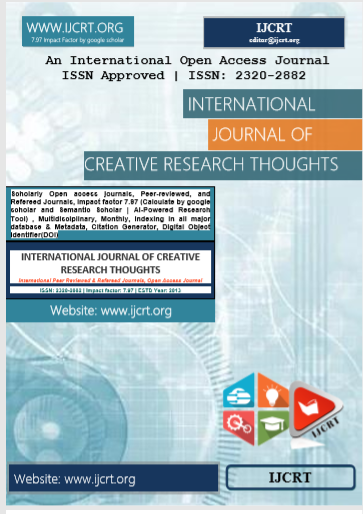
Downlaod After Publication 1) Table of content index in PDF
2) Table of content index in HTML 2)Table of content index in HTML
3) Front Page 3) Front Page
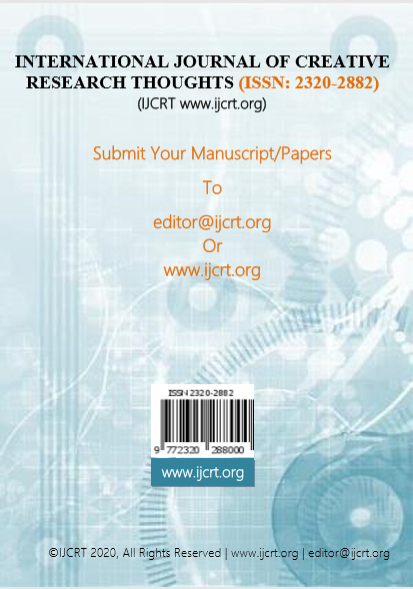
4) Back Page 4) Back Page
5) Editor Board Member 5)Editor Board Member
6) OLD Style Issue 6)OLD Style Issue
 |
 |
|---|---|
| IJCRT Journal front page | IJCRT Journal Back Page |
Paper Title: Impact Of Multimodal Intervention Programme On Anaemia Among Adolescent Girls At Selected BCM Hostels Of Vijayapura
Author Name(s): Ms Kaveri H, Dr Jayashree Pujari
Published Paper ID: - IJCRT2605642
Register Paper ID - 308798
Publisher Journal Name: IJPUBLICATION, IJCRT
DOI Member ID: 10.6084/m9.doi.one.IJCRT2605642 and DOI :
Author Country : Indian Author, India, 586103 , Vijayapura, 586103 , | Research Area: Health Science All Published Paper URL: http://ijcrt.org/viewfull.php?&p_id=IJCRT2605642 Published Paper PDF: download.php?file=IJCRT2605642 Published Paper PDF: http://www.ijcrt.org/papers/IJCRT2605642.pdf
Your Paper Publication Details:
Title: IMPACT OF MULTIMODAL INTERVENTION PROGRAMME ON ANAEMIA AMONG ADOLESCENT GIRLS AT SELECTED BCM HOSTELS OF VIJAYAPURA
DOI (Digital Object Identifier) :
Pubished in Volume: 14 | Issue: 5 | Year: May 2026
Publisher Name : IJCRT | www.ijcrt.org | ISSN : 2320-2882
Subject Area: Health Science All
Author type: Indian Author
Pubished in Volume: 14
Issue: 5
Pages: f609-f630
Year: May 2026
Downloads: 82
E-ISSN Number: 2320-2882
Abstract
Licence: creative commons attribution 4.0
License
Creative Commons Attribution 4.0 and The Open Definition

Keywords
Prevalance,Anemia,Multimodal intervention ,adolescent girls
License
Creative Commons Attribution 4.0 and The Open Definition
Paper Title: A CRITICAL EXAMINATION OF ANTI-DOPING REGULATION, INSTITUTIONAL GAPS, AND CONSTITUTIONAL RIGHTS
Author Name(s): Dr. Deepa Singh
Published Paper ID: - IJCRT2605641
Register Paper ID - 308787
Publisher Journal Name: IJPUBLICATION, IJCRT
DOI Member ID: 10.6084/m9.doi.one.IJCRT2605641 and DOI :
Author Country : Indian Author, India, 4520210 , Indore, 4520210 , | Research Area: Others area Published Paper URL: http://ijcrt.org/viewfull.php?&p_id=IJCRT2605641 Published Paper PDF: download.php?file=IJCRT2605641 Published Paper PDF: http://www.ijcrt.org/papers/IJCRT2605641.pdf
Your Paper Publication Details:
Title: A CRITICAL EXAMINATION OF ANTI-DOPING REGULATION, INSTITUTIONAL GAPS, AND CONSTITUTIONAL RIGHTS
DOI (Digital Object Identifier) :
Pubished in Volume: 14 | Issue: 5 | Year: May 2026
Publisher Name : IJCRT | www.ijcrt.org | ISSN : 2320-2882
Subject Area: Others area
Author type: Indian Author
Pubished in Volume: 14
Issue: 5
Pages: f597-f608
Year: May 2026
Downloads: 82
E-ISSN Number: 2320-2882
Abstract
Few questions in Indian sports law are as simultaneously urgent and underexplored as the regulation of doping. India carries one of the worst global records for anti-doping rule violations, yet for decades it ran its enforcement machinery without any dedicated statute -- relying instead on a patchwork of society-registered rules that courts could, and did, question at will. This paper traces the arc of that story: from NADA's earliest years as a body with authority but no legislative teeth, through the enactment of the National Anti-Doping Act in 2022, to the sweeping reform proposals contained in the National Anti-Doping (Amendment) Bill, 2025. Along the way, it examines India's obligations under the WADA Code and the UNESCO Convention Against Doping in Sports, and asks honestly how well the domestic framework has lived up to those commitments. The paper pays particular attention to three recurring failures that have plagued enforcement -- the 2019 suspension of the National Dope Testing Laboratory, the problem of inadvertent doping among under-educated athletes, and the procedural shortcomings of NADA's disciplinary panels. It also brings the constitutional dimension into focus, looking at how anti-doping sanctions interact with athletes' fundamental rights under Articles 14, 19, and 21 of the Constitution. The paper closes with concrete reform suggestions drawn from comparative experience and the specific contours of India's sporting ecosystem.
Licence: creative commons attribution 4.0
License
Creative Commons Attribution 4.0 and The Open Definition
Keywords
Anti-Doping, NADA India, WADA Code, National Anti-Doping Act 2022, Sports Law, Athlete Rights, Doping Rule Violations, NDTL, Strict Liability, Constitutional Rights.
License
Creative Commons Attribution 4.0 and The Open Definition
Paper Title: Reading Water as a Space in Abraham Verghese's The Covenant of Water
Author Name(s): Sangeetha K Mohan
Published Paper ID: - IJCRT2605640
Register Paper ID - 308790
Publisher Journal Name: IJPUBLICATION, IJCRT
DOI Member ID: 10.6084/m9.doi.one.IJCRT2605640 and DOI :
Author Country : Indian Author, India, 679329 , Nilambur, 679329 , | Research Area: Arts All Published Paper URL: http://ijcrt.org/viewfull.php?&p_id=IJCRT2605640 Published Paper PDF: download.php?file=IJCRT2605640 Published Paper PDF: http://www.ijcrt.org/papers/IJCRT2605640.pdf
Your Paper Publication Details:
Title: READING WATER AS A SPACE IN ABRAHAM VERGHESE'S THE COVENANT OF WATER
DOI (Digital Object Identifier) :
Pubished in Volume: 14 | Issue: 5 | Year: May 2026
Publisher Name : IJCRT | www.ijcrt.org | ISSN : 2320-2882
Subject Area: Arts All
Author type: Indian Author
Pubished in Volume: 14
Issue: 5
Pages: f593-f596
Year: May 2026
Downloads: 83
E-ISSN Number: 2320-2882
Abstract
This paper examines Abraham Verghese's The Covenant of Water through the lens of blue humanities, focusing on the spatial differentiation between Kerala's inland backwater environments and the coastal urban seascape of Kochi. The central argument posits that the contrast between familiar backwater environments and the threatening yet fascinating open sea exemplifies blue humanities' exploration of how different aquatic spaces shape human relationships with water--from intimate, domesticated waterways to the sublime and riveting open ocean. This paper reveals a critical gap in current blue humanities scholarship, which has predominantly focused on oceanic studies while neglecting the cultural significance of rivers, backwaters, and other inland water systems, particularly in postcolonial contexts, by focusing on a journey that transforms from the known domesticity of river travel to the anxiety-inducing vastness of harbor waters.
Licence: creative commons attribution 4.0
License
Creative Commons Attribution 4.0 and The Open Definition
Keywords
Blue Humanities, known to unknown, Hydroscapes
License
Creative Commons Attribution 4.0 and The Open Definition
Paper Title: The Architecture of Distrust: A Multi-Sectoral Study of India-China Relations (2020-2026)
Author Name(s): JOSEPH DEVASAHAYAM RAJ
Published Paper ID: - IJCRT2605639
Register Paper ID - 308783
Publisher Journal Name: IJPUBLICATION, IJCRT
DOI Member ID: 10.6084/m9.doi.one.IJCRT2605639 and DOI :
Author Country : Indian Author, India, 560001 , Bengaluru, 560001 , | Research Area: Social Science All Published Paper URL: http://ijcrt.org/viewfull.php?&p_id=IJCRT2605639 Published Paper PDF: download.php?file=IJCRT2605639 Published Paper PDF: http://www.ijcrt.org/papers/IJCRT2605639.pdf
Your Paper Publication Details:
Title: THE ARCHITECTURE OF DISTRUST: A MULTI-SECTORAL STUDY OF INDIA-CHINA RELATIONS (2020-2026)
DOI (Digital Object Identifier) :
Pubished in Volume: 14 | Issue: 5 | Year: May 2026
Publisher Name : IJCRT | www.ijcrt.org | ISSN : 2320-2882
Subject Area: Social Science All
Author type: Indian Author
Pubished in Volume: 14
Issue: 5
Pages: f584-f592
Year: May 2026
Downloads: 196
E-ISSN Number: 2320-2882
Abstract
This study uses a multi-sectoral examination of diplomacy, media, nationalism, digital governance, and strategic communication to look at how India-China ties changed between 2020 and 2026. It contends that the June 2020 conflict in the Galwan Valley signaled a significant break in the post-Cold War system of "managed competition," which had previously allowed both governments to strike a balance between strategic rivalry and economic collaboration. According to the study, this break represents the shift from the hopeful "Wuhan Spirit" of leader-driven diplomacy to the hostile "Galwan Reality," which is marked by increasing structural mistrust, militarized coexistence, and ideological conflict. Using a qualitative and interdisciplinary research methodology, the study draws upon media discourse analysis, strategic studies literature, diplomatic developments, and digital communication frameworks to examine the evolving architecture of distrust between the two states. The study illustrates how the conflict spread beyond the Line of Actual Control (LAC) into the domains of digital media, information ecosystems, and public consciousness by drawing on viewpoints from international relations, media studies, political communication, and strategic studies. In order to explain how geopolitical competition has increasingly emerged through narratives, algorithms, visual symbolism, and online emotional mobilization, it presents the idea of the "Digital Border." The paper also makes a distinction between "visual warfare" and "information warfare," demonstrating how open-source intelligence, satellite photos, viral videos, and broadcast nationalism changed the politics of perception both during and after the Galwan incident. The study also examines how journalism contributes to the development of conflicting nationalist narratives in China and India. China's controlled propaganda architecture and the economically motivated "Newsroom Nationalism" of Indian media are analyzed as opposing but similar systems of patriotic mobilization. Chinese state-controlled media fostered disciplined "defensive nationalism" focused on sacrifice, unity, and party legitimacy, while India's pluralistic media environment promoted performative nationalism through sensationalist programming and social media activism. In both situations, there was less room for diplomatic restraint and independent examination as journalism became intricately linked to strategic official goals. The study contends that the post-Galwan era marks the beginning of an extended "Cold Peace" in Asia by placing the rivalry between China and India within the larger framework of hybrid conflict and communication power. Although economic interdependence still exists, military readiness, digital securitization, strategic balance, and conflicting civilizational narratives are taking center stage. In the end, the study argues that in an era where narratives themselves serve as strategic weapons, the future of India-China relations will depend not only on border talks or military deterrence but also on both societies' capacity to handle the politics of perception, nationalism, and information warfare.
Licence: creative commons attribution 4.0
License
Creative Commons Attribution 4.0 and The Open Definition
Keywords
India-China Relations, Galwan Valley, Media Discourse, Digital Border, Information Warfare, Nationalistic Mobilization, Foreign Policy, Geopolitics
License
Creative Commons Attribution 4.0 and The Open Definition
Paper Title: A Study on Demographical Situation of Aimol Tribe in Manipur
Author Name(s): Sialloa Sumleailal Aimol, Prof. Lamalu Thaimei
Published Paper ID: - IJCRT2605638
Register Paper ID - 308781
Publisher Journal Name: IJPUBLICATION, IJCRT
DOI Member ID: 10.6084/m9.doi.one.IJCRT2605638 and DOI : https://doi.org/10.56975/ijcrt.v14i5.308781
Author Country : Indian Author, India, 795001 , Imphal West, 795001 , | Research Area: Social Science All Published Paper URL: http://ijcrt.org/viewfull.php?&p_id=IJCRT2605638 Published Paper PDF: download.php?file=IJCRT2605638 Published Paper PDF: http://www.ijcrt.org/papers/IJCRT2605638.pdf
Your Paper Publication Details:
Title: A STUDY ON DEMOGRAPHICAL SITUATION OF AIMOL TRIBE IN MANIPUR
DOI (Digital Object Identifier) : https://doi.org/10.56975/ijcrt.v14i5.308781
Pubished in Volume: 14 | Issue: 5 | Year: May 2026
Publisher Name : IJCRT | www.ijcrt.org | ISSN : 2320-2882
Subject Area: Social Science All
Author type: Indian Author
Pubished in Volume: 14
Issue: 5
Pages: f580-f583
Year: May 2026
Downloads: 123
E-ISSN Number: 2320-2882
Abstract
The Aimol, a Scheduled Tribe of Manipur, is a numerically small community with a population of 3,902 as per the 2011 Census. This paper examines key demographic indicators of the Aimol tribe using secondary data from the 2001 and 2011 Censuses. The objectives are to analyse the decadal growth rate, sex ratio, child sex ratio, literacy rate, and workforce participation rate. Results show a decadal growth rate of 2.12 per cent, compared with the Manipur ST average of 21.8 per cent, indicating demographic stagnation. Sex ratio stands at 976, and child sex ratio at 943. The literacy rate is 71.2 per cent, with a gender gap of 17.6 per cent. Workforce participation rate is 41.3 per cent, with 68.2 per cent of workers engaged as cultivators. The study highlights slow growth, gender disparity in education, and agrarian dependence. Targeted interventions under the Tribal Sub-Plan are suggested for female literacy and skill diversification. The findings provide baseline data for policy and future research on micro-tribes. Keywords: Aimol Tribe, Demography, Census 2011, Sex Ratio, Literacy, Manipur, Scheduled Introduction: Northeast India is home to over 200 Scheduled Tribes with diverse demographic characteristics. Manipur has 34 recognised STs, constituting 40.9 per cent of the state's population, as per the Census 2011. While major tribes are well documented, micro-tribes remain data-deficient. The Aimol are a Scheduled Tribe notified under the Constitution (Scheduled Tribes) Order, 1950. Ethnologue 2024 classifies the Aimol language as endangered, with 3,900 speakers. They are concentrated in the Tengnoupal (earlier Chandel), Churachandpur, and Senapati districts of Manipur. Existing literature on Aimol is largely ethnographic. Singh 1998 provides a cultural profile, but demographic data is limited to 2001. The post-2001 demographic transition of the Aimol remains unexamined. Census 2011 provides disaggregated ST data in A-11 and ST-14 tables, enabling micro-level analysis. Understanding the demographic profile of small tribes is crucial for allocating Tribal Sub-Plan resources and implementing NEP 2020. Hence, the present study examines the demographic profile of the Aimol tribe using the 2011 Census. The study fills the research gap on micro-tribes and provides an empirical baseline for policymakers.
Licence: creative commons attribution 4.0
License
Creative Commons Attribution 4.0 and The Open Definition
Keywords
Aimol Tribe, demography, census Govt of India
License
Creative Commons Attribution 4.0 and The Open Definition
Paper Title: The Impact of Economic Reforms on Indian Economy: A Comprehensive Assessment from F.Y. 1991 to 2024
Author Name(s): Kuldeep Choudhary, Dr Yogesh Pahariya
Published Paper ID: - IJCRT2605637
Register Paper ID - 308686
Publisher Journal Name: IJPUBLICATION, IJCRT
DOI Member ID: 10.6084/m9.doi.one.IJCRT2605637 and DOI :
Author Country : Indian Author, India, - , -, - , | Research Area: Science and Technology Published Paper URL: http://ijcrt.org/viewfull.php?&p_id=IJCRT2605637 Published Paper PDF: download.php?file=IJCRT2605637 Published Paper PDF: http://www.ijcrt.org/papers/IJCRT2605637.pdf
Your Paper Publication Details:
Title: THE IMPACT OF ECONOMIC REFORMS ON INDIAN ECONOMY: A COMPREHENSIVE ASSESSMENT FROM F.Y. 1991 TO 2024
DOI (Digital Object Identifier) :
Pubished in Volume: 14 | Issue: 5 | Year: May 2026
Publisher Name : IJCRT | www.ijcrt.org | ISSN : 2320-2882
Subject Area: Science and Technology
Author type: Indian Author
Pubished in Volume: 14
Issue: 5
Pages: f564-f579
Year: May 2026
Downloads: 443
E-ISSN Number: 2320-2882
Abstract
India's Economic Reforms began on 24th July 1991 during the P.V. Narasimha Rao government with Manmohan Singh as the Finance Minister of India. This paper is an expansion of the original assessment of the Economic Reforms in India (2013), and includes the period from 1991 to 2024. Major policy events covered here include the Goods and Services Tax (GST) of 2017, the Unified Payment Interface (UPI) revolution, constitution of National Institution of Transforming India (NITI) Aayog replacing the Planning Commission (2015), demonetisation (2016), Insolvency and Bankruptcy Code (IBC), Production Linked Incentive (PLI) schemes, and India emerging as the fifth largest economy in the world. The paper analyses India's economic reforms with a primary focus on economic developments while also taking note of the political economy dynamics in shaping policy making during various coalition governments ranging from those of the Indian National Congress (INC) United Progressive Alliance (UPA), to Bhartiya Janta Party (BJP) National Democratic Alliance (NDA) governments. While the paper acknowledges the ongoing structural issues, such as job creation and distress in agriculture, it highlights that the digital financial sector in India, foreign investment, and other macroeconomic indicators have undergone a paradigm shift over the past three decades.
Licence: creative commons attribution 4.0
License
Creative Commons Attribution 4.0 and The Open Definition
Keywords
Economic Reforms, GDP, Fiscal Deficit, GST, UPI, Digital India, FDI, NITI Aayog.
License
Creative Commons Attribution 4.0 and The Open Definition
Paper Title: Applications of Fluid Dynamics in Mathematics
Author Name(s): Dr.Ch.Suresh Kumar
Published Paper ID: - IJCRT2605636
Register Paper ID - 308797
Publisher Journal Name: IJPUBLICATION, IJCRT
DOI Member ID: 10.6084/m9.doi.one.IJCRT2605636 and DOI :
Author Country : Indian Author, India, 523201 , Addanki, 523201 , | Research Area: Mathematics All Published Paper URL: http://ijcrt.org/viewfull.php?&p_id=IJCRT2605636 Published Paper PDF: download.php?file=IJCRT2605636 Published Paper PDF: http://www.ijcrt.org/papers/IJCRT2605636.pdf
Your Paper Publication Details:
Title: APPLICATIONS OF FLUID DYNAMICS IN MATHEMATICS
DOI (Digital Object Identifier) :
Pubished in Volume: 14 | Issue: 5 | Year: May 2026
Publisher Name : IJCRT | www.ijcrt.org | ISSN : 2320-2882
Subject Area: Mathematics All
Author type: Indian Author
Pubished in Volume: 14
Issue: 5
Pages: f560-f563
Year: May 2026
Downloads: 166
E-ISSN Number: 2320-2882
Abstract
Fluid dynamics is a significant branch of applied mathematics that studies the motion of liquids and gases through mathematical models and computational techniques. The subject connects differential equations, numerical analysis, vector calculus, topology, and computational mathematics with practical applications in engineering, meteorology, medicine, astrophysics, and environmental science. This paper explores the mathematical foundations of fluid dynamics and its applications in modern mathematics. Special emphasis is placed on the Navier-Stokes equations, computational fluid dynamics (CFD), turbulence modeling, dynamical systems, and machine learning-assisted simulations. The paper also discusses current mathematical challenges, including the famous Navier-Stokes existence and smoothness problem, one of the Millennium Prize Problems. Fluid dynamics demonstrates how mathematical theories contribute directly to solving real-world scientific and engineering problems.
Licence: creative commons attribution 4.0
License
Creative Commons Attribution 4.0 and The Open Definition
Keywords
Fluid Dynamics, Applied Mathematics, Navier-Stokes Equations, Computational Fluid Dynamics, Differential Equations, Numerical Analysis, Turbulence, Mathematical Modeling
License
Creative Commons Attribution 4.0 and The Open Definition
Paper Title: The primary aim of this study is to evaluate the anti-diabetic activity of selected herbal extracts using experimental animal models and to scientifically validate their traditional use in diabetes management.
Author Name(s): Prof. Kaware A. P., Kumtekar Omkar Vilas, Tidke Om Ramkisan, Rathod Rohan Yogesh, Jadhav Sumit madhukar
Published Paper ID: - IJCRT2605635
Register Paper ID - 308777
Publisher Journal Name: IJPUBLICATION, IJCRT
DOI Member ID: 10.6084/m9.doi.one.IJCRT2605635 and DOI :
Author Country : Indian Author, India, 431122 , Beed, 431122 , | Research Area: Pharmacy All Published Paper URL: http://ijcrt.org/viewfull.php?&p_id=IJCRT2605635 Published Paper PDF: download.php?file=IJCRT2605635 Published Paper PDF: http://www.ijcrt.org/papers/IJCRT2605635.pdf
Your Paper Publication Details:
Title: THE PRIMARY AIM OF THIS STUDY IS TO EVALUATE THE ANTI-DIABETIC ACTIVITY OF SELECTED HERBAL EXTRACTS USING EXPERIMENTAL ANIMAL MODELS AND TO SCIENTIFICALLY VALIDATE THEIR TRADITIONAL USE IN DIABETES MANAGEMENT.
DOI (Digital Object Identifier) :
Pubished in Volume: 14 | Issue: 5 | Year: May 2026
Publisher Name : IJCRT | www.ijcrt.org | ISSN : 2320-2882
Subject Area: Pharmacy All
Author type: Indian Author
Pubished in Volume: 14
Issue: 5
Pages: f521-f559
Year: May 2026
Downloads: 86
E-ISSN Number: 2320-2882
Abstract
Diabetes mellitus is a chronic metabolic disorder characterized by persistent hyperglycemia due to defects in insulin secretion, insulin action, or both. The increasing prevalence of diabetes and the limitations of synthetic drugs have led to growing interest in herbal medicines. This study focuses on the evaluation of anti-diabetic activity of selected herbal extracts using experimental animal models. Herbal extracts were prepared using standard extraction techniques and evaluated for their phytochemical constituents. The anti-diabetic activity was assessed using streptozotocin (STZ)-induced diabetic rats. Parameters such as fasting blood glucose levels, body weight, lipid profile, and histopathological studies were analyzed. The results demonstrated significant reduction in blood glucose levels in treated groups, indicating potential anti-diabetic activity of the selected herbal extracts. The study supports the traditional use of these herbs and highlights their potential for development into safer anti- diabetic formulations.
Licence: creative commons attribution 4.0
License
Creative Commons Attribution 4.0 and The Open Definition
Keywords
Diabetes Mellitus, Herbal Extracts, STZ Model, Phytochemicals, Anti-diabetic Activity
License
Creative Commons Attribution 4.0 and The Open Definition
Paper Title: CropGenius: An Integrated Ai-Based Smart Farming And Crop Insurance Assistance System
Author Name(s): Supril Prakash Patil, Gourav Ganesh Apugade, Umer Jahakhan Attar, Parshwa Pradip Patil, Dr. G. V. Patil
Published Paper ID: - IJCRT2605634
Register Paper ID - 308772
Publisher Journal Name: IJPUBLICATION, IJCRT
DOI Member ID: 10.6084/m9.doi.one.IJCRT2605634 and DOI :
Author Country : Indian Author, India, 416006 , Kolhapur, 416006 , | Research Area: Science and Technology Published Paper URL: http://ijcrt.org/viewfull.php?&p_id=IJCRT2605634 Published Paper PDF: download.php?file=IJCRT2605634 Published Paper PDF: http://www.ijcrt.org/papers/IJCRT2605634.pdf
Your Paper Publication Details:
Title: CROPGENIUS: AN INTEGRATED AI-BASED SMART FARMING AND CROP INSURANCE ASSISTANCE SYSTEM
DOI (Digital Object Identifier) :
Pubished in Volume: 14 | Issue: 5 | Year: May 2026
Publisher Name : IJCRT | www.ijcrt.org | ISSN : 2320-2882
Subject Area: Science and Technology
Author type: Indian Author
Pubished in Volume: 14
Issue: 5
Pages: f514-f520
Year: May 2026
Downloads: 69
E-ISSN Number: 2320-2882
Abstract
Agriculture plays a significant role in the Indian economy, especially in states like Maharashtra where a large population depends on farming for livelihood. Farmers often face challenges such as improper crop selection, crop diseases, uncertain weather conditions, low profitability, and lack of awareness about crop insurance schemes. Most existing agricultural systems focus on individual services and do not provide an integrated solution for farmers. This paper presents CropGenius, an integrated AI-based smart farming assistance system developed using Machine Learning, Deep Learning, and web technologies. The system recommends suitable crops based on district, season, soil type, irrigation method, and land size using a Random Forest model. It also detects crop diseases from uploaded leaf images using CNN and TensorFlow Lite models. Additional features include yield and profit estimation, crop comparison, Smart Bima insurance recommendation, multilingual support, and expert chat assistance. The system is implemented using Flask, SQLite, Scikit-learn, TensorFlow, OpenCV, and Tailwind CSS. CropGenius combines multiple agricultural services into a single user-friendly platform to improve farming decisions, reduce crop losses, and increase farmer accessibility to digital agricultural support systems.
Licence: creative commons attribution 4.0
License
Creative Commons Attribution 4.0 and The Open Definition
Keywords
Artificial Intelligence, Machine Learning, Smart Farming, Crop Recommendation, Disease Detection, Deep Learning, Smart Agriculture, Crop Insurance, Random Forest, CNN, TensorFlow, Flask, Agricultural Decision Support System.
License
Creative Commons Attribution 4.0 and The Open Definition
Paper Title: Women Empowerment and Sustainable Livelihood through Weaving: A Study of Weavers of Chizami Weaves under Phek District
Author Name(s): Mr. Wetshote Thopi
Published Paper ID: - IJCRT2605633
Register Paper ID - 308809
Publisher Journal Name: IJPUBLICATION, IJCRT
DOI Member ID: 10.6084/m9.doi.one.IJCRT2605633 and DOI :
Author Country : Indian Author, India, 797106 , Chumoukedima, 797106 , | Research Area: Social Science All Published Paper URL: http://ijcrt.org/viewfull.php?&p_id=IJCRT2605633 Published Paper PDF: download.php?file=IJCRT2605633 Published Paper PDF: http://www.ijcrt.org/papers/IJCRT2605633.pdf
Your Paper Publication Details:
Title: WOMEN EMPOWERMENT AND SUSTAINABLE LIVELIHOOD THROUGH WEAVING: A STUDY OF WEAVERS OF CHIZAMI WEAVES UNDER PHEK DISTRICT
DOI (Digital Object Identifier) :
Pubished in Volume: 14 | Issue: 5 | Year: May 2026
Publisher Name : IJCRT | www.ijcrt.org | ISSN : 2320-2882
Subject Area: Social Science All
Author type: Indian Author
Pubished in Volume: 14
Issue: 5
Pages: f505-f513
Year: May 2026
Downloads: 89
E-ISSN Number: 2320-2882
Abstract
Women have been taking the whole charge in weaving, as men are taboo to weave in Naga society. The weaving monopoly by Naga women has been holding and carrying the Naga identity through weaving. The present study focuses on the role women involved in Chizami Weaves in the socio-economic empowerment of rural women in Phek district of Nagaland. Chizami Weaves was initiated by North East Network in 2008 and has emerged as an important platform for preserving traditional textile practices while generating sustainable livelihood opportunities for women weavers. The study examines the socio-economic condition of women engaged in the project, the benefits derived from their participation, and the challenges faced by them in their working environment. Chizami Weaves as an organization has played a significant role in enhancing women's economic independence, improving their standard of living and increasing their participation in social and economic activities. The project has also contributed towards the preservation of traditional weaving skills and the promotion of rural employment. However, issues such as financial limitations, marketing difficulties and infrastructural constrained continue to effect the women weavers. This study tries to analyze and understand how Chizami Weaves has emerged as an important instrument for women's empowerment, sustainable livelihood, and rural development in Nagaland.
Licence: creative commons attribution 4.0
License
Creative Commons Attribution 4.0 and The Open Definition
Keywords
Gender, Empowerment, Sustainable Livelihood, Economy, Weaving, etc
License
Creative Commons Attribution 4.0 and The Open Definition
Call For Paper September 2026
Call For Papers
September 2026
Volume 14 | Issue 9
Last Date :
31-Oct-2026
Submit Manuscript Online Impact Factor: 7.97 Review Results : Within 02-03 Days Paper Publication : Within 02-03 Days
September 2026
Volume 14 | Issue 9
Last Date :
31-Oct-2026
Submit Manuscript Online Impact Factor: 7.97 Review Results : Within 02-03 Days Paper Publication : Within 02-03 Days
Published Issue Details
For Authors
Forms / Downloads
Other IMP Links
Indexing Partner
Research Area
LICENSE





ISSN and 7.97 Impact Factor Details
ISSN: 2320-2882 Impact Factor: 7.97 and ISSN APPROVED Journal Starting Year (ESTD) : 2013


ISSN and 7.97 Impact Factor Details
ISSN: 2320-2882 Impact Factor: 7.97 and ISSN APPROVED Journal Starting Year (ESTD) : 2013
DOI Details
CONFERENCE
CONFERENCE MANAGMENT & PUBLICATION CONFERENCE PROPOSAL
RECENT CONFERENCE

CONFERENCE PROPOSAL CONFERENCE PROCEEDINGS
CONFERENCE PROPOSAL CONFERENCE PROCEEDINGS
For Reviewer /Referral (RMS) Earn 500 per paper
Important Links
NEWS & Conference
Digital Library
IJCRT RMS | Earn 500 Per Paper.

Open Access


LICENSE
Indexing Partner
Scholarly open access journals, Peer-reviewed, and Refereed Journals, Impact factor 7.97 (Calculate by google scholar and Semantic Scholar | AI-Powered Research Tool) , Multidisciplinary, Monthly, Indexing in all major database & Metadata, Citation Generator, Digital Object Identifier(DOI)