Important Details
IJCRT - International Peer Reviewed, Open Access Journal, Multidisciplinary, Monthly, Nominal(Low) Fees for Professional Research Services International Journal of Creative Research Thoughts - IJCRT Peer Review Journal, Refereed Journal, Peer Reviewed Journal , Referred Journal and Indexed Journal, Open access, Online and Print Journal,international Journal Open Access, Accepted by Indian and foreign university ,IJCRT Followed Norms, guidelines, requirement, listing criteria and methodology of score/point also applied from: Scopus , Web of Science , UGC Approved , UGC CARE, UGC-CARE .
UGC Approved Journal No: 49023 (18)
UGC approval Link
https://ijcrt.org/ugc%20approval.jpg
All Policy and Approval
Please Like Our Facebook Page | CrossRef DOI and Hard copy of Certificate Provide if required. | www.IJCRT.org | editor@IJCRT.org | IJCRT WhatsApp +91 94294 58311
Publication Details:
- Paper Submission : 31-Oct-2026. Call For Paper (Volume 14 | Issue 9 | Month- September 2026)
- Acceptance/Rejection Notification: Within 02-04 Days.
- Paper Publish: Within 02-04 Days after submitting all documents.
-
Submit Your Paper Any time There No deadline.
-
Publication fees : 1570 INR for Indian author & 59$ for foreign International author.
Please Like Our Facebook Page | CrossRef DOI and Hard copy of Certificate Provide if required.
Licence and Indexing
Indexing In Google Scholar, SSRN, ResearcherID-Publons, Semantic Scholar | AI-Powered Research Tool, Microsoft Academic, Academia.edu, arXiv.org, Research Gate, CiteSeerX, ResearcherID Thomson Reuters, Mendeley : reference manager, DocStoc, ISSUU, Scribd, and many more | High Impact Factor: 7.97 | Digital object identifier (DOI) and Hard Copy of certificate Provided.



























Licence
DOI
ISSN Approved impact factor: 7.97 
Creative Common 
Valid as per new UGC Gazette regulations 

INTERNATIONAL JOURNAL OF CREATIVE RESEARCH THOUGHTS - IJCRT (IJCRT.ORG)
International Peer Reviewed & Refereed Journals, Open Access Journal
IJCRT Peer-Reviewed (Refereed) Journal as Per New UGC Rules.
ISSN Approved Journal No: 2320-2882 | Impact factor: 7.97 | ESTD Year: 2013
Call For Paper - Volume 14 | Issue 9 | Month- September 2026
Scholarly open access journals, Peer-reviewed, and Refereed Journals, Impact factor 7.97 (Calculate by google scholar and Semantic Scholar | AI-Powered Research Tool) , Multidisciplinary, Monthly, Indexing in all major database & Metadata, Citation Generator, Digital Object Identifier(CrossRef DOI)
IJCRT WhatsApp Contact
IJCRT Search Xplore - Search all paper by Paper Name , Author Name, and Title
Volume 14 | Issue 5 |
Volume 14 | Issue 5 | Month
Downlaod After Publication 1) Table of content index in PDF
2) Table of content index in HTML 2)Table of content index in HTML
3) Front Page 3) Front Page
4) Back Page 4) Back Page
5) Editor Board Member 5)Editor Board Member
6) OLD Style Issue 6)OLD Style Issue
 |
 |
|---|---|
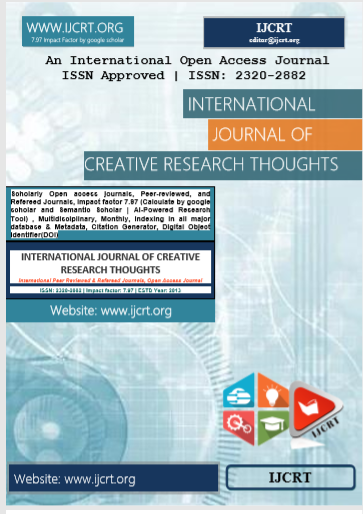
| IJCRT Journal front page | IJCRT Journal Back Page |
Paper Title: National Education Policy and Jammu & Kashmir: A Post Article 370 Assessment
Author Name(s): SHAZIA ZARGAR, Dr.Manju Sharma
Published Paper ID: - IJCRT2605531
Register Paper ID - 308503
Publisher Journal Name: IJPUBLICATION, IJCRT
DOI Member ID: 10.6084/m9.doi.one.IJCRT2605531 and DOI :
Author Country : Indian Author, India, 182222 , Doda Bhaderwah, 182222 , | Research Area: Medical Science All Published Paper URL: http://ijcrt.org/viewfull.php?&p_id=IJCRT2605531 Published Paper PDF: download.php?file=IJCRT2605531 Published Paper PDF: http://www.ijcrt.org/papers/IJCRT2605531.pdf
Your Paper Publication Details:
Title: NATIONAL EDUCATION POLICY AND JAMMU & KASHMIR: A POST ARTICLE 370 ASSESSMENT
DOI (Digital Object Identifier) :
Pubished in Volume: 14 | Issue: 5 | Year: May 2026
Publisher Name : IJCRT | www.ijcrt.org | ISSN : 2320-2882
Subject Area: Medical Science All
Author type: Indian Author
Pubished in Volume: 14
Issue: 5
Pages: e573-e580
Year: May 2026
Downloads: 94
E-ISSN Number: 2320-2882
Abstract
The abrogation of Article 370 in 2019 marked a significant constitutional and administrative shift in Jammu and Kashmir,resulting in greater alignment with national policy frameworks.In this context,the implementation of the National Education Policy 2020 assumes particular importance, as it represents a comprehensive reform agenda aimed at transforming India's education system in terms of Access,Equity,Quality and Governance.This paper presents a conceptual assessment of the National Education Policy in Jammu and Kashmir in the Post Article 370 period,focusing on the changing structures of educational governance and policy integration.Drawing on constitutional provisions,policy documents and existing scholarly literature,the study examines how the removal of special status has reshaped the institutional environment for education in the region.The paper conceptually analyses key components of NEP related to school education,higher education and discusses emerging opportunities and challenges with in the regional context.The study emphasizes the importance of context-sensitive implementation of national education reforms and identifies the need for future empirical research on educational outcomes in Jammu and Kashmir
Licence: creative commons attribution 4.0
License
Creative Commons Attribution 4.0 and The Open Definition

Keywords
National Education policy, Article 370, Educational Governance, Jammu and Kashmir
License
Creative Commons Attribution 4.0 and The Open Definition
Paper Title: Climate Smart Agriculture: Sustainable Farming For Food Security- A Review
Author Name(s): Namrata Naik, Leora Lopes, Anvitha, Vinyas.G, Tanish Rehaman
Published Paper ID: - IJCRT2605530
Register Paper ID - 308540
Publisher Journal Name: IJPUBLICATION, IJCRT
DOI Member ID: 10.6084/m9.doi.one.IJCRT2605530 and DOI :
Author Country : Indian Author, India, 575007 , Mangaluru, 575007 , | Research Area: Life Sciences All Published Paper URL: http://ijcrt.org/viewfull.php?&p_id=IJCRT2605530 Published Paper PDF: download.php?file=IJCRT2605530 Published Paper PDF: http://www.ijcrt.org/papers/IJCRT2605530.pdf
Your Paper Publication Details:
Title: CLIMATE SMART AGRICULTURE: SUSTAINABLE FARMING FOR FOOD SECURITY- A REVIEW
DOI (Digital Object Identifier) :
Pubished in Volume: 14 | Issue: 5 | Year: May 2026
Publisher Name : IJCRT | www.ijcrt.org | ISSN : 2320-2882
Subject Area: Life Sciences All
Author type: Indian Author
Pubished in Volume: 14
Issue: 5
Pages: e568-e572
Year: May 2026
Downloads: 98
E-ISSN Number: 2320-2882
Abstract
The increasing threat of climate change poses significant challenges to global agricultural productivity, food security, and environmental sustainability. Climate Smart Agriculture (CSA) is the most suitable strategic framework to address the triple challenge of sustainably increasing productivity, reducing greenhouse gas emissions and enhancing resilience. This review provides current evidence on CSA as a roadmap for sustainable farming and long-term food security. The conceptual framework of CSA is explained with its three core pillars, namely productivity, adaptation, and mitigation and its link to sustainable agriculture and food system resilience. Key CSA practices, including conservation agriculture, agroforestry, crop diversification, integrated nutrient and pest management and climate-resilient crop varieties, were studied. The role of digital technologies such as remote sensing, crop modelling, and artificial intelligence in enhancing farm-level decision-making is discussed, along with persistent barriers to adoption among smallholder farmers. Empirical studies from Africa and other developing regions highlight the potential of CSA to improve yields, household nutrition, and climate resilience, while also highlighting the influence of socioeconomic conditions, governance, and policy design. The paper concludes with research gaps and policy recommendations for mainstreaming CSA within national agricultural strategies and global sustainability agendas, particularly the Sustainable Development Goals.
Licence: creative commons attribution 4.0
License
Creative Commons Attribution 4.0 and The Open Definition
Keywords
Climate Smart Agriculture, sustainable agriculture, food security, climate resilience, smallholder farmers, green house gas mitigation.
License
Creative Commons Attribution 4.0 and The Open Definition
Paper Title: Machine Learning-Based Prediction of Sleep Quality Using Smartphone Usage Patterns
Author Name(s): Mayuri Sunil Muthekar, Diksha chandrashekhar marathe, Priya pandurang patil, Vaishnavi Narendra Mali, Pooja Kurne, Poonam Fegade
Published Paper ID: - IJCRT2605529
Register Paper ID - 308559
Publisher Journal Name: IJPUBLICATION, IJCRT
DOI Member ID: 10.6084/m9.doi.one.IJCRT2605529 and DOI :
Author Country : Indian Author, India, 423205 , Nashik, 423205 , | Research Area: Science and Technology Published Paper URL: http://ijcrt.org/viewfull.php?&p_id=IJCRT2605529 Published Paper PDF: download.php?file=IJCRT2605529 Published Paper PDF: http://www.ijcrt.org/papers/IJCRT2605529.pdf
Your Paper Publication Details:
Title: MACHINE LEARNING-BASED PREDICTION OF SLEEP QUALITY USING SMARTPHONE USAGE PATTERNS
DOI (Digital Object Identifier) :
Pubished in Volume: 14 | Issue: 5 | Year: May 2026
Publisher Name : IJCRT | www.ijcrt.org | ISSN : 2320-2882
Subject Area: Science and Technology
Author type: Indian Author
Pubished in Volume: 14
Issue: 5
Pages: e562-e567
Year: May 2026
Downloads: 89
E-ISSN Number: 2320-2882
Abstract
Licence: creative commons attribution 4.0
License
Creative Commons Attribution 4.0 and The Open Definition
Keywords
Keywords--Machine Learning, Sleep Quality Prediction, Smartphone Usage Patterns, Random Forest Regression, Predictive Modeling, Digital Wellness, Behavioural Analytics
License
Creative Commons Attribution 4.0 and The Open Definition
Paper Title: LEVERAGING AI TO PREDICT MENTAL ILLNESS FROM CURRENT LIFESTYLE AND SITUATIONAL DATA
Author Name(s): Fariha Baqi, Aaftab Alam, Dr. Mohd. Haroon
Published Paper ID: - IJCRT2605528
Register Paper ID - 308441
Publisher Journal Name: IJPUBLICATION, IJCRT
DOI Member ID: 10.6084/m9.doi.one.IJCRT2605528 and DOI :
Author Country : Indian Author, India, 226026 , Lucknow, 226026 , | Research Area: Science and Technology Published Paper URL: http://ijcrt.org/viewfull.php?&p_id=IJCRT2605528 Published Paper PDF: download.php?file=IJCRT2605528 Published Paper PDF: http://www.ijcrt.org/papers/IJCRT2605528.pdf
Your Paper Publication Details:
Title: LEVERAGING AI TO PREDICT MENTAL ILLNESS FROM CURRENT LIFESTYLE AND SITUATIONAL DATA
DOI (Digital Object Identifier) :
Pubished in Volume: 14 | Issue: 5 | Year: May 2026
Publisher Name : IJCRT | www.ijcrt.org | ISSN : 2320-2882
Subject Area: Science and Technology
Author type: Indian Author
Pubished in Volume: 14
Issue: 5
Pages: e550-e561
Year: May 2026
Downloads: 91
E-ISSN Number: 2320-2882
Abstract
In recent lots of people are experiencing depression, anxiety, or stress and these conditions really damage people's health. The problem is well recognized, but most individuals do not receive a proper diagnosis or treatment due to the social stigma associated with mental disorders, lack of mental health services, and our traditional method of diagnosing diseases, which is dependent upon self-reporting. Luckily, artificial intelligence is improving rapidly and because we have so much digital information, we can now create new algorithms based on data to identify mental health problems. This project is about using artificial intelligence to find mental disorders and it does this by looking at both organised and less organised information using machine learning. In order to make things clear, it uses traditional approaches such as Logistic Regression, SVM, and Random Forest; as well as sophisticated deep learning models such as LSTM and BERT. The older approaches are good because they are easy to understand and work brilliantly with straightforward information, while Deep Learning models are for finding hidden patterns and using those to predict what's going on. The system uses a chatbot to get information as it's needed. Accuracy-wise, the proposed hybrid approach shows excellent performance accuracy, having an accuracy prediction rate of 92.50% with the AUC-ROC score of 0.9759. This means it's more accurate than any of the models used on their own, but it is just as good at being precise, and at finding all the relevant information.
Licence: creative commons attribution 4.0
License
Creative Commons Attribution 4.0 and The Open Definition
Keywords
Artificial Intelligence, Mental Health Prediction, Machine Learning, NLP, Chatbot, Lifestyle Data, Digital Psychiatry
License
Creative Commons Attribution 4.0 and The Open Definition
Paper Title: Empowering nursing in the digital era with innovative Cutting edge technology
Author Name(s): Kanchan yadav
Published Paper ID: - IJCRT2605527
Register Paper ID - 306670
Publisher Journal Name: IJPUBLICATION, IJCRT
DOI Member ID: 10.6084/m9.doi.one.IJCRT2605527 and DOI :
Author Country : Indian Author, India, 221001 , Varanasi UP, 221001 , | Research Area: Health Science All Published Paper URL: http://ijcrt.org/viewfull.php?&p_id=IJCRT2605527 Published Paper PDF: download.php?file=IJCRT2605527 Published Paper PDF: http://www.ijcrt.org/papers/IJCRT2605527.pdf
Your Paper Publication Details:
Title: EMPOWERING NURSING IN THE DIGITAL ERA WITH INNOVATIVE CUTTING EDGE TECHNOLOGY
DOI (Digital Object Identifier) :
Pubished in Volume: 14 | Issue: 5 | Year: May 2026
Publisher Name : IJCRT | www.ijcrt.org | ISSN : 2320-2882
Subject Area: Health Science All
Author type: Indian Author
Pubished in Volume: 14
Issue: 5
Pages: e544-e549
Year: May 2026
Downloads: 158
E-ISSN Number: 2320-2882
Abstract
Nursing practice is changing internationally as a result of the healthcare industry's fast digital transformation, putting nurses at the forefront of technology-driven care delivery. Since they make up about 59% of the healthcare workforce worldwide, nurses are essential to the effective implementation of digital health advances. Digital technologies like artificial intelligence (AI), telemedicine, and electronic health records (EHRs) are being used more and more to fill staffing gaps and improve treatment efficiency as the global healthcare sector is expected to have a deficit of 5.7 million nurses by 2030. Digital solutions have proven to have the capacity to enhance productivity, lower mistakes, and improve patient outcomes on a global scale. Artificial intelligence (AI) and robots are revolutionizing clinical decision-making and patient monitoring, allowing nurses to provide accurate, data-driven care. Additionally, real-time data gathering is made easier by digital health systems, which enhance population health management and promote evidence-based nursing practice. Government initiatives like national digital health programs and more private sector investment are driving a major digital transformation in healthcare in India. The COVID-19 pandemic further accelerated the use of digital platforms and telemedicine, increasing accessibility, especially in underserved and rural areas. According to recent estimates, hospitals in India are progressively using AI and digital solutions to lessen burden; these technologies may save medical workers two to three hours of their daily workday.
Licence: creative commons attribution 4.0
License
Creative Commons Attribution 4.0 and The Open Definition
Keywords
:- Digital transformation, Cutting edge technology, AI, Telemedicine and global health workforce.
License
Creative Commons Attribution 4.0 and The Open Definition
Paper Title: Understanding Tribes through Demographic Perspectives: A Comparative Study among Santal and Sabar Communities of Jhargram District, West Bengal
Author Name(s): Kaberi Murmu, Jayasree Laha, Ramkrishna Maiti
Published Paper ID: - IJCRT2605526
Register Paper ID - 308432
Publisher Journal Name: IJPUBLICATION, IJCRT
DOI Member ID: 10.6084/m9.doi.one.IJCRT2605526 and DOI : https://doi.org/10.56975/ijcrt.v14i5.308432
Author Country : Indian Author, India, 721102 , Midnapore, 721102 , | Research Area: Social Science All Published Paper URL: http://ijcrt.org/viewfull.php?&p_id=IJCRT2605526 Published Paper PDF: download.php?file=IJCRT2605526 Published Paper PDF: http://www.ijcrt.org/papers/IJCRT2605526.pdf
Your Paper Publication Details:
Title: UNDERSTANDING TRIBES THROUGH DEMOGRAPHIC PERSPECTIVES: A COMPARATIVE STUDY AMONG SANTAL AND SABAR COMMUNITIES OF JHARGRAM DISTRICT, WEST BENGAL
DOI (Digital Object Identifier) : https://doi.org/10.56975/ijcrt.v14i5.308432
Pubished in Volume: 14 | Issue: 5 | Year: May 2026
Publisher Name : IJCRT | www.ijcrt.org | ISSN : 2320-2882
Subject Area: Social Science All
Author type: Indian Author
Pubished in Volume: 14
Issue: 5
Pages: e535-e543
Year: May 2026
Downloads: 115
E-ISSN Number: 2320-2882
Abstract
Abstract: Scheduled tribes of Jangle Mahal, eastern fringe of Chotanagpur plateau region are socio-economically backward and marginalised ethnic groups. Tribal people accounts 8.6 percent of India's total population. Since, after seven decades of independence, Scheduled Tribes (ST) are still at the margin of society. This study seeks a deeper insight into the demographic situation of the tribal communities. Primary data were collected from 117 and 114 sample houses of the Sabar and Santal communities, drawn from 9 selected villages following a stratified random sampling technique. The result indicates that Santals perform better in education than Sabar community. Both communities have high sex ratio compared to the national sex ratio. The average dependency ratio of the Sabar community is more (47.8 %) than Santal community (42.02 %). Also, the Sabar community show higher Child Women Ratio (284.72), indicating a higher level of fertility than the Santals (235.29). Sabar has a nuclear family system, with average family size of 3.65 and Santals shows joint family system with average family size of 4.59. The unemployment problem is very high among the Sabar community. The study reveals that illiteracy, a greater degree of dependency, and limited access to the mainstream socio-economic activities make the tribal people vulnerable. Collective and coordinated efforts of Govt. policy makers, planners, economists, and social scientists may formulate community specific plan for economic as well as social upliftment of these marginalised groups.
Licence: creative commons attribution 4.0
License
Creative Commons Attribution 4.0 and The Open Definition
Keywords
Tribal Society, Literacy, Dependency Ratio, Child Women Ratio
License
Creative Commons Attribution 4.0 and The Open Definition
Paper Title: Sustainable Talent Ecosystems in Fintech: A Conceptual Model of Employee Well-Being, Ethical Leadership, and Organizational Resilience during Funding Downturns
Author Name(s): Dr. Nitu Sharma, Rikitha G
Published Paper ID: - IJCRT2605525
Register Paper ID - 308362
Publisher Journal Name: IJPUBLICATION, IJCRT
DOI Member ID: 10.6084/m9.doi.one.IJCRT2605525 and DOI :
Author Country : Indian Author, India, 560052 , Bengaluru , 560052 , | Research Area: Commerce All Published Paper URL: http://ijcrt.org/viewfull.php?&p_id=IJCRT2605525 Published Paper PDF: download.php?file=IJCRT2605525 Published Paper PDF: http://www.ijcrt.org/papers/IJCRT2605525.pdf
Your Paper Publication Details:
Title: SUSTAINABLE TALENT ECOSYSTEMS IN FINTECH: A CONCEPTUAL MODEL OF EMPLOYEE WELL-BEING, ETHICAL LEADERSHIP, AND ORGANIZATIONAL RESILIENCE DURING FUNDING DOWNTURNS
DOI (Digital Object Identifier) :
Pubished in Volume: 14 | Issue: 5 | Year: May 2026
Publisher Name : IJCRT | www.ijcrt.org | ISSN : 2320-2882
Subject Area: Commerce All
Author type: Indian Author
Pubished in Volume: 14
Issue: 5
Pages: e517-e534
Year: May 2026
Downloads: 107
E-ISSN Number: 2320-2882
Abstract
The sustainability of modern digital enterprises depends as much on the stability and well-being of their workforce as on financial performance. India's fintech sector, once buoyed by record venture capital inflows, has encountered a pronounced period of investment deceleration- commonly described as the funding winter- that has introduced significant organizational and human resource challenges. Workforce reductions, aggressive cost rationalization, and intensified performance expectations have converged to heighten workplace stress, weaken employee morale, and threaten long-term retention. This paper presents a conceptual study that examines the interplay between employee well-being, ethical leadership, and organizational resilience within fintech firms navigating financial constraints. Anchored in Stakeholder Theory and Sustainable Human Resource Management (SHRM), the study argues that organizations which place human sustainability at the heart of their strategic response to funding downturns are considerably better positioned to preserve talent continuity and strategic adaptability. A conceptual framework is proposed in which ethical leadership and supportive organizational culture function as mediating forces - moderating workplace stress, reducing turnover intentions, and ultimately strengthening organizational resilience. The paper advances the idea of the sustainable talent ecosystem as a purposeful construct within digital financial organizations and offers a theoretical model to guide future empirical investigation into fintech workforce management.
Licence: creative commons attribution 4.0
License
Creative Commons Attribution 4.0 and The Open Definition
Keywords
: Sustainable Commerce, Fintech Workforce, Ethical Leadership, Employee Well-Being, Organizational Resilience, Talent Retention.
License
Creative Commons Attribution 4.0 and The Open Definition
Paper Title: SAMVAAD - SIGN AND MULTIMODAL VOICE ASSISTIVE ACCESS & DIALOGUE
Author Name(s): Priyanka Narawade, Gaurav Sunil Thakare, Shreya Dattatray Choure, Krushnal Manoj Mahajan, Niketa Mahajan
Published Paper ID: - IJCRT2605524
Register Paper ID - 308422
Publisher Journal Name: IJPUBLICATION, IJCRT
DOI Member ID: 10.6084/m9.doi.one.IJCRT2605524 and DOI :
Author Country : Indian Author, India, 411057 , Maharashtra, 411057 , | Research Area: Science All Published Paper URL: http://ijcrt.org/viewfull.php?&p_id=IJCRT2605524 Published Paper PDF: download.php?file=IJCRT2605524 Published Paper PDF: http://www.ijcrt.org/papers/IJCRT2605524.pdf
Your Paper Publication Details:
Title: SAMVAAD - SIGN AND MULTIMODAL VOICE ASSISTIVE ACCESS & DIALOGUE
DOI (Digital Object Identifier) :
Pubished in Volume: 14 | Issue: 5 | Year: May 2026
Publisher Name : IJCRT | www.ijcrt.org | ISSN : 2320-2882
Subject Area: Science All
Author type: Indian Author
Pubished in Volume: 14
Issue: 5
Pages: e512-e516
Year: May 2026
Downloads: 88
E-ISSN Number: 2320-2882
Abstract
SAMVAAD (Sign and Multimodal Voice Assistive Access & Dialogue) is an AI-powered accessibility platform developed to bridgecommunication gaps between individuals with hearing, speech, and visual impairments and the general public. Existingassistive systems generally focus on only one form of disability and fail to provide integrated communication support.SAMVAAD addresses this limitation by combining Sign Language recognition, Speech-to-Text (STT), Text-toSpeech(TTS), Braille translation, and 3D avatar-based sign visualization into a unified web-based platform. The system uses Artificial Intelligence, Computer Vision, and Natural Language Processing technologies such as OpenCV, MediaPipe, and Flaskto enable real-time multimodal communication. The proposed framework provides users with text, speech, sign, and Braille interaction modes while maintaining a lightweight and locally deployable architecture. The platform also includesan educational module for learning Sign Language and Braille, thereby promoting accessibility awareness and inclusiveinteraction. SAMVAAD demonstrates how AI can be ethically utilized for social good by improving communication accessibility and empowering differently-abled individuals.
Licence: creative commons attribution 4.0
License
Creative Commons Attribution 4.0 and The Open Definition
Keywords
Index Terms - Artificial Intelligence, Accessibility, Sign Language Recognition, Braille Translation, Speech-to-Text, Textto-Speech, , OpenCV, MediaPipe.
License
Creative Commons Attribution 4.0 and The Open Definition
Paper Title: BLOCKCHAIN-BASED CERTIFICATE VERIFICATION SYSTEM
Author Name(s): Aman Mathur
Published Paper ID: - IJCRT2605523
Register Paper ID - 308589
Publisher Journal Name: IJPUBLICATION, IJCRT
DOI Member ID: 10.6084/m9.doi.one.IJCRT2605523 and DOI :
Author Country : Indian Author, India, 342008 , Jodhpur, 342008 , | Research Area: Science and Technology Published Paper URL: http://ijcrt.org/viewfull.php?&p_id=IJCRT2605523 Published Paper PDF: download.php?file=IJCRT2605523 Published Paper PDF: http://www.ijcrt.org/papers/IJCRT2605523.pdf
Your Paper Publication Details:
Title: BLOCKCHAIN-BASED CERTIFICATE VERIFICATION SYSTEM
DOI (Digital Object Identifier) :
Pubished in Volume: 14 | Issue: 5 | Year: May 2026
Publisher Name : IJCRT | www.ijcrt.org | ISSN : 2320-2882
Subject Area: Science and Technology
Author type: Indian Author
Pubished in Volume: 14
Issue: 5
Pages: e504-e511
Year: May 2026
Downloads: 83
E-ISSN Number: 2320-2882
Abstract
Traditional certificate verification is slow, fraud-prone, and built on centralized systems that create obvious single points of failure. This paper proposes and implements a blockchain-based certificate verification system on Ethereum that addresses these problems at the architectural level. The system uses Solidity smart contracts for certificate lifecycle management, SHA-256 hashing for tamper detection, and IPFS for decentralized document storage. A role-based access control model, ECDSA digital signatures, and consensus-based validation protect against forgery and unauthorized changes. Four modules handle the core workflows: institutional issuance, student credential management, employer verification, and administrative governance. Testing on a private Ethereum network with 5,000 certificate transactions showed a 99.97% reduction in verification time compared to paper-based methods, zero successful fraud attempts, and improved system availability through distributed architecture.
Licence: creative commons attribution 4.0
License
Creative Commons Attribution 4.0 and The Open Definition
Keywords
Blockchain, Certificate Verification, Smart Contracts, Ethereum, Distributed Ledger Technology, SHA-256 Hashing, Digital Credentials, IPFS, Solidity, Decentralized Applications.
License
Creative Commons Attribution 4.0 and The Open Definition
Paper Title: LLM AUGMENTED FINANCIAL DATA EXPLORATION VIA PROGRAMMATIC FILTER SYNTHESIS
Author Name(s): Siddhesh Kabra, Mustafa Mujawar, Suraj Shrivastav, Vishwas Kalunge
Published Paper ID: - IJCRT2605522
Register Paper ID - 308220
Publisher Journal Name: IJPUBLICATION, IJCRT
DOI Member ID: 10.6084/m9.doi.one.IJCRT2605522 and DOI :
Author Country : Indian Author, India, 411014 , Pune, 411014 , | Research Area: Science and Technology Published Paper URL: http://ijcrt.org/viewfull.php?&p_id=IJCRT2605522 Published Paper PDF: download.php?file=IJCRT2605522 Published Paper PDF: http://www.ijcrt.org/papers/IJCRT2605522.pdf
Your Paper Publication Details:
Title: LLM AUGMENTED FINANCIAL DATA EXPLORATION VIA PROGRAMMATIC FILTER SYNTHESIS
DOI (Digital Object Identifier) :
Pubished in Volume: 14 | Issue: 5 | Year: May 2026
Publisher Name : IJCRT | www.ijcrt.org | ISSN : 2320-2882
Subject Area: Science and Technology
Author type: Indian Author
Pubished in Volume: 14
Issue: 5
Pages: e496-e503
Year: May 2026
Downloads: 94
E-ISSN Number: 2320-2882
Abstract
Today, amid the ever-evolving financial markets, tools like Chartink play a vital role in finding investment targets. Nevertheless, their dependence on manually constructed filters and quasi-programmingbased syntax results in serious usability issues. To tackle these problems, we propose a next-generation cloudbased solution based on the dual Large Language Model (LLM) architecture that will let you easily scan the financial market using simple and conversational NLP input. The proposed system uses an innovative approach to filtering data dubbed as Programmatic Filter Synthesis. In this process, the Qwen3-14B model from the OpenRouter API creates a JSON object including SQL query parameters that are validated by our system and safely executed against the DuckDB analytical engine running queries on 5.5 GB of Apache Parquet data. Moreover, our system is equipped with a local guard module known as Qwen3Guard-Gen-0.6B that filters out all the possible hazardous or inappropriate inputs before processing them via the generation module. The entire stack includes the following: web front-end: React/Next.js 16; server-side: Python FastAPI with SSE streaming, caching: Redis service and Supabase authentication. We achieved an 87% adjusted semantic accuracy rate while testing our system on 100 benchmark prompts.
Licence: creative commons attribution 4.0
License
Creative Commons Attribution 4.0 and The Open Definition
Keywords
Cloud Computing, Large Language Model (LLM), Financial Data Analysis, Programmatic Filter Synthesis, Natural Language Processing (NLP), Text-to-SQL, DuckDB, Dual-LLM Architecture, Server-Sent Events (SSE).
License
Creative Commons Attribution 4.0 and The Open Definition
Call For Paper September 2026
Call For Papers
September 2026
Volume 14 | Issue 9
Last Date :
31-Oct-2026
Submit Manuscript Online Impact Factor: 7.97 Review Results : Within 02-03 Days Paper Publication : Within 02-03 Days
September 2026
Volume 14 | Issue 9
Last Date :
31-Oct-2026
Submit Manuscript Online Impact Factor: 7.97 Review Results : Within 02-03 Days Paper Publication : Within 02-03 Days
Published Issue Details
For Authors
Forms / Downloads
Other IMP Links
Indexing Partner
Research Area
LICENSE





ISSN and 7.97 Impact Factor Details
ISSN: 2320-2882 Impact Factor: 7.97 and ISSN APPROVED Journal Starting Year (ESTD) : 2013


ISSN and 7.97 Impact Factor Details
ISSN: 2320-2882 Impact Factor: 7.97 and ISSN APPROVED Journal Starting Year (ESTD) : 2013
DOI Details
CONFERENCE
CONFERENCE MANAGMENT & PUBLICATION CONFERENCE PROPOSAL
RECENT CONFERENCE

CONFERENCE PROPOSAL CONFERENCE PROCEEDINGS
CONFERENCE PROPOSAL CONFERENCE PROCEEDINGS
For Reviewer /Referral (RMS) Earn 500 per paper
Important Links
NEWS & Conference
Digital Library
IJCRT RMS | Earn 500 Per Paper.

Open Access


LICENSE
Indexing Partner
Scholarly open access journals, Peer-reviewed, and Refereed Journals, Impact factor 7.97 (Calculate by google scholar and Semantic Scholar | AI-Powered Research Tool) , Multidisciplinary, Monthly, Indexing in all major database & Metadata, Citation Generator, Digital Object Identifier(DOI)