Important Details
IJCRT - International Peer Reviewed, Open Access Journal, Multidisciplinary, Monthly, Nominal(Low) Fees for Professional Research Services International Journal of Creative Research Thoughts - IJCRT Peer Review Journal, Refereed Journal, Peer Reviewed Journal , Referred Journal and Indexed Journal, Open access, Online and Print Journal,international Journal Open Access, Accepted by Indian and foreign university ,IJCRT Followed Norms, guidelines, requirement, listing criteria and methodology of score/point also applied from: Scopus , Web of Science , UGC Approved , UGC CARE, UGC-CARE .
UGC Approved Journal No: 49023 (18)
UGC approval Link
https://ijcrt.org/ugc%20approval.jpg
All Policy and Approval
Please Like Our Facebook Page | CrossRef DOI and Hard copy of Certificate Provide if required. | www.IJCRT.org | editor@IJCRT.org | IJCRT WhatsApp +91 94294 58311
Publication Details:
- Paper Submission : 31-Oct-2026. Call For Paper (Volume 14 | Issue 9 | Month- September 2026)
- Acceptance/Rejection Notification: Within 02-04 Days.
- Paper Publish: Within 02-04 Days after submitting all documents.
-
Submit Your Paper Any time There No deadline.
-
Publication fees : 1570 INR for Indian author & 59$ for foreign International author.
Please Like Our Facebook Page | CrossRef DOI and Hard copy of Certificate Provide if required.
Licence and Indexing
Indexing In Google Scholar, SSRN, ResearcherID-Publons, Semantic Scholar | AI-Powered Research Tool, Microsoft Academic, Academia.edu, arXiv.org, Research Gate, CiteSeerX, ResearcherID Thomson Reuters, Mendeley : reference manager, DocStoc, ISSUU, Scribd, and many more | High Impact Factor: 7.97 | Digital object identifier (DOI) and Hard Copy of certificate Provided.



























Licence
DOI
ISSN Approved impact factor: 7.97 
Creative Common 
Valid as per new UGC Gazette regulations 

INTERNATIONAL JOURNAL OF CREATIVE RESEARCH THOUGHTS - IJCRT (IJCRT.ORG)
International Peer Reviewed & Refereed Journals, Open Access Journal
IJCRT Peer-Reviewed (Refereed) Journal as Per New UGC Rules.
ISSN Approved Journal No: 2320-2882 | Impact factor: 7.97 | ESTD Year: 2013
Call For Paper - Volume 14 | Issue 9 | Month- September 2026
Scholarly open access journals, Peer-reviewed, and Refereed Journals, Impact factor 7.97 (Calculate by google scholar and Semantic Scholar | AI-Powered Research Tool) , Multidisciplinary, Monthly, Indexing in all major database & Metadata, Citation Generator, Digital Object Identifier(CrossRef DOI)
IJCRT WhatsApp Contact
IJCRT Search Xplore - Search all paper by Paper Name , Author Name, and Title
Volume 13 | Issue 5 |
Volume 13 | Issue 5 | Month
Downlaod After Publication 1) Table of content index in PDF
2) Table of content index in HTML 2)Table of content index in HTML
3) Front Page 3) Front Page
4) Back Page 4) Back Page
5) Editor Board Member 5)Editor Board Member
6) OLD Style Issue 6)OLD Style Issue
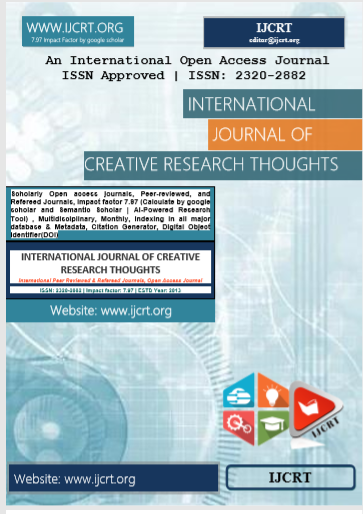 |
 |
|---|---|
| IJCRT Journal front page | IJCRT Journal Back Page |
Paper Title: AGRICULTURE ROBOT FOR PLANT DISEASE DETECTION USING MACHINE LEARNING AND IOT TECHNOLOGIES
Author Name(s): K S Abhishek, K Hariprasad, Prakasha M, Dr. Radhika M N
Published Paper ID: - IJCRT25A5340
Register Paper ID - 287349
Publisher Journal Name: IJPUBLICATION, IJCRT
DOI Member ID: 10.6084/m9.doi.one.IJCRT25A5340 and DOI :
Author Country : Indian Author, India, 571401 , MANDYA, 571401 , | Research Area: Science and Technology Published Paper URL: http://ijcrt.org/viewfull.php?&p_id=IJCRT25A5340 Published Paper PDF: download.php?file=IJCRT25A5340 Published Paper PDF: http://www.ijcrt.org/papers/IJCRT25A5340.pdf
Your Paper Publication Details:
Title: AGRICULTURE ROBOT FOR PLANT DISEASE DETECTION USING MACHINE LEARNING AND IOT TECHNOLOGIES
DOI (Digital Object Identifier) :
Pubished in Volume: 13 | Issue: 5 | Year: May 2025
Publisher Name : IJCRT | www.ijcrt.org | ISSN : 2320-2882
Subject Area: Science and Technology
Author type: Indian Author
Pubished in Volume: 13
Issue: 5
Pages: l734-l742
Year: May 2025
Downloads: 189
E-ISSN Number: 2320-2882
Abstract
Abstract--This study introduces a comprehensive solution for automating plant disease identification and pesticide delivery through a mobile-operated agricultural robot. Leveraging the MobileNetV2 deep learning architecture, the system performs real-time image classification to detect plant diseases with precision. Upon detection, it enables focused pesticide spraying via a Bluetooth-enabled control interface. Integrated environmental sensors--including temperature, humidity, rainfall, and light sensors--enhance the robot's adaptability to diverse field conditions. The proposed model offers a smart, scalable, and economical approach to enhancing productivity and sustainability in modern agriculture.
Licence: creative commons attribution 4.0
License
Creative Commons Attribution 4.0 and The Open Definition

Keywords
Index Terms--MobileNetV2, Smart Farming, IoT, Deep Learning, Precision Agriculture, Plant Disease Detection.
License
Creative Commons Attribution 4.0 and The Open Definition
Paper Title: NEW EDUCATION POLICY: PROBLEM AND PROSPECTS
Author Name(s): K. Ranjana Devi, Dr. Ch. Ghanajit Singh
Published Paper ID: - IJCRT25A5339
Register Paper ID - 287244
Publisher Journal Name: IJPUBLICATION, IJCRT
DOI Member ID: 10.6084/m9.doi.one.IJCRT25A5339 and DOI :
Author Country : Indian Author, India, - , -, - , | Research Area: Science and Technology Published Paper URL: http://ijcrt.org/viewfull.php?&p_id=IJCRT25A5339 Published Paper PDF: download.php?file=IJCRT25A5339 Published Paper PDF: http://www.ijcrt.org/papers/IJCRT25A5339.pdf
Your Paper Publication Details:
Title: NEW EDUCATION POLICY: PROBLEM AND PROSPECTS
DOI (Digital Object Identifier) :
Pubished in Volume: 13 | Issue: 5 | Year: May 2025
Publisher Name : IJCRT | www.ijcrt.org | ISSN : 2320-2882
Subject Area: Science and Technology
Author type: Indian Author
Pubished in Volume: 13
Issue: 5
Pages: l723-l733
Year: May 2025
Downloads: 168
E-ISSN Number: 2320-2882
Abstract
NEP is a comprehensive framework to guide the development of education in the country. The need for a policy was first felt in 1964 when Congress MP Siddheshwar Prasad criticised the then government for lacking a vision and philosophy for education. The same year, a 17-member Education Commission, headed by then UGC Chairperson D S Kothari, was constituted to draft a national and coordinated policy on education. Based on the suggestions of this Commission, Parliament passed the first education policy in 1968. A new NEP usually comes along every few decades. India has had three to date. The first came in 1968 and the second in 1986, under Indira Gandhi and Rajiv Gandhi respectively; the NEP of 1986 was revised in 1992 when P V Narasimha Rao was Prime Minister. The third is the NEP released Wednesday under the Prime Ministership of Narendra Modi.
Licence: creative commons attribution 4.0
License
Creative Commons Attribution 4.0 and The Open Definition
Keywords
National Education Policy (NEP), D. S. Kothari Commission, Education Reform, Parliament Policy 1968, Government of India
License
Creative Commons Attribution 4.0 and The Open Definition
Paper Title: Turning Waste into Wellness: Formulating Antioxidant Cream from Potato Peel Extract
Author Name(s): DR. B.D. Tiwari, Miss Sakhre A.A, Upadhye Yukta Sunil, Divya Udgiri
Published Paper ID: - IJCRT25A5338
Register Paper ID - 284971
Publisher Journal Name: IJPUBLICATION, IJCRT
DOI Member ID: 10.6084/m9.doi.one.IJCRT25A5338 and DOI :
Author Country : Indian Author, India, - , -, - , | Research Area: Science and Technology Published Paper URL: http://ijcrt.org/viewfull.php?&p_id=IJCRT25A5338 Published Paper PDF: download.php?file=IJCRT25A5338 Published Paper PDF: http://www.ijcrt.org/papers/IJCRT25A5338.pdf
Your Paper Publication Details:
Title: TURNING WASTE INTO WELLNESS: FORMULATING ANTIOXIDANT CREAM FROM POTATO PEEL EXTRACT
DOI (Digital Object Identifier) :
Pubished in Volume: 13 | Issue: 5 | Year: May 2025
Publisher Name : IJCRT | www.ijcrt.org | ISSN : 2320-2882
Subject Area: Science and Technology
Author type: Indian Author
Pubished in Volume: 13
Issue: 5
Pages: l712-l722
Year: May 2025
Downloads: 197
E-ISSN Number: 2320-2882
Abstract
As the beauty industry embraces cleaner and more eco-conscious practices, researchers are turning to natural, upcycled ingredients that not only benefit the skin but also reduce environmental impact. One such promising ingredient is potato peel (Solanum tuberosum) a common kitchen byproduct typically discarded as waste. Rich in antioxidants, including chlorogenic acid, caffeic acid, and flavonoids, potato peel offers significant potential in skincare for protecting against oxidative stress and promoting overall skin health. This study presents the formulation and evaluation of an antioxidant cream using ethanolic extracts of potato peel. The extract was obtained through cold maceration and then incorporated into an oil-in-water emulsion base. The resulting cream underwent thorough physicochemical assessments, including pH, spreadability, and stability over four weeks. Antioxidant activity was measured using the DPPH (2,2-diphenyl-1-picrylhydrazyl) assay, revealing strong free radical scavenging capacity. Skin compatibility was confirmed through patch testing on healthy volunteers, with no adverse effects reported. These results suggest that potato peel extract is not only effective in delivering antioxidant benefits but is also safe for topical application. Importantly, this work highlights the broader value of transforming food waste into high-performance skincare products aligning with both consumer demand and environmental responsibility. By bridging natural efficacy with sustainable formulation, this study supports the emerging field of green cosmetics and offers a model for repurposing agricultural waste in innovative, skin-friendly ways.
Licence: creative commons attribution 4.0
License
Creative Commons Attribution 4.0 and The Open Definition
Keywords
Turning Waste into Wellness: Formulating Antioxidant Cream from Potato Peel Extract
License
Creative Commons Attribution 4.0 and The Open Definition
Paper Title: MECHANISMS FOR COLLABORATION IN AI AGENTIC MULTI-AGENT ARCHITECTURES
Author Name(s): Anand Kumar Singh, Nilesh G. Charankar
Published Paper ID: - IJCRT25A5337
Register Paper ID - 287196
Publisher Journal Name: IJPUBLICATION, IJCRT
DOI Member ID: 10.6084/m9.doi.one.IJCRT25A5337 and DOI :
Author Country : Foreign Author, United States of America, 48185 , Westland, 48185 , | Research Area: Science and Technology Published Paper URL: http://ijcrt.org/viewfull.php?&p_id=IJCRT25A5337 Published Paper PDF: download.php?file=IJCRT25A5337 Published Paper PDF: http://www.ijcrt.org/papers/IJCRT25A5337.pdf
Your Paper Publication Details:
Title: MECHANISMS FOR COLLABORATION IN AI AGENTIC MULTI-AGENT ARCHITECTURES
DOI (Digital Object Identifier) :
Pubished in Volume: 13 | Issue: 5 | Year: May 2025
Publisher Name : IJCRT | www.ijcrt.org | ISSN : 2320-2882
Subject Area: Science and Technology
Author type: Foreign Author
Pubished in Volume: 13
Issue: 5
Pages: l706-l711
Year: May 2025
Downloads: 233
E-ISSN Number: 2320-2882
Abstract
Abstract: Multi-agent systems (MAS) powered by agentic AI represent a leap forward in solving complex, real-world problems through collaborative intelligence. Unlike single-agent systems, MAS leverage multiple autonomous agents that coordinate, communicate, and share tasks to achieve shared goals. This paper explores the core mechanisms enabling collaboration in agentic multi-agent architectures, including communication protocols, coordination strategies, task decomposition, And dynamic orchestration. We propose a framework for designing effective cooperation mechanisms, drawing on case studies in software development, healthcare and smart cities. Our analysis exposes trade-bands amid scalability, efficiency and strength, providing insight to researchers and physicians with the aim of creating flexible, adaptive MAS. By synthesizing recent advances and identifying open challenges, this work provides a roadmap to advance the collaborative agent system
Licence: creative commons attribution 4.0
License
Creative Commons Attribution 4.0 and The Open Definition
Keywords
gentic AI, multi-agent systems (MAS), collaborative intelligence, autonomous agents, agent communication protocols, coordination strategies, task decomposition, dynamic orchestration, MAS framework design, scalability and efficiency in MAS, adaptive agent systems, agent collaboration mechanisms, distributed AI, real-world MAS applications, smart cities and agentic AI, healthcare AI systems, software engineering with MAS, AI cooperation models, open challenges in MAS, flexible multi-agent archite
License
Creative Commons Attribution 4.0 and The Open Definition
Paper Title: Leveraging Technology in reverse supply chain on clothing rental sector
Author Name(s): Rutuparna Dash, Golakh Kumar Behera
Published Paper ID: - IJCRT25A5336
Register Paper ID - 287261
Publisher Journal Name: IJPUBLICATION, IJCRT
DOI Member ID: 10.6084/m9.doi.one.IJCRT25A5336 and DOI :
Author Country : Indian Author, India, 754012 , Bhubaneswar, 754012 , | Research Area: Commerce and Management, MBA All Branch Published Paper URL: http://ijcrt.org/viewfull.php?&p_id=IJCRT25A5336 Published Paper PDF: download.php?file=IJCRT25A5336 Published Paper PDF: http://www.ijcrt.org/papers/IJCRT25A5336.pdf
Your Paper Publication Details:
Title: LEVERAGING TECHNOLOGY IN REVERSE SUPPLY CHAIN ON CLOTHING RENTAL SECTOR
DOI (Digital Object Identifier) :
Pubished in Volume: 13 | Issue: 5 | Year: May 2025
Publisher Name : IJCRT | www.ijcrt.org | ISSN : 2320-2882
Subject Area: Commerce and Management, MBA All Branch
Author type: Indian Author
Pubished in Volume: 13
Issue: 5
Pages: l698-l705
Year: May 2025
Downloads: 161
E-ISSN Number: 2320-2882
Abstract
This research aims to investigate the technology adoption in the reverse logistics in clothing rental firms and offering numerous strategies to increase the efficiency in the operation process. A quantitative approach used to investigate the efficiency improvement potential in reverse logistics within the clothing rental model and 300 valid responses were gathered with the help of the purposive sampling method. The statistical output results revealed that a strong positive relationship between the implementation of technological solutions and operational efficiency in clothing rental sector. The Pearson correlation coefficient range from .699 to .995 indicates higher implementation of technological solutions is strongly associated with enhanced operational efficiency. It was found that the alternative hypothesis (H1) is supported, affirming that the implementation of technological solutions is positively associated with operational efficiency in the context of clothing rental reverse logistics sector. This finding underscores the critical role of technology in improving operational efficiency.
Licence: creative commons attribution 4.0
License
Creative Commons Attribution 4.0 and The Open Definition
Keywords
Technology adoption, operational efficiency, reverse logistics, clothing rental sector.
License
Creative Commons Attribution 4.0 and The Open Definition
Paper Title: Decoding the Divide: Forensic Discrepancies In Windows OS Identification
Author Name(s): M B Pathak, Emmanuel Ben T, Eswara Sai Prasad Chunduru, M Krishna, Sourav Mondal
Published Paper ID: - IJCRT25A5335
Register Paper ID - 287167
Publisher Journal Name: IJPUBLICATION, IJCRT
DOI Member ID: 10.6084/m9.doi.one.IJCRT25A5335 and DOI :
Author Country : Indian Author, India, 500013 , Hyderabad, 500013 , | Research Area: Science and Technology Published Paper URL: http://ijcrt.org/viewfull.php?&p_id=IJCRT25A5335 Published Paper PDF: download.php?file=IJCRT25A5335 Published Paper PDF: http://www.ijcrt.org/papers/IJCRT25A5335.pdf
Your Paper Publication Details:
Title: DECODING THE DIVIDE: FORENSIC DISCREPANCIES IN WINDOWS OS IDENTIFICATION
DOI (Digital Object Identifier) :
Pubished in Volume: 13 | Issue: 5 | Year: May 2025
Publisher Name : IJCRT | www.ijcrt.org | ISSN : 2320-2882
Subject Area: Science and Technology
Author type: Indian Author
Pubished in Volume: 13
Issue: 5
Pages: l689-l697
Year: May 2025
Downloads: 198
E-ISSN Number: 2320-2882
Abstract
The accurate identification of an operating system (OS) version is pivotal in forensic investigations and registry analysis. However, discrepancies in the detection results provided by different forensic tools can lead to significant challenges. This research paper explores the disparity observed when Magnet AXIOM identifies the OS version as Windows 11 Pro, whereas other registry analysis tools detect it as Windows 10 Pro. We investigate the underlying causes of this inconsistency by examining the various algorithms, registry keys, and parsing techniques employed by these tools. Our analysis reveals that differences in detection algorithms, registry key interpretation, software configuration, and data parsing methods contribute to the observed disparities. By understanding these factors, we aim to provide forensic professionals with insights to achieve consistent and reliable OS version detection across different forensic tools. This study underscores the importance of harmonizing detection methods and highlights the need for standardized approaches in forensic software development.
Licence: creative commons attribution 4.0
License
Creative Commons Attribution 4.0 and The Open Definition
Keywords
Registry, Operating System, Digital Forensic, OS Forensic
License
Creative Commons Attribution 4.0 and The Open Definition
Paper Title: Efficient Dual Battery Management System for Electric Vehicles using Solar PV
Author Name(s): J.Kabilan, V.Kishore, D.Rooshshan, M.Vimal, J.Jayakumar
Published Paper ID: - IJCRT25A5334
Register Paper ID - 287277
Publisher Journal Name: IJPUBLICATION, IJCRT
DOI Member ID: 10.6084/m9.doi.one.IJCRT25A5334 and DOI :
Author Country : Indian Author, India, 607109 , Cuddalore, 607109 , | Research Area: Science and Technology Published Paper URL: http://ijcrt.org/viewfull.php?&p_id=IJCRT25A5334 Published Paper PDF: download.php?file=IJCRT25A5334 Published Paper PDF: http://www.ijcrt.org/papers/IJCRT25A5334.pdf
Your Paper Publication Details:
Title: EFFICIENT DUAL BATTERY MANAGEMENT SYSTEM FOR ELECTRIC VEHICLES USING SOLAR PV
DOI (Digital Object Identifier) :
Pubished in Volume: 13 | Issue: 5 | Year: May 2025
Publisher Name : IJCRT | www.ijcrt.org | ISSN : 2320-2882
Subject Area: Science and Technology
Author type: Indian Author
Pubished in Volume: 13
Issue: 5
Pages: l683-l688
Year: May 2025
Downloads: 395
E-ISSN Number: 2320-2882
Abstract
The increasing adoption of electric vehicles (EVs) as a sustainable transportation alternative underscores the critical importance of battery management systems (BMS) in ensuring they perform optimally, remain safe, also last long. This paper develops from a clever Dual-Battery Management System that is designed for the improvement of energy efficiency and reliability in EV applications. The proposed system monitors important battery parameters including voltage, current, and temperature. This safeguarding prevents overcharging as well as deep discharging as well as thermal fluctuations that degrade battery health. Because of charge status, automated switching makes certain of uninterrupted operation for a dual-battery setup permits one battery for active use while the other is being charged simultaneously by solar energy. The ThingSpeak cloud platform is integrated since real-time data acquisition and monitoring are eased, and remote visualization and analysis of battery performance metrics are enabled. Furthermore, a Serial Bluetooth Terminal interface enables system data access wirelessly by mobile devices, and this helps with local diagnostics plus operational control. The system's architecture improves operational safety in addition to prolonging battery lifespan. The architecture also uses solar charging and smart battery switching for energy sustainability. In proposing of a solution for this, we can approach to energy in order to manage it efficiently and to scale the modern electric mobility systems practically.
Licence: creative commons attribution 4.0
License
Creative Commons Attribution 4.0 and The Open Definition
Keywords
Electric vehicle (EV), dual-battery management system (BMS),solar charging, real-time monitoring.
License
Creative Commons Attribution 4.0 and The Open Definition
Paper Title: Effect of Emotional stabilty and mental health in classroom teaching behavior
Author Name(s): Pragya Singh
Published Paper ID: - IJCRT25A5333
Register Paper ID - 287045
Publisher Journal Name: IJPUBLICATION, IJCRT
DOI Member ID: 10.6084/m9.doi.one.IJCRT25A5333 and DOI :
Author Country : Indian Author, India, 222002 , jaunpur, 222002 , | Research Area: Social Science All Published Paper URL: http://ijcrt.org/viewfull.php?&p_id=IJCRT25A5333 Published Paper PDF: download.php?file=IJCRT25A5333 Published Paper PDF: http://www.ijcrt.org/papers/IJCRT25A5333.pdf
Your Paper Publication Details:
Title: EFFECT OF EMOTIONAL STABILTY AND MENTAL HEALTH IN CLASSROOM TEACHING BEHAVIOR
DOI (Digital Object Identifier) :
Pubished in Volume: 13 | Issue: 5 | Year: May 2025
Publisher Name : IJCRT | www.ijcrt.org | ISSN : 2320-2882
Subject Area: Social Science All
Author type: Indian Author
Pubished in Volume: 13
Issue: 5
Pages: l681-l682
Year: May 2025
Downloads: 150
E-ISSN Number: 2320-2882
Abstract
In today's busy and rushed lifestyle , it is very necessary to talk and debate about emotional stability and mental healthof an individual. As my research is on how does it affect the classroom teaching behavior of a teacher, do their daily life's trauma and uncertainity effect their teaching behavior, if not then good means teacher is very meditative, focused and disciplined, but if yes which can be in most cases because it is human tendency to absorb the human environment around then how can it's negative effect can be minimized in classroom.
Licence: creative commons attribution 4.0
License
Creative Commons Attribution 4.0 and The Open Definition
Keywords
education, emotional stability, teachereducation, classroon, mental health
License
Creative Commons Attribution 4.0 and The Open Definition
Paper Title: Homoeopathic Approach in Nocturnal Enuresis
Author Name(s): Dr. Khushboo Prajapati, Dr. Kinjal Patel, Dr. Chandni Ganatra
Published Paper ID: - IJCRT25A5332
Register Paper ID - 287269
Publisher Journal Name: IJPUBLICATION, IJCRT
DOI Member ID: 10.6084/m9.doi.one.IJCRT25A5332 and DOI :
Author Country : Indian Author, India, 380058 , Ahmedabad, 380058 , | Research Area: Health Science All Published Paper URL: http://ijcrt.org/viewfull.php?&p_id=IJCRT25A5332 Published Paper PDF: download.php?file=IJCRT25A5332 Published Paper PDF: http://www.ijcrt.org/papers/IJCRT25A5332.pdf
Your Paper Publication Details:
Title: HOMOEOPATHIC APPROACH IN NOCTURNAL ENURESIS
DOI (Digital Object Identifier) :
Pubished in Volume: 13 | Issue: 5 | Year: May 2025
Publisher Name : IJCRT | www.ijcrt.org | ISSN : 2320-2882
Subject Area: Health Science All
Author type: Indian Author
Pubished in Volume: 13
Issue: 5
Pages: l677-l680
Year: May 2025
Downloads: 201
E-ISSN Number: 2320-2882
Abstract
Nocturnal Enuresis affects 15% to 20% of 5 year old children, 5% of 10-year-old children, and 1% to 2% of people aged 15 years and over. Without treatment, 15% of affected children will become dry each year. Nocturnal Enuresis also called bed wetting is involuntary urination while asleep after the age at which staying dry at night can be reasonably expected. Homoeopathy has a Great scope in the treatment of Nocturnal Enuresis because of its dynamic, individual and holistic concept where individual is considered for the treatment not the disease.
Licence: creative commons attribution 4.0
License
Creative Commons Attribution 4.0 and The Open Definition
Keywords
Enuresis, homoeopathic, children, old age, nocturnal, nocturnal polyuria voiding diary.
License
Creative Commons Attribution 4.0 and The Open Definition
Paper Title: Textual Histories and Social Voices: Amitav Ghosh and Arundhati Roy in Conversation with Modern India
Author Name(s): K.Udhayakumar, Dr.J.Kiruba Sharmila
Published Paper ID: - IJCRT25A5331
Register Paper ID - 287186
Publisher Journal Name: IJPUBLICATION, IJCRT
DOI Member ID: 10.6084/m9.doi.one.IJCRT25A5331 and DOI :
Author Country : Indian Author, India, 600117 , Chennai, 600117 , | Research Area: Arts All Published Paper URL: http://ijcrt.org/viewfull.php?&p_id=IJCRT25A5331 Published Paper PDF: download.php?file=IJCRT25A5331 Published Paper PDF: http://www.ijcrt.org/papers/IJCRT25A5331.pdf
Your Paper Publication Details:
Title: TEXTUAL HISTORIES AND SOCIAL VOICES: AMITAV GHOSH AND ARUNDHATI ROY IN CONVERSATION WITH MODERN INDIA
DOI (Digital Object Identifier) :
Pubished in Volume: 13 | Issue: 5 | Year: May 2025
Publisher Name : IJCRT | www.ijcrt.org | ISSN : 2320-2882
Subject Area: Arts All
Author type: Indian Author
Pubished in Volume: 13
Issue: 5
Pages: l672-l676
Year: May 2025
Downloads: 195
E-ISSN Number: 2320-2882
Abstract
This paper explores how two major Indian authors, Amitav Ghosh and Arundhati Roy, use fiction to reflect on India's social and historical realities. Their novels do not simply tell stories--they also raise important questions about how history is remembered, who gets to tell it, and which voices are often left out. The study looks at selected works by both authors, including Ghosh's The Shadow Lines, Sea of Poppies, and The Glass Palace, as well as Roy's The God of Small Things and The Ministry of Utmost Happiness.Through these books, Ghosh brings attention to India's colonial past, cross-cultural experiences, and the way personal lives are shaped by global events. His writing often focuses on how the effects of empire, migration, and war reach into everyday lives. Roy, on the other hand, turns her attention to people who are pushed to the edges of society--such as women, Dalits, and political outcasts--and gives them space to be heard. Her stories deal with pain, injustice, and resistance, but also with love, survival, and human connection. By comparing their works, this paper shows how both authors use storytelling to challenge dominant ideas about history, society, and identity. Even though they focus on different themes and settings, Ghosh and Roy both give strong attention to people whose lives are shaped by larger systems of power. Their novels speak to issues that are still relevant in modern India, such as inequality, memory, and the struggle for justice. In doing so, they help readers see a richer, more complex image of the country--one that includes both its wounds and its hopes.
Licence: creative commons attribution 4.0
License
Creative Commons Attribution 4.0 and The Open Definition
Keywords
Keywords: Postcolonial Literature, Narrative Discourse, Literary Politics, Historical Memory, Socio-political Commentary, Indian English Fiction, Cultural Representation, Resistance Narratives, Literary Activism, Subaltern Voices.
License
Creative Commons Attribution 4.0 and The Open Definition
Call For Paper September 2026
Call For Papers
September 2026
Volume 14 | Issue 9
Last Date :
31-Oct-2026
Submit Manuscript Online Impact Factor: 7.97 Review Results : Within 02-03 Days Paper Publication : Within 02-03 Days
September 2026
Volume 14 | Issue 9
Last Date :
31-Oct-2026
Submit Manuscript Online Impact Factor: 7.97 Review Results : Within 02-03 Days Paper Publication : Within 02-03 Days
Published Issue Details
For Authors
Forms / Downloads
Other IMP Links
Indexing Partner
Research Area
LICENSE





ISSN and 7.97 Impact Factor Details
ISSN: 2320-2882 Impact Factor: 7.97 and ISSN APPROVED Journal Starting Year (ESTD) : 2013


ISSN and 7.97 Impact Factor Details
ISSN: 2320-2882 Impact Factor: 7.97 and ISSN APPROVED Journal Starting Year (ESTD) : 2013
DOI Details
CONFERENCE
CONFERENCE MANAGMENT & PUBLICATION CONFERENCE PROPOSAL
RECENT CONFERENCE

CONFERENCE PROPOSAL CONFERENCE PROCEEDINGS
CONFERENCE PROPOSAL CONFERENCE PROCEEDINGS
For Reviewer /Referral (RMS) Earn 500 per paper
Important Links
NEWS & Conference
Digital Library
IJCRT RMS | Earn 500 Per Paper.

Open Access


LICENSE
Indexing Partner
Scholarly open access journals, Peer-reviewed, and Refereed Journals, Impact factor 7.97 (Calculate by google scholar and Semantic Scholar | AI-Powered Research Tool) , Multidisciplinary, Monthly, Indexing in all major database & Metadata, Citation Generator, Digital Object Identifier(DOI)